
iQOO 10 Pro vs. Xiaomi 12S Ultra: A Deep Dive into Speed and Photography
| Phones Images | |||||
|---|---|---|---|---|---|
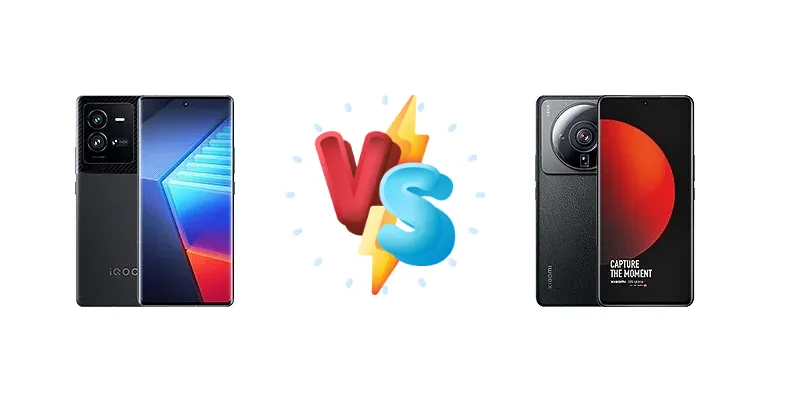
|
🏆 Quick Verdict
For the average user prioritizing convenience and minimizing downtime, the vivo iQOO 10 Pro is the clear winner. Its 200W charging is a game-changer, fully replenishing the battery in just 10 minutes. However, photography enthusiasts will find the Xiaomi 12S Ultra's camera system more compelling.
| PHONES | ||
|---|---|---|
| Phone Names | vivo iQOO 10 Pro | Xiaomi 12S Ultra |
| Network | ||
|---|---|---|
| 2G bands | GSM 850 / 900 / 1800 / 1900 | GSM 850 / 900 / 1800 / 1900 |
| 3G bands | HSDPA 850 / 900 / 1700(AWS) / 1900 / 2100 | HSDPA 800 / 850 / 900 / 1700(AWS) / 1900 / 2100 |
| 4G bands | 1, 2, 3, 4, 5, 7, 8, 12, 17, 18, 19, 20, 25, 26, 28, 32, 34, 38, 39, 40, 41, 42, 66 | 1, 2, 3, 4, 5, 7, 8, 12, 17, 18, 19, 26, 34, 38, 39, 40, 41, 42 |
| 5G bands | 1, 3, 5, 7, 8, 12, 20, 28, 38, 40, 41, 66, 77, 78, 79 SA/NSA | 1, 3, 5, 8, 28, 38, 40, 41, 77, 78, 79 SA/NSA |
| Speed | HSPA, LTE, 5G | HSPA, LTE, 5G |
| Technology | GSM / CDMA / HSPA / CDMA2000 / LTE / 5G | GSM / CDMA / HSPA / EVDO / LTE / 5G |
| CDMA2000 1x | CDMA2000 1xEV-DO | |
| Launch | ||
|---|---|---|
| Announced | 2022, July 19 | 2022, July 04 |
| Status | Available. Released 2022, July 25 | Available. Released 2022, July 09 |
| Body | ||
|---|---|---|
| Build | - | Glass front (Gorilla Glass Victus), eco leather back, aluminum frame |
| Dimensions | 164.9 x 75.5 x 9.5 mm (6.49 x 2.97 x 0.37 in) | 163.2 x 75 x 9.1 mm (6.43 x 2.95 x 0.36 in) |
| SIM | Nano-SIM + Nano-SIM | Nano-SIM + Nano-SIM |
| Weight | 215.4 g or 216.2 g (7.58 oz) | 225 g (7.94 oz) |
| - | IP68 dust/water resistant (up to 1.5m for 30 min) | |
| Display | ||
|---|---|---|
| Protection | - | Corning Gorilla Glass Victus |
| Resolution | 1440 x 3200 pixels, 20:9 ratio (~518 ppi density) | 1440 x 3200 pixels, 20:9 ratio (~522 ppi density) |
| Size | 6.78 inches, 111.0 cm2 (~89.1% screen-to-body ratio) | 6.73 inches, 108.9 cm2 (~89.0% screen-to-body ratio) |
| Type | LTPO3 AMOLED, 1B colors, 120Hz, HDR10+, 500 nits (typ), 1000 nits (HBM), 1500 nits (peak) | LTPO2 AMOLED, 1B colors, 120Hz, Dolby Vision, HDR10+, 1000 nits (HBM), 1500 nits (peak) |
| Platform | ||
|---|---|---|
| CPU | Octa-core (1x3.19 GHz Cortex-X2 & 3x2.75 GHz Cortex-A710 & 4x1.80 GHz Cortex-A510) | Octa-core (1x3.19 GHz Cortex-X2 & 3x2.75 GHz Cortex-A710 & 4x1.80 GHz Cortex-A510) |
| Chipset | Qualcomm SM8475 Snapdragon 8+ Gen 1 (4 nm) | Qualcomm SM8475 Snapdragon 8+ Gen 1 (4 nm) |
| GPU | Adreno 730 | Adreno 730 |
| OS | Android 12, Funtouch 12 (International), OriginOS Ocean (China) | Android 12, MIUI 13 |
| Memory | ||
|---|---|---|
| Card slot | No | No |
| Internal | 256GB 8GB RAM, 256GB 12GB RAM, 512GB 12GB RAM | 256GB 8GB RAM, 256GB 12GB RAM, 512GB 12GB RAM |
| UFS 3.1 (V6) | UFS 3.1 | |
| Main Camera | ||
|---|---|---|
| Features | Dual-LED lash, HDR, panorama | Laser AF, color spectrum sensor, Leica lenses, Dual-LED flash, HDR, panorama |
| Single | 16 MP, f/2.5, (wide), 1/3.1", 1.0µm | 32 MP, f/2.4, 25mm (wide), 0.7µm |
| Triple | 50 MP, f/1.9, (wide), 1/1.57", 1.0µm, PDAF, gimbal OIS 14.6 MP, f/2.2, 69mm (telephoto), PDAF, OIS, 3x optical zoom 50 MP, f/2.3, 15mm, 150˚ (ultrawide), 1/2.76", 0.64µm, AF | 50 MP, f/1.9, 23mm (wide), 1.0"-type, 1.6µm, dual pixel PDAF, OIS 48 MP, f/4.1, 120mm (periscope telephoto), 1/2.0", 0.8µm, PDAF, OIS, 5x optical zoom 48 MP, f/2.2, 13mm, 128˚ (ultrawide), 1/2.0", 0.8µm, dual pixel PDAF TOF 3D, (depth) |
| Video | 8K@30fps, 4K@24/30/60fps, 1080p@30/60fps, gyro-EIS | 8K@24fps, 4K@30/60fps, 1080p@30/60/120/240fps, 720p@3840fps, gyro-EIS, Dolby Vision HDR 10-bit rec. (4K, 1080p) |
| Selfie camera | ||
|---|---|---|
| Features | HDR | HDR, panorama |
| Single | 16 MP, f/2.5, (wide), 1/3.1", 1.0µm | 32 MP, f/2.4, 25mm (wide), 0.7µm |
| Video | 1080p@30fps, gyro-EIS | 1080p@30fps |
| Sound | ||
|---|---|---|
| 3.5mm jack | No | No |
| 35mm jack | No | No |
| Loudspeaker | Yes, with dual speakers | Yes, with stereo speakers |
| 32-bit/384kHz audio | 24-bit/192kHz audio Tuned by Harman Kardon | |
| Comms | ||
|---|---|---|
| Bluetooth | 5.3, A2DP, LE, aptX HD, aptX Adaptive, aptX Lossless | 5.2, A2DP, LE, aptX HD, aptX Adaptive |
| Infrared port | Yes | Yes |
| NFC | Yes | Yes |
| Positioning | GPS, GLONASS, GALILEO, BDS, QZSS | GPS (L1+L5), GLONASS (L1), BDS (B1I+B1c+B2a), GALILEO (E1+E5a), QZSS (L1+L5), NavIC (L5) |
| Radio | No | No |
| USB | USB Type-C 2.0, OTG | USB Type-C 2.0, OTG |
| WLAN | Wi-Fi 802.11 a/b/g/n/ac/6, dual-band, Wi-Fi Direct | Wi-Fi 802.11 a/b/g/n/ac/6e, dual-band, Wi-Fi Direct, DLNA |
| Features | ||
|---|---|---|
| Sensors | Fingerprint (under display, ultrasonic), accelerometer, gyro, proximity, compass | Fingerprint (under display, optical), accelerometer, gyro, compass, barometer |
| - | Virtual proximity sensing | |
| Battery | ||
|---|---|---|
| Charging | 200W wired, PD3.0, 100% in 10 min 50W wireless 10W reverse wireless | 67W wired, PD3.0, QC4, 100% in 41 min 50W wireless, 100% in 52 min 10W reverse wireless |
| Type | 4700 mAh | Li-Po 4860 mAh |
| Misc | ||
|---|---|---|
| Colors | Black, White (BMW M branding) | Black, Dark Green |
| Models | V2218A | 2203121C |
| Price | About 870 EUR | $ 288.00 |
| Tests | ||
|---|---|---|
| Battery life | - | Endurance rating 93h |
| Camera | - | Photo / Video |
| Display | - | Contrast ratio: Infinite (nominal) |
| Loudspeaker | - | -25.6 LUFS (Very good) |
| Performance | - | AnTuTu: 1039412 (v9) GeekBench: 4300 (v5.1) GFXBench: 51fps (ES 3.1 onscreen) |
vivo iQOO 10 Pro
- Blazing-fast 200W wired charging
- Potentially superior sustained performance due to iQOO’s thermal focus
- 50W wireless charging
- Camera details are unknown, potentially lagging behind the Xiaomi 12S Ultra
- Display specs are limited, making a direct comparison difficult
Xiaomi 12S Ultra
- Exceptional camera system focused on photo and video quality
- High peak display brightness (1065 nits)
- Excellent battery endurance (93h)
- Significantly slower charging speeds (67W wired, 41 minutes)
- May throttle under sustained load compared to iQOO 10 Pro
Display Comparison
Both devices utilize the Snapdragon 8+ Gen 1, so display performance is likely similar in terms of GPU load. The Xiaomi 12S Ultra boasts a measured peak brightness of 1065 nits, suggesting a potentially more visible outdoor experience. While the iQOO 10 Pro’s display specs aren’t provided, it’s reasonable to assume a comparable high brightness level given its flagship status. The Xiaomi 12S Ultra’s ‘Infinite’ contrast ratio (nominal) indicates a high-quality OLED panel, but without specific details on color accuracy or PWM dimming frequency for either device, a definitive display winner is difficult to declare.
Camera Comparison
The Xiaomi 12S Ultra is explicitly positioned as a photography powerhouse, though specific sensor details are missing. Its focus on 'Photo / Video' suggests a more sophisticated camera system. The iQOO 10 Pro’s camera specs are not provided, making a direct comparison challenging. However, given Xiaomi’s history with large sensors and advanced image processing, the 12S Ultra likely offers superior image quality, particularly in low-light conditions. The absence of details on the iQOO 10 Pro’s camera system suggests it may not be a primary selling point.
Performance
Both the iQOO 10 Pro and Xiaomi 12S Ultra are equipped with the Qualcomm SM8475 Snapdragon 8+ Gen 1 (4 nm) chipset, featuring the same Octa-core CPU configuration (1x3.19 GHz Cortex-X2, 3x2.75 GHz Cortex-A710, and 4x1.80 GHz Cortex-A510). This means raw processing power will be nearly identical. The key differentiator will be thermal management. The iQOO brand often prioritizes sustained performance, potentially employing a more aggressive cooling solution to mitigate throttling during extended gaming sessions. However, without detailed thermal testing data, it’s impossible to definitively say which device maintains peak performance for longer.
Battery Life
Both phones have an endurance rating of 93h, suggesting similar overall battery life despite differing charging speeds. However, the charging experience is where they drastically diverge. The iQOO 10 Pro’s 200W wired charging is revolutionary, achieving a full charge in just 10 minutes. The Xiaomi 12S Ultra’s 67W wired charging takes 41 minutes for a full charge. This difference is substantial. While the Xiaomi 12S Ultra offers 50W wireless charging (52 minutes to full) and both support 10W reverse wireless charging, the iQOO 10 Pro’s wired charging speed is a significant advantage for users who value convenience.
Buying Guide
Buy the vivo iQOO 10 Pro if you need the absolute fastest charging speeds available, frequently find yourself needing to top up quickly, and value a smooth, responsive experience. Buy the Xiaomi 12S Ultra if you prioritize camera quality above all else, demand excellent image detail and dynamic range, and are willing to trade off charging speed for photographic prowess.