
vivo iQOO 10 Pro vs vivo X80 Pro: The Ultimate Showdown
| Phones Images | |||||
|---|---|---|---|---|---|
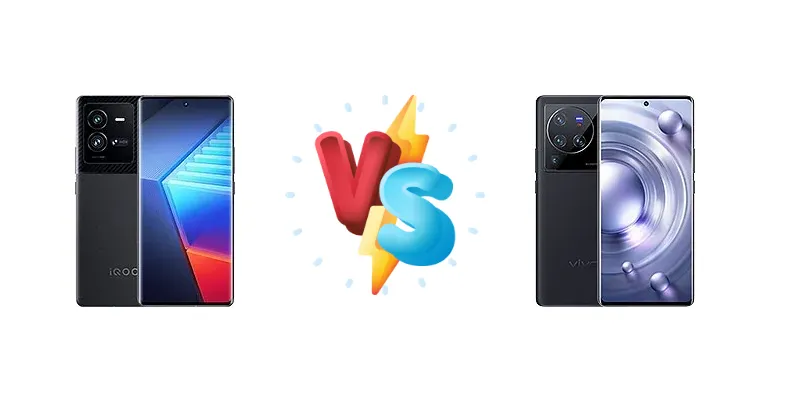
|
🏆 Quick Verdict
The iQOO 10 Pro wins on charging speed and raw performance thanks to the Snapdragon 8+ Gen 1. However, the X80 Pro boasts a potentially superior camera system and a more refined overall experience. It depends on your priorities: speed vs. photography.
| PHONES | ||
|---|---|---|
| Phone Names | vivo iQOO 10 Pro | vivo X80 Pro |
| Network | ||
|---|---|---|
| 2G bands | GSM 850 / 900 / 1800 / 1900 | GSM 850 / 900 / 1800 / 1900 |
| 3G bands | HSDPA 850 / 900 / 1700(AWS) / 1900 / 2100 | HSDPA 800 / 850 / 900 / 1700(AWS) / 1900 / 2100 |
| 4G bands | 1, 2, 3, 4, 5, 7, 8, 12, 17, 18, 19, 20, 25, 26, 28, 32, 34, 38, 39, 40, 41, 42, 66 | 1, 2, 3, 4, 5, 7, 8, 12, 13, 17, 18, 19, 20, 26, 28, 32, 38, 39, 40, 41, 42, 66 - International |
| 5G bands | 1, 3, 5, 7, 8, 12, 20, 28, 38, 40, 41, 66, 77, 78, 79 SA/NSA | 1, 2, 3, 5, 7, 8, 20, 28, 38, 40, 41, 66, 77, 78 SA/NSA - International |
| Speed | HSPA, LTE, 5G | HSPA, LTE, 5G |
| Technology | GSM / CDMA / HSPA / CDMA2000 / LTE / 5G | GSM / CDMA / HSPA / EVDO / LTE / 5G |
| CDMA2000 1x | 1, 3, 5, 7, 8, 12, 20, 28, 66, 38, 40, 41, 77, 78, 79 SA/NSA - China | |
| Launch | ||
|---|---|---|
| Announced | 2022, July 19 | 2022, April 25 |
| Status | Available. Released 2022, July 25 | Available. Released 2022, April 29 |
| Body | ||
|---|---|---|
| Build | - | Glass front (Schott Xensation Up), glass back or ceramic back or eco leather back, aluminum frame |
| Dimensions | 164.9 x 75.5 x 9.5 mm (6.49 x 2.97 x 0.37 in) | 164.6 x 75.3 x 9.1 mm (6.48 x 2.96 x 0.36 in) |
| SIM | Nano-SIM + Nano-SIM | Nano-SIM + Nano-SIM |
| Weight | 215.4 g or 216.2 g (7.58 oz) | 215 g / 219 g (7.58 oz) |
| - | IP68 dust/water resistant (up to 1.5m for 30 min) | |
| Display | ||
|---|---|---|
| Protection | - | Schott Xensation Up |
| Resolution | 1440 x 3200 pixels, 20:9 ratio (~518 ppi density) | 1440 x 3200 pixels, 20:9 ratio (~517 ppi density) |
| Size | 6.78 inches, 111.0 cm2 (~89.1% screen-to-body ratio) | 6.78 inches, 111.4 cm2 (~89.9% screen-to-body ratio) |
| Type | LTPO3 AMOLED, 1B colors, 120Hz, HDR10+, 500 nits (typ), 1000 nits (HBM), 1500 nits (peak) | LTPO3 AMOLED, 1B colors, 120Hz, HDR10+, 1500 nits (peak) |
| Platform | ||
|---|---|---|
| CPU | Octa-core (1x3.19 GHz Cortex-X2 & 3x2.75 GHz Cortex-A710 & 4x1.80 GHz Cortex-A510) | Octa-core (1x3.00 GHz Cortex-X2 & 3x2.50 GHz Cortex-A710 & 4x1.80 GHz Cortex-A510)Octa-core (1x3.05 GHz Cortex-X2 & 3x2.85 GHz Cortex-A710 & 4x1.80 GHz Cortex-A510) |
| Chipset | Qualcomm SM8475 Snapdragon 8+ Gen 1 (4 nm) | Qualcomm SM8450 Snapdragon 8 Gen 1 (4 nm)Mediatek Dimensity 9000 (4 nm) |
| GPU | Adreno 730 | Adreno 730Mali-G710 MC10 |
| OS | Android 12, Funtouch 12 (International), OriginOS Ocean (China) | Android 12, upgradable to Android 14, Funtouch 14 (Global), OriginOS Ocean (China) |
| Memory | ||
|---|---|---|
| Card slot | No | No |
| Internal | 256GB 8GB RAM, 256GB 12GB RAM, 512GB 12GB RAM | 256GB 8GB RAM, 256GB 12GB RAM, 512GB 12GB RAM |
| UFS 3.1 (V6) | UFS 3.1 | |
| Main Camera | ||
|---|---|---|
| Features | Dual-LED lash, HDR, panorama | Laser AF, color spectrum sensor, Zeiss optics, Zeiss T* lens coating, Pixel Shift, dual-LED dual-tone flash, HDR, panorama |
| Quad | - | 50 MP, f/1.6, (wide), 1/1.3", PDAF, OIS 8 MP, f/3.4, (periscope telephoto), 1/4.4", 1.0µm, PDAF, OIS, 5x optical zoom 12 MP, f/1.9, 50mm (telephoto), 1/2.93", 1.22µm, dual pixel PDAF, 2x optical zoom, gimbal OIS 48 MP, f/2.2, 114˚ (ultrawide), 1/2.0", AF |
| Single | 16 MP, f/2.5, (wide), 1/3.1", 1.0µm | 32 MP, f/2.5, 24mm (wide), 1/2.8", 0.8µm |
| Triple | 50 MP, f/1.9, (wide), 1/1.57", 1.0µm, PDAF, gimbal OIS 14.6 MP, f/2.2, 69mm (telephoto), PDAF, OIS, 3x optical zoom 50 MP, f/2.3, 15mm, 150˚ (ultrawide), 1/2.76", 0.64µm, AF | - |
| Video | 8K@30fps, 4K@24/30/60fps, 1080p@30/60fps, gyro-EIS | 8K@30fps, 4K@30/60fps, 1080p@30/60fps, gyro-EIS |
| Selfie camera | ||
|---|---|---|
| Features | HDR | HDR |
| Single | 16 MP, f/2.5, (wide), 1/3.1", 1.0µm | 32 MP, f/2.5, 24mm (wide), 1/2.8", 0.8µm |
| Video | 1080p@30fps, gyro-EIS | 1080p@30fps |
| Sound | ||
|---|---|---|
| 3.5mm jack | No | No |
| 35mm jack | No | No |
| Loudspeaker | Yes, with dual speakers | Yes, with stereo speakers |
| 32-bit/384kHz audio | 32-bit/192kHz audio | |
| Comms | ||
|---|---|---|
| Bluetooth | 5.3, A2DP, LE, aptX HD, aptX Adaptive, aptX Lossless | 5.2 (Snapdragon)/ 5.3 (Dimensity), A2DP, LE, aptX HD, aptX Adaptive, aptX Lossless |
| Infrared port | Yes | Yes |
| NFC | Yes | Yes |
| Positioning | GPS, GLONASS, GALILEO, BDS, QZSS | GPS (L1+L5), GLONASS, BDS, GALILEO, QZSS, NavIC |
| Radio | No | No |
| USB | USB Type-C 2.0, OTG | USB Type-C 3.1 (Global)/ 3.2 (China), OTG |
| WLAN | Wi-Fi 802.11 a/b/g/n/ac/6, dual-band, Wi-Fi Direct | Wi-Fi 802.11 a/b/g/n/ac/6, dual-band, Wi-Fi Direct |
| Features | ||
|---|---|---|
| Sensors | Fingerprint (under display, ultrasonic), accelerometer, gyro, proximity, compass | Fingerprint (under display, ultrasonic), accelerometer, gyro, proximity, compass |
| Battery | ||
|---|---|---|
| Charging | 200W wired, PD3.0, 100% in 10 min 50W wireless 10W reverse wireless | 80W wired, 100% in 38 min 50W wireless, 100% in 50 min Reverse wired |
| Type | 4700 mAh | 4700 mAh |
| Misc | ||
|---|---|---|
| Colors | Black, White (BMW M branding) | Cosmic Black, Blue, Orange |
| Models | V2218A | V2185A, V2145 |
| Price | About 870 EUR | About 850 EUR |
| Tests | ||
|---|---|---|
| Battery life | - | Endurance rating 79h |
| Camera | - | Photo / Video |
| Display | - | Contrast ratio: Infinite (nominal) |
| Loudspeaker | - | -25.1 LUFS (Very good) |
vivo iQOO 10 Pro
- Blazing-fast 200W charging
- Superior performance (Snapdragon 8+ Gen 1)
- Aggressive pricing
- Excellent display
- Potentially less refined camera compared to X80 Pro
- Design might be less premium than X80 Pro
- Software experience can be polarizing
vivo X80 Pro
- Exceptional camera system (Zeiss partnership)
- Long battery life (79h endurance rating)
- Premium design and build quality
- Bright and vibrant display
- Slower charging speed (80W)
- Potentially higher price
- Performance slightly behind iQOO 10 Pro
Display Comparison
Both phones feature excellent AMOLED displays, but the X80 Pro's 1014 nits peak brightness gives it a slight edge in outdoor visibility. The X80 Pro also touts an 'infinite' contrast ratio, suggesting deeper blacks and richer colors, though this is a nominal claim. The iQOO 10 Pro's display is still vibrant and sharp, offering a great viewing experience.
Camera Comparison
The X80 Pro is generally considered to have the better camera system. While both offer excellent photo and video capabilities, the X80 Pro's larger sensor and advanced image processing algorithms often produce superior results, especially in low light. The X80 Pro also benefits from vivo's partnership with Zeiss for lens optimization.
Performance
The iQOO 10 Pro's Snapdragon 8+ Gen 1 is undeniably faster than the X80 Pro's Snapdragon 8 Gen 1 or Dimensity 9000. Expect smoother gaming and quicker app loading times on the iQOO 10 Pro. While the X80 Pro's chipsets are still powerful, the 8+ Gen 1 offers a noticeable performance boost.
Battery Life
The X80 Pro's endurance rating of 79 hours suggests exceptional battery life. While the iQOO 10 Pro's battery capacity is likely similar, the X80 Pro's power efficiency is noteworthy. However, the iQOO 10 Pro's 200W charging is a game-changer, allowing for incredibly fast top-ups.
Buying Guide
The vivo iQOO 10 Pro is ideal for gamers and power users who prioritize blazing-fast charging and top-tier performance. The vivo X80 Pro is better suited for photography enthusiasts and those seeking a more premium, well-rounded flagship experience.