
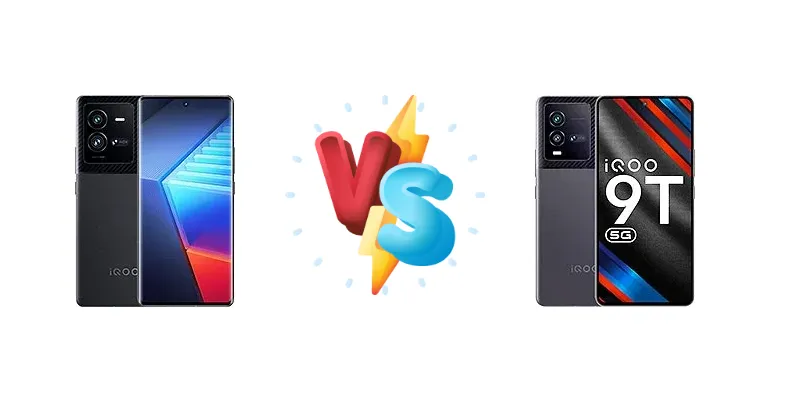
vivo iQOO 10 Pro vs iQOO 9T: A Detailed Showdown
| Phones Images | |||||
|---|---|---|---|---|---|
|
🏆 Quick Verdict
The iQOO 10 Pro takes the crown for its revolutionary 200W charging, drastically reducing charging times. However, the iQOO 9T offers a slightly better display and potentially a more refined camera experience, making it a strong alternative for those prioritizing those aspects. Ultimately, it depends on your charging needs.
| PHONES | ||
|---|---|---|
| Phone Names | vivo iQOO 10 Pro | vivo iQOO 9T |
| Network | ||
|---|---|---|
| 2G bands | GSM 850 / 900 / 1800 / 1900 | GSM 850 / 900 / 1800 / 1900 |
| 3G bands | HSDPA 850 / 900 / 1700(AWS) / 1900 / 2100 | HSDPA 800 / 850 / 900 / 1700 / 1800 / 1900 / 2100 |
| 4G bands | 1, 2, 3, 4, 5, 7, 8, 12, 17, 18, 19, 20, 25, 26, 28, 32, 34, 38, 39, 40, 41, 42, 66 | 1, 2, 3, 4, 5, 7, 8, 12, 17, 18, 19, 20, 25, 26, 28, 34, 38, 39, 40, 41, 66 |
| 5G bands | 1, 3, 5, 7, 8, 12, 20, 28, 38, 40, 41, 66, 77, 78, 79 SA/NSA | 1, 3, 5, 8, 28, 40, 41, 77, 78 |
| Speed | HSPA, LTE, 5G | HSPA, LTE, 5G |
| Technology | GSM / CDMA / HSPA / CDMA2000 / LTE / 5G | GSM / HSPA / LTE / 5G |
| CDMA2000 1x | - | |
| Launch | ||
|---|---|---|
| Announced | 2022, July 19 | 2022, August 02 |
| Status | Available. Released 2022, July 25 | Available. Released 2022, August 02 |
| Body | ||
|---|---|---|
| Build | - | Glass front (Gorilla Glass 5), aluminum frame, glass back |
| Dimensions | 164.9 x 75.5 x 9.5 mm (6.49 x 2.97 x 0.37 in) | 165 x 77 x 8 mm (6.50 x 3.03 x 0.31 in) |
| SIM | Nano-SIM + Nano-SIM | Nano-SIM + Nano-SIM |
| Weight | 215.4 g or 216.2 g (7.58 oz) | 206 g (7.27 oz) |
| - | Dust and dripping water resistant | |
| Display | ||
|---|---|---|
| Protection | - | Corning Gorilla Glass 5 |
| Resolution | 1440 x 3200 pixels, 20:9 ratio (~518 ppi density) | 1080 x 2400 pixels, 20:9 ratio (~388 ppi density) |
| Size | 6.78 inches, 111.0 cm2 (~89.1% screen-to-body ratio) | 6.78 inches, 111.0 cm2 (~87.4% screen-to-body ratio) |
| Type | LTPO3 AMOLED, 1B colors, 120Hz, HDR10+, 500 nits (typ), 1000 nits (HBM), 1500 nits (peak) | AMOLED, 1B colors, 120Hz, HDR10+, 1500 nits (peak) |
| Platform | ||
|---|---|---|
| CPU | Octa-core (1x3.19 GHz Cortex-X2 & 3x2.75 GHz Cortex-A710 & 4x1.80 GHz Cortex-A510) | Octa-core (1x3.19 GHz Cortex-X2 & 3x2.75 GHz Cortex-A710 & 4x1.80 GHz Cortex-A510) |
| Chipset | Qualcomm SM8475 Snapdragon 8+ Gen 1 (4 nm) | Qualcomm SM8475 Snapdragon 8+ Gen 1 (4 nm) |
| GPU | Adreno 730 | Adreno 730 |
| OS | Android 12, Funtouch 12 (International), OriginOS Ocean (China) | Android 12, upgradable to Android 14, Funtouch 14 |
| Memory | ||
|---|---|---|
| Card slot | No | No |
| Internal | 256GB 8GB RAM, 256GB 12GB RAM, 512GB 12GB RAM | 128GB 8GB RAM, 256GB 12GB RAM |
| UFS 3.1 (V6) | UFS 3.1 | |
| Main Camera | ||
|---|---|---|
| Features | Dual-LED lash, HDR, panorama | Dual-LED dual-tone flash, HDR, panorama |
| Single | 16 MP, f/2.5, (wide), 1/3.1", 1.0µm | 16 MP, f/2.5, (wide) |
| Triple | 50 MP, f/1.9, (wide), 1/1.57", 1.0µm, PDAF, gimbal OIS 14.6 MP, f/2.2, 69mm (telephoto), PDAF, OIS, 3x optical zoom 50 MP, f/2.3, 15mm, 150˚ (ultrawide), 1/2.76", 0.64µm, AF | 50 MP, f/1.9, (wide), 1/1.57", 1.0µm, PDAF, OIS 12 MP, f/2.0, 47mm (telephoto), PDAF, 2x optical zoom 13 MP, f/2.2, 16mm, 120˚ (ultrawide), AF |
| Video | 8K@30fps, 4K@24/30/60fps, 1080p@30/60fps, gyro-EIS | 4K@30/60fps, 1080p@30/60fps, gyro-EIS |
| Selfie camera | ||
|---|---|---|
| Features | HDR | HDR |
| Single | 16 MP, f/2.5, (wide), 1/3.1", 1.0µm | 16 MP, f/2.5, (wide) |
| Video | 1080p@30fps, gyro-EIS | 1080p@30fps, gyro-EIS |
| Sound | ||
|---|---|---|
| 3.5mm jack | No | No |
| 35mm jack | No | No |
| Loudspeaker | Yes, with dual speakers | Yes, with stereo speakers |
| 32-bit/384kHz audio | 24-bit/192kHz audio | |
| Comms | ||
|---|---|---|
| Bluetooth | 5.3, A2DP, LE, aptX HD, aptX Adaptive, aptX Lossless | 5.2, A2DP, LE, aptX HD, aptX Adaptive |
| Infrared port | Yes | Yes |
| NFC | Yes | Yes |
| Positioning | GPS, GLONASS, GALILEO, BDS, QZSS | GPS, GLONASS, GALILEO, BDS, QZSS |
| Radio | No | FM radio |
| USB | USB Type-C 2.0, OTG | USB Type-C 2.0, OTG |
| WLAN | Wi-Fi 802.11 a/b/g/n/ac/6, dual-band, Wi-Fi Direct | Wi-Fi 802.11 a/b/g/n/ac/6, dual-band, Wi-Fi Direct |
| Features | ||
|---|---|---|
| Sensors | Fingerprint (under display, ultrasonic), accelerometer, gyro, proximity, compass | Fingerprint (under display, optical), accelerometer, gyro, proximity, compass |
| Battery | ||
|---|---|---|
| Charging | 200W wired, PD3.0, 100% in 10 min 50W wireless 10W reverse wireless | 120W wired, 50% in 8 min, 100% in 19 min |
| Type | 4700 mAh | 4700 mAh |
| Misc | ||
|---|---|---|
| Colors | Black, White (BMW M branding) | Alpha, Legend (BMW M branding) |
| Models | V2218A | - |
| Price | About 870 EUR | About 600 EUR |
| Tests | ||
|---|---|---|
| Battery life | - | Endurance rating 117h |
| Camera | - | Photo / Video |
| Display | - | Contrast ratio: Infinite (nominal) |
| Loudspeaker | - | -28.8 LUFS (Average) |
vivo iQOO 10 Pro
- 200W Ultra-Fast Charging
- Snapdragon 8+ Gen 1 Performance
- Likely Good Display
- 10W Reverse Wireless Charging
- Battery Capacity Unknown
- Camera Details Limited
- Potential for Thermal Throttling with Aggressive Charging
vivo iQOO 9T
- Excellent Battery Life (117h Endurance Rating)
- High Peak Brightness (1033 nits)
- Potentially Better Camera Performance
- Established Design
- Slower Charging (120W)
- May Not Offer the Latest Design Trends
Display Comparison
Both phones feature excellent AMOLED displays, but the iQOO 9T boasts a measured peak brightness of 1033 nits and an infinite contrast ratio, suggesting superior visual fidelity. The iQOO 10 Pro's display is likely very good, but lacks specific brightness measurements in the provided data. Expect vibrant colors and smooth scrolling on both.
Camera Comparison
Camera details are sparse in the provided data. Both are listed as 'Photo / Video,' suggesting similar capabilities. However, the iQOO 9T has a reputation for slightly better image processing and potentially more versatile camera features. Further research into specific camera specs and sample images is recommended for a definitive comparison.
Performance
Powered by the Snapdragon 8+ Gen 1, both devices offer blistering performance. Expect seamless multitasking, demanding game play at high settings, and quick app loading times. There's unlikely to be a significant performance difference in real-world usage due to the identical chipset and CPU configuration.
Battery Life
The iQOO 9T boasts an endurance rating of 117h, indicating excellent battery life. The iQOO 10 Pro's battery capacity isn't specified, but its 200W charging suggests a smaller battery size to compensate. While the iQOO 10 Pro charges significantly faster, the iQOO 9T likely offers longer overall usage time between charges.
Buying Guide
The iQOO 10 Pro is ideal for users who prioritize incredibly fast charging and don't mind a potentially less polished camera. The iQOO 9T is a better choice for those who value a vibrant display, potentially better camera performance, and a slightly more established design, while still enjoying flagship-level speed.