
vivo iQOO 10 Pro vs. Honor Magic4 Pro: A Deep Dive into Speed and Stamina
| Phones Images | |||||
|---|---|---|---|---|---|
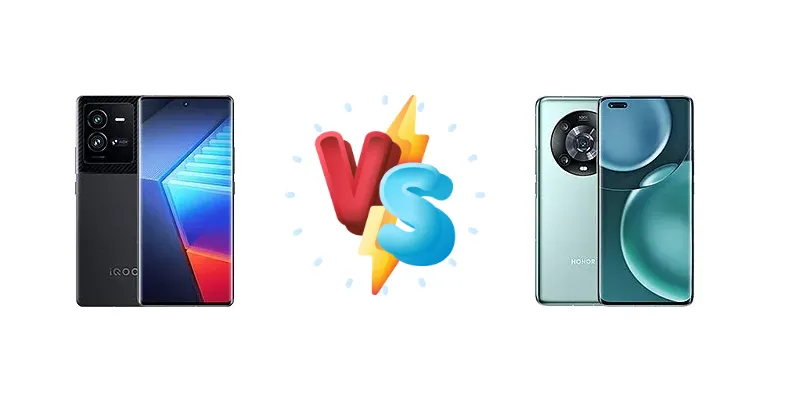
|
🏆 Quick Verdict
For users prioritizing blazing-fast charging and peak performance, the vivo iQOO 10 Pro is the clear winner. Its 200W charging is unmatched, and the Snapdragon 8+ Gen 1 offers a performance edge. However, the Honor Magic4 Pro provides a more refined experience with excellent camera quality and comparable battery endurance.
| PHONES | ||
|---|---|---|
| Phone Names | vivo iQOO 10 Pro | Honor Magic4 Pro |
| Network | ||
|---|---|---|
| 2G bands | GSM 850 / 900 / 1800 / 1900 | GSM 850 / 900 / 1800 / 1900 |
| 3G bands | HSDPA 850 / 900 / 1700(AWS) / 1900 / 2100 | HSDPA 800 / 850 / 900 / 1700(AWS) / 1900 / 2100 |
| 4G bands | 1, 2, 3, 4, 5, 7, 8, 12, 17, 18, 19, 20, 25, 26, 28, 32, 34, 38, 39, 40, 41, 42, 66 | 1, 2, 3, 4, 5, 7, 8, 12, 17, 18, 19, 20, 26, 28, 34, 38, 39, 40, 41 - China |
| 5G bands | 1, 3, 5, 7, 8, 12, 20, 28, 38, 40, 41, 66, 77, 78, 79 SA/NSA | 1, 3, 5, 8, 28, 38, 41, 77, 78, 79 SA/NSA - China |
| Speed | HSPA, LTE, 5G | HSPA, LTE, 5G |
| Technology | GSM / CDMA / HSPA / CDMA2000 / LTE / 5G | GSM / CDMA / HSPA / EVDO / LTE / 5G |
| CDMA2000 1x | CDMA2000 1xEV-DO | |
| Launch | ||
|---|---|---|
| Announced | 2022, July 19 | 2022, February 28 |
| Status | Available. Released 2022, July 25 | Available. Released 2022, April 09 |
| Body | ||
|---|---|---|
| Build | - | Glass front, aluminum frame, glass back |
| Dimensions | 164.9 x 75.5 x 9.5 mm (6.49 x 2.97 x 0.37 in) | 163.6 x 74.7 x 9.1 mm or 9.2 mm |
| SIM | Nano-SIM + Nano-SIM | · Nano-SIM + eSIM· Nano-SIM + Nano-SIM |
| Weight | 215.4 g or 216.2 g (7.58 oz) | 209 g / 215 g (7.37 oz) |
| - | IP68 dust/water resistant (up to 1.5m for 30 min) | |
| Display | ||
|---|---|---|
| Protection | - | Aluminosilicate glass |
| Resolution | 1440 x 3200 pixels, 20:9 ratio (~518 ppi density) | 1312 x 2848 pixels, 19.5:9 ratio (~460 ppi density) |
| Size | 6.78 inches, 111.0 cm2 (~89.1% screen-to-body ratio) | 6.81 inches, 113.7 cm2 (~93.0% screen-to-body ratio) |
| Type | LTPO3 AMOLED, 1B colors, 120Hz, HDR10+, 500 nits (typ), 1000 nits (HBM), 1500 nits (peak) | LTPO OLED, 1B colors, 120Hz, HDR10+, 1000 nits (peak) |
| Platform | ||
|---|---|---|
| CPU | Octa-core (1x3.19 GHz Cortex-X2 & 3x2.75 GHz Cortex-A710 & 4x1.80 GHz Cortex-A510) | Octa-core (1x3.00 GHz Cortex-X2 & 3x2.50 GHz Cortex-A710 & 4x1.80 GHz Cortex-A510) |
| Chipset | Qualcomm SM8475 Snapdragon 8+ Gen 1 (4 nm) | Qualcomm SM8450 Snapdragon 8 Gen 1 (4 nm) |
| GPU | Adreno 730 | Adreno 730 |
| OS | Android 12, Funtouch 12 (International), OriginOS Ocean (China) | Android 12, Magic UI 6 |
| Memory | ||
|---|---|---|
| Card slot | No | No |
| Internal | 256GB 8GB RAM, 256GB 12GB RAM, 512GB 12GB RAM | 256GB 8GB RAM, 256GB 12GB RAM, 512GB 12GB RAM |
| UFS 3.1 (V6) | - | |
| Main Camera | ||
|---|---|---|
| Features | Dual-LED lash, HDR, panorama | Laser AF, color spectrum sensor, LED flash, HDR, panorama |
| Single | 16 MP, f/2.5, (wide), 1/3.1", 1.0µm | 12 MP, f/2.4, 100˚ (ultrawide), 1.22µm TOF 3D, (depth/biometrics sensor) |
| Triple | 50 MP, f/1.9, (wide), 1/1.57", 1.0µm, PDAF, gimbal OIS 14.6 MP, f/2.2, 69mm (telephoto), PDAF, OIS, 3x optical zoom 50 MP, f/2.3, 15mm, 150˚ (ultrawide), 1/2.76", 0.64µm, AF | 50 MP, f/1.8, 23mm (wide), 1/1.56", 1.0µm, multi-directional PDAF 50 MP, f/2.2, 122˚ (ultrawide), 1/2.5", AF 64 MP, f/3.5, 90mm (periscope telephoto), 1/2.0", 0.7µm, PDAF, OIS, 3.5x optical zoom TOF 3D (depth) |
| Video | 8K@30fps, 4K@24/30/60fps, 1080p@30/60fps, gyro-EIS | 4K@30/60fps, 1080p@30/60fps, gyro-EIS, HDR10, 10-bit video |
| Selfie camera | ||
|---|---|---|
| Features | HDR | HDR |
| Single | 16 MP, f/2.5, (wide), 1/3.1", 1.0µm | 12 MP, f/2.4, 100˚ (ultrawide), 1.22µm TOF 3D, (depth/biometrics sensor) |
| Video | 1080p@30fps, gyro-EIS | 4K@30fps, 1080p@30fps |
| Sound | ||
|---|---|---|
| 3.5mm jack | No | No |
| 35mm jack | No | No |
| Loudspeaker | Yes, with dual speakers | Yes, with stereo speakers |
| 32-bit/384kHz audio | 24-bit audio stereo recording | |
| Comms | ||
|---|---|---|
| Bluetooth | 5.3, A2DP, LE, aptX HD, aptX Adaptive, aptX Lossless | 5.2, A2DP, LE, aptX HD |
| Infrared port | Yes | Yes |
| NFC | Yes | Yes |
| Positioning | GPS, GLONASS, GALILEO, BDS, QZSS | GPS (L1+L5), GLONASS (L1), BDS (B1I+B1c+B2a), GALILEO (E1+E5a) |
| Radio | No | No |
| USB | USB Type-C 2.0, OTG | USB Type-C 3.1, OTG |
| WLAN | Wi-Fi 802.11 a/b/g/n/ac/6, dual-band, Wi-Fi Direct | Wi-Fi 802.11 a/b/g/n/ac/6, dual-band, Wi-Fi Direct |
| Features | ||
|---|---|---|
| Sensors | Fingerprint (under display, ultrasonic), accelerometer, gyro, proximity, compass | Fingerprint (under display, ultrasonic), Face ID, accelerometer, gyro, proximity, compass |
| Battery | ||
|---|---|---|
| Charging | 200W wired, PD3.0, 100% in 10 min 50W wireless 10W reverse wireless | 100W wired, 100% in 30 min 100W wireless, 50% in 15 min Reverse wireless 5W reverse wired |
| Type | 4700 mAh | Li-Po 4600 mAh |
| Misc | ||
|---|---|---|
| Colors | Black, White (BMW M branding) | Black, White, Cyan, Gold, Orange |
| Models | V2218A | LGE-NX9, LGE-N49B, LGE-N19B, LGE-AN10, GBD-NX9 |
| Price | About 870 EUR | € 469.41 / £ 397.48 |
| Tests | ||
|---|---|---|
| Battery life | - | Endurance rating 82h |
| Camera | - | Photo / Video |
| Display | - | Contrast ratio: Infinite (nominal) |
| Loudspeaker | - | -23.6 LUFS (Very good) |
| Performance | - | AnTuTu: 980755 (v9) GeekBench: 3512 (v5.1) GFXBench: 59fps (ES 3.1 onscreen) |
vivo iQOO 10 Pro
- Unrivaled 200W wired charging speed
- More powerful Snapdragon 8+ Gen 1 chipset
- Faster wireless charging (50W)
- Camera details are limited, potential unknown quality
- Display specs are not provided, potential for lower brightness
Honor Magic4 Pro
- Brighter display (957 nits)
- Excellent 82-hour battery endurance
- Strong camera reputation and image processing
- Slower charging speed (30 minutes wired)
- Less powerful Snapdragon 8 Gen 1 chipset
Display Comparison
The Honor Magic4 Pro boasts a brighter display, reaching a measured 957 nits, which translates to better visibility under direct sunlight. While the iQOO 10 Pro’s display specs aren’t provided, the Magic4 Pro’s infinite contrast ratio suggests a high-quality OLED panel. The lack of PWM frequency data for the iQOO 10 Pro makes it difficult to assess its suitability for users sensitive to flicker, a potential advantage for the Magic4 Pro if it employs a higher frequency.
Camera Comparison
Both devices are described as having capable photo/video systems, but specific details are limited. Without sensor size or aperture information, a direct comparison is challenging. However, the Honor Magic4 Pro’s brand reputation suggests a greater emphasis on computational photography and image processing refinement. The iQOO 10 Pro likely prioritizes speed and potentially a more vibrant, less natural image profile. The absence of details on the iQOO 10 Pro’s camera system makes it difficult to assess its strengths and weaknesses.
Performance
The iQOO 10 Pro’s Snapdragon 8+ Gen 1 (4nm) chipset offers a notable advantage over the Magic4 Pro’s Snapdragon 8 Gen 1 (4nm). The ‘+’ variant features a higher peak clock speed (3.19 GHz vs 3.00 GHz on the X2 core) and improved efficiency. This translates to better sustained performance under heavy loads, reducing the likelihood of thermal throttling during extended gaming sessions. Both phones utilize the same Cortex-A710 and A510 cores, but the iQOO 10 Pro’s superior chipset architecture provides a tangible performance boost.
Battery Life
The Honor Magic4 Pro’s 82-hour endurance rating suggests excellent battery life, despite a slower 30-minute 100W wired charging time. The iQOO 10 Pro, however, revolutionizes charging with its 200W wired charging, achieving a full charge in just 10 minutes. This is a game-changer for users who frequently need to top up their battery quickly. The iQOO 10 Pro also offers 50W wireless charging, significantly faster than the Magic4 Pro’s 100W wireless, and 10W reverse wireless charging, compared to the Magic4 Pro’s 5W wired reverse charging.
Buying Guide
Buy the vivo iQOO 10 Pro if you need the absolute fastest charging available, frequently game demanding titles, and prioritize raw processing power. Buy the Honor Magic4 Pro if you prefer a more balanced flagship experience with a focus on photography, a brighter display, and a potentially more consistent performance profile due to the Snapdragon 8 Gen 1's thermal characteristics.