
iQOO 10 Pro vs. ROG Phone 6 Pro: A Deep Dive into Speed and Gaming
| Phones Images | |||||
|---|---|---|---|---|---|
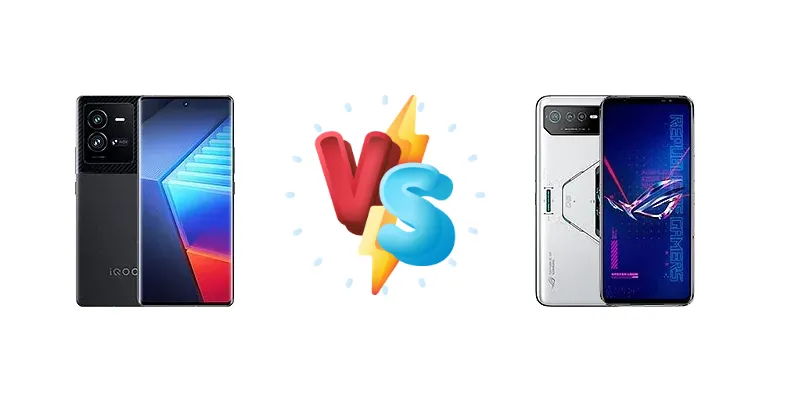
|
🏆 Quick Verdict
For the average user prioritizing everyday performance and incredibly fast charging, the vivo iQOO 10 Pro is the better choice. Its 200W charging capability is a game-changer, and the Snapdragon 8+ Gen 1 provides ample power. However, dedicated mobile gamers will find the ROG Phone 6 Pro’s specialized features and cooling system more compelling.
| PHONES | ||
|---|---|---|
| Phone Names | vivo iQOO 10 Pro | Asus ROG Phone 6 Pro |
| Network | ||
|---|---|---|
| 2G bands | GSM 850 / 900 / 1800 / 1900 | GSM 850 / 900 / 1800 / 1900 |
| 3G bands | HSDPA 850 / 900 / 1700(AWS) / 1900 / 2100 | HSDPA 800 / 850 / 900 / 1700(AWS) / 1900 / 2100 |
| 4G bands | 1, 2, 3, 4, 5, 7, 8, 12, 17, 18, 19, 20, 25, 26, 28, 32, 34, 38, 39, 40, 41, 42, 66 | 1, 2, 3, 4, 5, 7, 8, 12, 13, 17, 18, 19, 20, 25, 26, 28, 29, 30, 32, 34, 38, 39, 40, 41, 42, 43, 48, 66, 71 - Version A |
| 5G bands | 1, 3, 5, 7, 8, 12, 20, 28, 38, 40, 41, 66, 77, 78, 79 SA/NSA | 1, 2, 3, 5, 7, 8, 12, 13, 18, 20, 25, 26, 28, 38, 40, 41, 48, 66, 71, 77, 78, 79 SA/NSA/Sub6 - Version A |
| Speed | HSPA, LTE, 5G | HSPA 42.2/5.76 Mbps, LTE (6CA) Cat20 2024/210 Mbps, 5G |
| Technology | GSM / CDMA / HSPA / CDMA2000 / LTE / 5G | GSM / CDMA / HSPA / LTE / 5G |
| CDMA2000 1x | 1, 3, 5, 8, 28, 41, 77, 78, 79 - Version B | |
| Launch | ||
|---|---|---|
| Announced | 2022, July 19 | 2022, July 05 |
| Status | Available. Released 2022, July 25 | Available. Released 2022, July 13 |
| Body | ||
|---|---|---|
| Build | - | Glass front (Gorilla Glass Victus), glass back (Gorilla Glass 3), aluminum frame |
| Dimensions | 164.9 x 75.5 x 9.5 mm (6.49 x 2.97 x 0.37 in) | 173 x 77 x 10.3 mm (6.81 x 3.03 x 0.41 in) |
| SIM | Nano-SIM + Nano-SIM | Nano-SIM + Nano-SIM |
| Weight | 215.4 g or 216.2 g (7.58 oz) | 239 g (8.43 oz) |
| - | IPX4 water resistant 2" OLED display (on the back) Pressure sensitive zones (Gaming triggers) | |
| Display | ||
|---|---|---|
| Protection | - | Corning Gorilla Glass Victus |
| Resolution | 1440 x 3200 pixels, 20:9 ratio (~518 ppi density) | 1080 x 2448 pixels (~395 ppi density) |
| Size | 6.78 inches, 111.0 cm2 (~89.1% screen-to-body ratio) | 6.78 inches, 109.5 cm2 (~82.2% screen-to-body ratio) |
| Type | LTPO3 AMOLED, 1B colors, 120Hz, HDR10+, 500 nits (typ), 1000 nits (HBM), 1500 nits (peak) | AMOLED, 1B colors, 165Hz, HDR10+, 800 nits (typ), 1200 nits (peak) |
| Platform | ||
|---|---|---|
| CPU | Octa-core (1x3.19 GHz Cortex-X2 & 3x2.75 GHz Cortex-A710 & 4x1.80 GHz Cortex-A510) | Octa-core (1x3.19 GHz Cortex-X2 & 3x2.75 GHz Cortex-A710 & 4x1.80 GHz Cortex-A510) |
| Chipset | Qualcomm SM8475 Snapdragon 8+ Gen 1 (4 nm) | Qualcomm SM8475 Snapdragon 8+ Gen 1 (4 nm) |
| GPU | Adreno 730 | Adreno 730 |
| OS | Android 12, Funtouch 12 (International), OriginOS Ocean (China) | Android 12, upgradable to Android 13 |
| Memory | ||
|---|---|---|
| Card slot | No | No |
| Internal | 256GB 8GB RAM, 256GB 12GB RAM, 512GB 12GB RAM | 512GB 18GB RAM |
| UFS 3.1 (V6) | UFS 3.1 NTFS support for external storage | |
| Main Camera | ||
|---|---|---|
| Features | Dual-LED lash, HDR, panorama | LED flash, HDR, panorama |
| Single | 16 MP, f/2.5, (wide), 1/3.1", 1.0µm | - |
| Triple | 50 MP, f/1.9, (wide), 1/1.57", 1.0µm, PDAF, gimbal OIS 14.6 MP, f/2.2, 69mm (telephoto), PDAF, OIS, 3x optical zoom 50 MP, f/2.3, 15mm, 150˚ (ultrawide), 1/2.76", 0.64µm, AF | 50 MP, f/1.9, (wide), 1/1.56", 1.0µm, PDAF 13 MP, f/2.2, (ultrawide) 5 MP (macro) |
| Video | 8K@30fps, 4K@24/30/60fps, 1080p@30/60fps, gyro-EIS | 8K@24fps, 4K@30/60/120fps, 1080p@30/60/120/240fps, 720p@480fps; gyro-EIS |
| Selfie camera | ||
|---|---|---|
| Features | HDR | Panorama, HDR |
| Single | 16 MP, f/2.5, (wide), 1/3.1", 1.0µm | 12 MP, 28mm (wide) |
| Video | 1080p@30fps, gyro-EIS | 1080p@30fps |
| Sound | ||
|---|---|---|
| 3.5mm jack | No | Yes |
| 35mm jack | No | Yes |
| Loudspeaker | Yes, with dual speakers | Yes, with stereo speakers (2 amplifiers) |
| 32-bit/384kHz audio | 32-bit/384kHz audio | |
| Comms | ||
|---|---|---|
| Bluetooth | 5.3, A2DP, LE, aptX HD, aptX Adaptive, aptX Lossless | 5.2, A2DP, LE, aptX HD, aptX Adaptive, aptX Lossless |
| Infrared port | Yes | - |
| NFC | Yes | Yes |
| Positioning | GPS, GLONASS, GALILEO, BDS, QZSS | GPS (L1+L5), GLONASS (L1), BDS (B1I+B1c+B2a), GALILEO (E1+E5a), QZSS (L1+L5), NavIC (L5) |
| Radio | No | No |
| USB | USB Type-C 2.0, OTG | USB Type-C 3.1 (side), USB Type-C 2.0 (bottom), OTG, accessory connector |
| WLAN | Wi-Fi 802.11 a/b/g/n/ac/6, dual-band, Wi-Fi Direct | Wi-Fi 802.11 a/b/g/n/ac/6e, tri-band, Wi-Fi Direct |
| Features | ||
|---|---|---|
| Sensors | Fingerprint (under display, ultrasonic), accelerometer, gyro, proximity, compass | Fingerprint (under display, optical), accelerometer, gyro, proximity, compass |
| Battery | ||
|---|---|---|
| Charging | 200W wired, PD3.0, 100% in 10 min 50W wireless 10W reverse wireless | 65W wired, PD3.0, QC5, 100% in 42 min 10W reverse wired |
| Type | 4700 mAh | Li-Po 6000 mAh |
| Misc | ||
|---|---|---|
| Colors | Black, White (BMW M branding) | Storm White |
| Models | V2218A | AI2201_D |
| Price | About 870 EUR | About 800 EUR |
| Tests | ||
|---|---|---|
| Battery life | - | Endurance rating 119h |
| Camera | - | Photo / Video |
| Display | - | Contrast ratio: Infinite (nominal) |
| Loudspeaker | - | -24.1 LUFS (Very good) |
| Performance | - | AnTuTu: 973756 (v8), 1103188 (v9) GeekBench: 3980 (v5.1) GFXBench: 79fps (ES 3.1 onscreen) |
vivo iQOO 10 Pro
- Revolutionary 200W wired charging
- 50W wireless charging for added convenience
- Potentially better camera performance (based on brand focus)
- Potential for thermal throttling under sustained load
- Limited details on display specifications
Asus ROG Phone 6 Pro
- Advanced cooling system for sustained gaming
- High refresh rate display for smoother gameplay
- Excellent battery endurance (119h rating)
- Significantly slower charging speed (65W)
- Potentially less refined camera experience
Display Comparison
Both phones utilize the Snapdragon 8+ Gen 1, so display differences become crucial. The ROG Phone 6 Pro boasts a measured peak brightness of 829 nits, suggesting a brighter outdoor viewing experience. While the iQOO 10 Pro’s display specs aren’t provided, it’s likely competitive. The ROG Phone 6 Pro’s infinite contrast ratio (nominal) indicates a true OLED panel, offering deep blacks. The ROG Phone 6 Pro’s high refresh rate (likely 165Hz, based on ROG Phone tradition) is a significant advantage for gaming, reducing motion blur. The iQOO 10 Pro’s display technology is unknown, but a high refresh rate would be expected in this price bracket.
Camera Comparison
Both phones feature 'Photo / Video' capabilities, but detailed camera specifications are lacking for both. Without sensor size, aperture, or OIS details, a direct comparison is difficult. However, the ROG Phone line historically prioritizes gaming features over camera prowess, suggesting the iQOO 10 Pro may offer a more refined photographic experience. The absence of details on both phones suggests neither is positioned as a camera-centric flagship.
Performance
Both devices are powered by the Qualcomm SM8475 Snapdragon 8+ Gen 1 (4 nm) chipset, featuring the same Octa-core CPU configuration (1x3.19 GHz Cortex-X2, 3x2.75 GHz Cortex-A710, and 4x1.80 GHz Cortex-A510). This means raw processing power is largely equivalent. However, the ROG Phone 6 Pro’s advanced cooling system – a hallmark of the ROG line – is likely to sustain peak performance for longer durations during intensive gaming sessions, mitigating thermal throttling. The iQOO 10 Pro, while capable, may experience more throttling under prolonged load. RAM configurations are not specified, but LPDDR5X is expected on both, contributing to fast data access.
Battery Life
The ROG Phone 6 Pro has an endurance rating of 119 hours, indicating solid battery life. The iQOO 10 Pro’s battery capacity is unknown, but its defining feature is its 200W wired charging, capable of a full charge in just 10 minutes. This is a massive advantage over the ROG Phone 6 Pro’s 65W charging, which takes 42 minutes for a full charge. Both offer 10W reverse wireless charging, but the iQOO 10 Pro also includes 50W wireless charging, a significant convenience feature absent on the ROG Phone 6 Pro. The iQOO 10 Pro’s charging speed effectively mitigates any potential disadvantage from a smaller battery capacity.
Buying Guide
Buy the vivo iQOO 10 Pro if you need the absolute fastest charging available, value a sleek design, and want a powerful all-rounder. Buy the Asus ROG Phone 6 Pro if you prioritize sustained gaming performance, require advanced cooling solutions, and appreciate gaming-centric features like AirTriggers and a high refresh rate display.