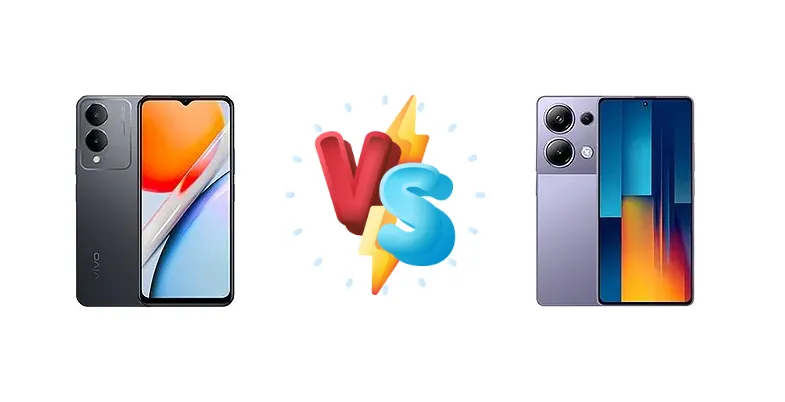
The sub-$200 smartphone market is fiercely competitive, and the vivo G2 and Xiaomi Poco M6 Pro 4G represent compelling options. While both devices utilize Mediatek chipsets and target similar users, they diverge significantly in charging technology and measured display performance, creating a clear trade-off between convenience and raw screen visibility.
🏆 Quick Verdict
For most users, the Xiaomi Poco M6 Pro 4G emerges as the stronger choice. Its significantly faster 67W charging, achieving a full charge in just 44 minutes, and brighter 1053 nit display outweigh the G2’s slightly more efficient chipset in everyday use.
| Network |
|---|
| 2G bands | GSM 850 / 900 / 1800 / 1900 | GSM 850 / 900 / 1800 / 1900 |
| 3G bands | HSDPA 850 / 900 / 2100 | HSDPA 800 / 850 / 900 / 1700(AWS) / 1900 / 2100 |
| 4G bands | 1, 3, 5, 8, 28, 34, 38, 39, 40, 41 | 1, 2, 3, 4, 5, 7, 8, 12, 13, 17, 18, 19, 20, 26, 28, 38, 40, 41, 66 |
| 5G bands | 1, 5, 8, 28, 41, 77, 78 SA/NSA | - |
| Speed | HSPA, LTE, 5G | HSPA, LTE |
| Technology | GSM / HSPA / LTE / 5G | GSM / HSPA / LTE |
| Launch |
|---|
| Announced | 2024, January 19 | 2024, January 11 |
| Status | Available. Released 2024, January 19 | Available. Released 2024, January 12 |
| Body |
|---|
| Build | Glass front, plastic frame, plastic back | Glass front (Gorilla Glass 5), plastic frame |
| Dimensions | 163.7 x 75.4 x 8.1 mm (6.44 x 2.97 x 0.32 in) | 161.1 x 75 x 8 mm (6.34 x 2.95 x 0.31 in) |
| SIM | Nano-SIM + Nano-SIM | Nano-SIM + Nano-SIM |
| Weight | 186 g (6.56 oz) | 179 g (6.31 oz) |
| Display |
|---|
| Protection | - | Corning Gorilla Glass 5 |
| Resolution | 720 x 1612 pixels, 20:9 ratio (~269 ppi density) | 1080 x 2400 pixels, 20:9 ratio (~395 ppi density) |
| Size | 6.56 inches, 103.4 cm2 (~83.8% screen-to-body ratio) | 6.67 inches, 107.4 cm2 (~88.9% screen-to-body ratio) |
| Type | IPS LCD, 90Hz, 840 nits (HBM) | AMOLED, 120Hz, 1000 nits (HBM), 1300 nits (peak) |
| Platform |
|---|
| CPU | Octa-core (2x2.2 GHz Cortex-A76 & 6x2.0 GHz Cortex-A55) | Octa-core (2x2.2 GHz Cortex-A76 & 6x2.0 GHz Cortex-A55) |
| Chipset | Mediatek Dimensity 6020 (7 nm) | Mediatek Helio G99 Ultra |
| GPU | Mali-G57 MC2 | Mali-G57 MC2 |
| OS | Android 13, OriginOS 3 | Android 13, MIUI 14, planned upgrade to Android 14, HyperOS |
| Memory |
|---|
| Card slot | No | microSDXC (uses shared SIM slot) |
| Internal | 128GB 4GB RAM, 128GB 6GB RAM, 128GB 8GB RAM, 256GB 8GB RAM | 256GB 8GB RAM, 512GB 12GB RAM |
| Main Camera |
|---|
| Features | LED flash, panorama | LED flash, HDR, panorama |
| Single | 13 MP, f/2.2, (wide), PDAF
Anti-stroboscopic sensor | - |
| Triple | - | 64 MP, f/1.8, 25mm (wide), 1/2.0", 0.7µm, PDAF, OIS
8 MP, f/2.2, (ultrawide)
2 MP (macro) |
| Video | 1080p@30fps | 1080p@30/60fps, gyro-EIS |
| Selfie camera |
|---|
| Single | 5 MP, f/1.8, (wide) | 16 MP, f/2.5, (wide) |
| Video | Yes | 1080p@30/60fps |
| Sound |
|---|
| 35mm jack | Yes | Yes |
| Loudspeaker | Yes | Yes, with dual speakers |
| Comms |
|---|
| Bluetooth | 5.1, A2DP, LE, aptX HD | 5.2, A2DP, LE |
| Infrared port | - | Yes |
| NFC | No | Yes (market/region dependent) |
| Positioning | GPS, GLONASS, BDS | GPS, GALILEO, GLONASS, BDS |
| Radio | FM radio | FM radio |
| USB | USB Type-C 2.0, OTG | USB Type-C 2.0, OTG |
| WLAN | Wi-Fi 802.11 a/b/g/n/ac, dual-band | Wi-Fi 802.11 a/b/g/n/ac, dual-band |
| Features |
|---|
| Sensors | Fingerprint (side-mounted), accelerometer, proximity, compass | Fingerprint (under display, optical), accelerometer, gyro, compass |
| Battery |
|---|
| Charging | 15W wired
Reverse wired | 67W wired, 100% in 44 min |
| Type | 5000 mAh | 5000 mAh |
| Misc |
|---|
| Colors | Black | Black, Blue, Purple |
| Models | V2318A | 2312FPCA6G |
| Price | About 160 EUR | $ 170.00 |
| SAR | - | 1.09 W/kg (head) 1.09 W/kg (body) |
| SAR EU | - | 0.99 W/kg (head) 0.99 W/kg (body) |
vivo G2
- Potentially better thermal efficiency due to the Dimensity 6020's architecture.
- Reverse wired charging offers added versatility.
- May be slightly more affordable depending on regional pricing.
- Significantly slower 15W charging.
- Likely lower peak display brightness impacting outdoor visibility.
Xiaomi Poco M6 Pro 4G
- Ultra-fast 67W charging (0-100% in 44 minutes).
- Brighter 1053 nit display for excellent outdoor visibility.
- Helio G99 Ultra may offer a slight gaming performance advantage.
- Potentially slightly less power efficient than the Dimensity 6020.
- Camera specs are largely unknown.
Display Comparison
The Xiaomi Poco M6 Pro 4G boasts a substantial advantage in display technology, achieving a measured peak brightness of 1053 nits. This is crucial for outdoor visibility, a scenario where the vivo G2’s unspecified brightness will likely struggle. While both phones share a similar resolution, the Poco’s higher peak brightness translates to a more usable experience in direct sunlight. We lack PWM frequency data for either device, but the brightness difference is a key differentiator.
Camera Comparison
Context data for both devices is limited regarding camera capabilities. Both phones feature a 'Photo / Video' capability, but details on sensor size, aperture, or image stabilization are absent. Without this information, a meaningful comparison is difficult. The presence of a 2MP macro camera on either device is unlikely to significantly impact image quality, and should be considered a marketing feature rather than a core strength. We can assume both phones will offer adequate image quality for social media sharing, but will likely struggle in low-light conditions.
Performance
Both the vivo G2 and Poco M6 Pro 4G are powered by octa-core CPUs featuring the same core configuration: 2x2.2 GHz Cortex-A76 and 6x2.0 GHz Cortex-A55. However, the Poco utilizes the Mediatek Helio G99 Ultra, while the G2 employs the Dimensity 6020. While core counts are identical, the G99 Ultra is built on a 6nm process, potentially offering slightly better efficiency than the G2’s 7nm Dimensity 6020. In real-world usage, the performance difference will be minimal for most tasks, but the G99 Ultra’s GPU may provide a slight edge in gaming. Neither phone specifies RAM type or speed, a crucial factor for multitasking.
Battery Life
The Xiaomi Poco M6 Pro 4G shines in the battery and charging department. While the battery capacity isn’t specified, the active use score of 11:46h indicates strong endurance. More importantly, its 67W wired charging capability, achieving a full charge in just 44 minutes, is a game-changer. The vivo G2’s 15W charging is significantly slower, requiring considerably longer to reach 100%. This difference in charging speed is a major convenience factor, especially for users who frequently need to top up their battery.
Buying Guide
Buy the vivo G2 if you prioritize long-term efficiency and are comfortable with slower 15W charging. This phone suits users who rarely top up their battery and value a potentially cooler running device. Buy the Xiaomi Poco M6 Pro 4G if you demand rapid charging and a highly visible screen, even in bright sunlight. This is the better option for power users and those who frequently find themselves needing a quick battery boost.
Frequently Asked Questions
❓ Does the Poco M6 Pro 4G's Helio G99 Ultra chipset get hot during extended gaming sessions?
While the Helio G99 Ultra is a capable chipset, its thermal performance will depend on the Poco M6 Pro 4G's cooling solution, which isn't specified. However, the 6nm process node generally offers better thermal efficiency than older nodes, suggesting it should handle moderate gaming without excessive throttling. Prolonged, demanding gaming may still lead to some heat buildup.
❓ Is the 15W charging on the vivo G2 slow enough to be a dealbreaker for frequent users?
For users accustomed to fast charging, the 15W charging on the vivo G2 will feel significantly slower. A full charge will take considerably longer than the Poco M6 Pro 4G's 44-minute timeframe. If you regularly need to quickly top up your battery throughout the day, the G2's charging speed is a major drawback.
❓ How does the Dimensity 6020 in the vivo G2 compare to the Helio G99 Ultra in terms of power efficiency for everyday tasks?
The Dimensity 6020, built on a 7nm process, is likely slightly more power-efficient than the Helio G99 Ultra's 6nm process for basic tasks like browsing and social media. However, the difference will be marginal and unlikely to be noticeable in typical daily use. The Poco M6 Pro's faster charging mitigates any potential efficiency gains of the G2.