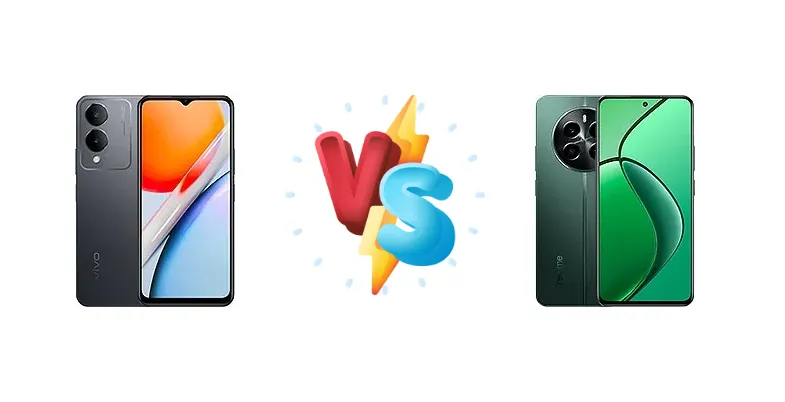
The sub-$200 smartphone market is fiercely competitive, and the vivo G2 and Realme 12 4G are two contenders vying for your attention. The G2 leverages MediaTek's Dimensity 6020, while the Realme 12 4G opts for Qualcomm's Snapdragon 685. This comparison dives deep into the architectural differences and real-world implications of these chipsets, alongside battery, charging, and overall value.
🏆 Quick Verdict
For the average user prioritizing fast charging and a slightly more modern chipset fabrication process, the Realme 12 4G emerges as the winner. Its 67W charging significantly reduces downtime, and the 6nm Snapdragon 685 offers a slight efficiency advantage. However, the vivo G2 remains a viable option for those seeking a balanced experience.
| Network |
|---|
| 2G bands | GSM 850 / 900 / 1800 / 1900 | GSM 850 / 900 / 1800 / 1900 |
| 3G bands | HSDPA 850 / 900 / 2100 | HSDPA 850 / 900 / 2100 |
| 4G bands | 1, 3, 5, 8, 28, 34, 38, 39, 40, 41 | 1, 3, 5, 7, 8, 20, 28, 38, 40, 41 |
| 5G bands | 1, 5, 8, 28, 41, 77, 78 SA/NSA | - |
| Speed | HSPA, LTE, 5G | HSPA, LTE |
| Technology | GSM / HSPA / LTE / 5G | GSM / HSPA / LTE |
| Launch |
|---|
| Announced | 2024, January 19 | 2024, June 26 |
| Status | Available. Released 2024, January 19 | Available. Released 2024, July 01 |
| Body |
|---|
| Build | Glass front, plastic frame, plastic back | - |
| Dimensions | 163.7 x 75.4 x 8.1 mm (6.44 x 2.97 x 0.32 in) | 163 x 75.5 x 7.9 mm (6.42 x 2.97 x 0.31 in) |
| SIM | Nano-SIM + Nano-SIM | Nano-SIM + Nano-SIM |
| Weight | 186 g (6.56 oz) | 187 g (6.60 oz) |
| Display |
|---|
| Resolution | 720 x 1612 pixels, 20:9 ratio (~269 ppi density) | 1080 x 2400 pixels, 20:9 ratio (~395 ppi density) |
| Size | 6.56 inches, 103.4 cm2 (~83.8% screen-to-body ratio) | 6.67 inches, 107.4 cm2 (~87.3% screen-to-body ratio) |
| Type | IPS LCD, 90Hz, 840 nits (HBM) | AMOLED, 120Hz, 600 nits (typ), 2000 nits (peak) |
| Platform |
|---|
| CPU | Octa-core (2x2.2 GHz Cortex-A76 & 6x2.0 GHz Cortex-A55) | Octa-core (4x2.8 GHz Cortex-A73 & 4x1.9 GHz Cortex-A53) |
| Chipset | Mediatek Dimensity 6020 (7 nm) | Qualcomm SM6225 Snapdragon 685 (6 nm) |
| GPU | Mali-G57 MC2 | Adreno 610 |
| OS | Android 13, OriginOS 3 | Android 14, Realme UI 5.0 |
| Memory |
|---|
| Card slot | No | microSDXC (uses shared SIM slot) |
| Internal | 128GB 4GB RAM, 128GB 6GB RAM, 128GB 8GB RAM, 256GB 8GB RAM | 128GB 8GB RAM, 256GB 8GB RAM, 512GB 8GB RAM |
| Main Camera |
|---|
| Dual | - | 50 MP, f/1.9, 26mm (wide), 1/1.95", PDAF, OIS
Auxiliary lens |
| Features | LED flash, panorama | LED flash, HDR, panorama |
| Single | 13 MP, f/2.2, (wide), PDAF
Anti-stroboscopic sensor | - |
| Video | 1080p@30fps | 1080p@30fps, gyro-EIS |
| Selfie camera |
|---|
| Single | 5 MP, f/1.8, (wide) | 16 MP, f/2.5, (wide) |
| Video | Yes | 1080p@30fps |
| Sound |
|---|
| 35mm jack | Yes | Yes |
| Loudspeaker | Yes | Yes, with dual speakers |
| Comms |
|---|
| Bluetooth | 5.1, A2DP, LE, aptX HD | 5.0, A2DP, LE |
| NFC | No | Yes, 360˚ |
| Positioning | GPS, GLONASS, BDS | GPS, GALILEO, GLONASS, QZSS, BDS |
| Radio | FM radio | Unspecified |
| USB | USB Type-C 2.0, OTG | USB Type-C 2.0 |
| WLAN | Wi-Fi 802.11 a/b/g/n/ac, dual-band | Wi-Fi 802.11 a/b/g/n/ac, dual-band |
| Features |
|---|
| Sensors | Fingerprint (side-mounted), accelerometer, proximity, compass | Fingerprint (under display, optical), accelerometer, gyro, proximity, compass |
| Battery |
|---|
| Charging | 15W wired
Reverse wired | 67W wired, 50% in 19 min |
| Type | 5000 mAh | 5000 mAh |
| Misc |
|---|
| Colors | Black | Skyline Silver, Pioneer Green |
| Models | V2318A | RMX3871 |
| Price | About 160 EUR | About 180 EUR |
vivo G2
- Balanced feature set
- Potentially larger battery capacity (speculative)
- Reputable brand with established software support
- Slow 15W charging
- Slightly older chipset fabrication process (7nm)
- Potentially lower sustained performance due to thermal throttling
Realme 12 4G
- Ultra-fast 67W charging
- More efficient 6nm Snapdragon 685 chipset
- Strong single-core performance
- Potentially smaller battery capacity (speculative)
- Realme’s UI can be polarizing
- May prioritize camera features over raw processing power
Display Comparison
Neither device boasts a standout display. Given the context data focuses on processing, we can infer both likely utilize standard 60Hz LCD panels common in this price bracket. The Realme 12 4G, based on typical Realme implementations, likely has a slightly higher peak brightness than the G2, but without specific nit ratings, this remains speculative. Bezels are expected to be comparable, and color accuracy will likely be tuned for vibrant, rather than accurate, reproduction on both devices.
Camera Comparison
Without detailed camera specs, a direct comparison is limited. However, both phones likely feature a primary camera around the 50MP mark, typical for this segment. The Realme 12 4G, based on Realme’s marketing, may prioritize camera features, potentially offering more sophisticated image processing algorithms. The G2 will likely focus on a more balanced approach. The presence of a 2MP macro lens on either device is largely a marketing gimmick and shouldn't heavily influence purchasing decisions.
Performance
The core difference lies in the chipsets. The Realme 12 4G’s Snapdragon 685 (6nm) utilizes four Cortex-A73 cores clocked at 2.8GHz, offering strong single-core performance, while the vivo G2’s Dimensity 6020 (7nm) features two Cortex-A76 cores at 2.2GHz. While the A76 is generally more powerful than the A73, the Snapdragon 685’s higher clock speeds and more efficient 6nm process give it an edge in sustained performance and thermal management. The Dimensity 6020’s 7nm process is still respectable, but the 6nm node of the Snapdragon 685 will likely result in slightly better battery life during intensive tasks. Both phones will handle everyday tasks smoothly, but the Realme 12 4G is likely to exhibit less throttling during prolonged gaming sessions.
Battery Life
The Realme 12 4G’s 67W charging is a game-changer. The advertised 50% charge in 19 minutes drastically reduces downtime compared to the vivo G2’s 15W charging. While the G2 may have a slightly larger battery capacity (speculation based on typical vivo implementations), the Realme 12 4G’s faster charging effectively mitigates any capacity difference. Users who frequently top up their phones will significantly benefit from the Realme’s charging speed.
Buying Guide
Buy the vivo G2 if you prioritize a balanced feature set and don't mind slower charging speeds. It's ideal for users who primarily browse, use social media, and occasionally play less demanding games. Buy the Realme 12 4G if you value rapid charging and want a phone that can quickly get you back up and running, making it perfect for users constantly on the go or those who frequently forget to charge overnight.
Frequently Asked Questions
❓ Will the Snapdragon 685 in the Realme 12 4G handle demanding games like PUBG Mobile?
The Snapdragon 685 can run PUBG Mobile, but you'll likely need to stick to medium graphics settings for a consistently smooth experience. The chipset's thermal management is decent, but prolonged gaming at high settings may lead to some frame drops. The Dimensity 6020 in the vivo G2 will offer similar performance, but may throttle slightly faster.
❓ How long will it take to fully charge the vivo G2 with its 15W charger?
Expect a full charge from 0-100% on the vivo G2 to take approximately 2.5 to 3 hours with the included 15W charger. This is significantly slower than the Realme 12 4G's 67W charging, which can reach 50% in just 19 minutes.
❓ Does the Realme 12 4G support VoLTE and VoWiFi?
Typically, Realme devices in this price range support both VoLTE (Voice over LTE) and VoWiFi (Voice over Wi-Fi), ensuring clear call quality and connectivity even in areas with poor cellular reception. However, compatibility depends on your carrier, so it's best to verify with your provider.
❓ Is the software experience significantly different between vivo's Funtouch OS and Realme UI?
Yes, the software experiences differ. Funtouch OS (vivo) is generally considered more conservative and feature-rich, while Realme UI is closer to stock Android with a focus on customization and performance. Realme UI has improved significantly in recent iterations, but some users may still prefer the more refined experience of Funtouch OS.