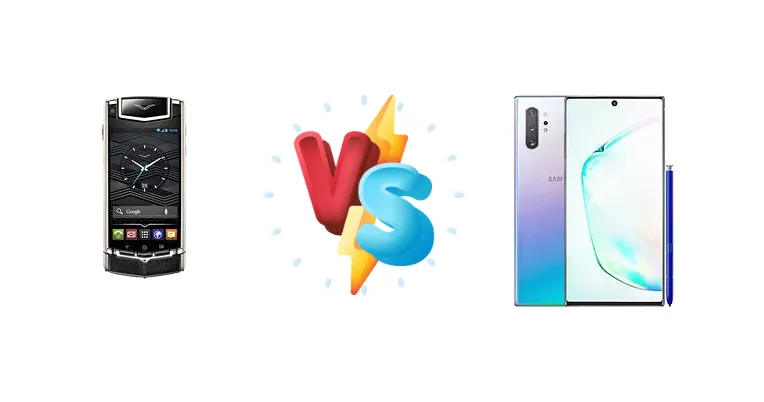
The Vertu Ti represents the pinnacle of luxury smartphone design, boasting handcrafted materials and bespoke services. Conversely, the Samsung Galaxy Note10+ is a powerhouse of modern technology, packed with features and raw performance. This comparison explores which phone reigns supreme.
🏆 Quick Verdict
The Samsung Galaxy Note10+ decisively wins on performance, camera capabilities, and battery life. The Vertu Ti's appeal lies solely in its luxury branding and materials; it's a statement piece, not a tech champion. For most users, the Note10+ offers far greater value.
| Network |
|---|
| 2G bands | GSM 850 / 900 / 1800 / 1900 | GSM 850 / 900 / 1800 / 1900 |
| 3G bands | HSDPA 850 / 900 / 1900 / 2100 | HSDPA 850 / 900 / 1700(AWS) / 1900 / 2100 |
| 4G bands | - | 1, 2, 3, 4, 5, 7, 8, 12, 13, 17, 18, 19, 20, 25, 26, 28, 32, 38, 39, 40, 41, 66 - Global, LATAM |
| EDGE | - | No |
| GPRS | - | Yes |
| Speed | HSPA 21.1/5.76 Mbps | HSPA 42.2/5.76 Mbps, LTE (7CA) Cat20 2000/150 Mbps |
| Technology | GSM / HSPA | GSM / CDMA / HSPA / EVDO / LTE |
| | - | 1, 2, 3, 4, 5, 7, 8, 12, 13, 18, 19, 20, 25, 29, 30, 38, 39, 40, 41, 46, 66, 71 - Canada |
| Launch |
|---|
| Announced | 2013, February. Released 2013, February | 2019, August 07. Released 2019, August 23 |
| Status | Discontinued | Discontinued |
| Body |
|---|
| Build | - | Glass front (Gorilla Glass 6), glass back (Gorilla Glass 6), aluminum frame |
| Dimensions | - | 162.3 x 77.2 x 7.9 mm (6.39 x 3.04 x 0.31 in) |
| Keyboard | - | QWERTY |
| SIM | Mini-SIM | · Nano-SIM· Nano-SIM + Nano-SIM |
| Weight | - | 196 g (6.91 oz) |
| | Titanium body (grade 5) | IP68 dust/water resistant (up to 1.5m for 30 min)
Stylus, 42ms latency (Bluetooth integration, accelerometer, gyro) |
| Display |
|---|
| Protection | Scratch-resistant glass | Corning Gorilla Glass 6 |
| Resolution | 480 x 800 pixels, 5:3 ratio (~252 ppi density) | 1440 x 3040 pixels, 19:9 ratio (~498 ppi density) |
| Size | 3.7 inches, 39.0 cm2 | 6.8 inches, 114.0 cm2 (~91.0% screen-to-body ratio) |
| Type | Sapphire crystal glass | Dynamic AMOLED, HDR10+ |
| | - | Always-on display |
| Platform |
|---|
| CPU | Dual-core 1.7 GHz | Octa-core (2x2.73 GHz Mongoose M4 & 2x2.4 GHz Cortex-A75 & 4x1.9 GHz Cortex-A55) - EMEA/LATAMOcta-core (1x2.84 GHz Kryo 485 & 3x2.42 GHz Kryo 485 & 4x1.78 GHz Kryo 485) - USA/China |
| Chipset | - | Exynos 9825 (7 nm) - EMEA/LATAMQualcomm SM8150 Snapdragon 855 (7 nm) - USA/China |
| GPU | - | Mali-G76 MP12 - EMEA/LATAMAdreno 640 - USA/China |
| OS | Android 4.0 (Ice Cream Sandwich) | Android 9.0 (Pie), upgradable to Android 12, One UI 4 |
| Memory |
|---|
| Call records | - | Yes |
| Card slot | microSDHC (dedicated slot) | microSDXC (uses shared SIM slot) - dual SIM model only |
| Internal | 64GB 1GB RAM | 256GB 12GB RAM, 512GB 12GB RAM |
| Phonebook | - | 200 entries |
| | - | UFS 3.0 |
| Main Camera |
|---|
| Features | LED flash | LED flash, auto-HDR, panorama |
| Single | 8 MP, AF | CIF |
| Triple | - | 12 MP, f/1.5-2.4, 27mm (wide), 1/2.55", 1.4µm, dual pixel PDAF, OIS
12 MP, f/2.1, 52mm (telephoto), 1/3.6", 1.0µm, PDAF, OIS, 2x optical zoom
16 MP, f/2.2, 12mm (ultrawide), 1/3.1", 1.0µm, Super Steady video
0.3 MP, TOF 3D, (depth) |
| Video | 1080p@30fps | 4K@30/60fps, 1080p@30/60/240fps, 720p@960fps, HDR10+, stereo sound rec., gyro-EIS & OIS |
| Selfie camera |
|---|
| Features | - | HDR |
| Single | 1.3 MP | 10 MP, f/2.2, 26mm (wide), 1/3", 1.22µm, dual pixel PDAF |
| Video | - | 4K@30/60fps |
| Sound |
|---|
| 3.5mm jack | Yes | No |
| 35mm jack | Yes | No |
| Loudspeaker | Yes, with stereo speakers (Bang&Olufsen) | Yes, with stereo speakers |
| | - | 32-bit/384kHz audio
Tuned by AKG |
| Comms |
|---|
| Bluetooth | 4.0, A2DP | 5.0, A2DP, LE, aptX |
| NFC | No | Yes |
| Positioning | GPS | GPS, GLONASS, BDS, GALILEO |
| Radio | No | FM radio (USA & Canada only) |
| USB | microUSB 2.0 | USB Type-C 3.1 |
| WLAN | Wi-Fi 802.11 b/g/n, hotspot | Wi-Fi 802.11 a/b/g/n/ac/6, dual-band, Wi-Fi Direct |
| Features |
|---|
| Browser | - | WAP 2.0 |
| Games | - | Downloadable |
| Java | - | No |
| Messaging | - | SMS, MMS |
| Sensors | Accelerometer, proximity, compass | Fingerprint (under display, ultrasonic), accelerometer, gyro, proximity, compass, barometer |
| | - | Samsung DeX, Samsung Wireless DeX (desktop experience support)
ANT+
Bixby natural language commands and dictation
Samsung Pay (Visa, MasterCard certified) |
| Battery |
|---|
| Charging | - | 45W wired, PD3.0
15W wireless (Qi)
4.5W reverse wireless |
| Stand-by | - | Up to 450 h |
| Talk time | - | Up to 6 h |
| Type | Li-Ion, non-removable | Li-Ion 4300 mAh, non-removable |
| Misc |
|---|
| Colors | Black/Gray | Aura Glow, Aura White, Aura Black, Aura Blue |
| Models | - | SM-N975F, SM-N975U, SM-N9750, SM-N975U1, SM-N975W, SM-N975N, SM-N975X, SCV45 |
| Price | About 7900 EUR | About 220 EUR |
| SAR | - | 0.35 W/kg (head) 0.70 W/kg (body) |
| SAR EU | - | 0.19 W/kg (head) 1.40 W/kg (body) |
| Tests |
|---|
| Audio quality | - |
Noise -94.0dB / Crosstalk -95.1dB |
| Battery life | - |
Endurance rating 107h
|
| Camera | - |
Photo / Video |
| Display | - |
Contrast ratio: infinite (nominal) |
| Loudspeaker | - |
-26.0 LUFS (Very good)
|
| Performance | - |
AnTuTu: 342208 (v7), 438622 (v8)
GeekBench: 10403 (v4.4), 2154 (v5.1)
GFXBench: 24fps (ES 3.1 onscreen) |
Vertu Ti
- Handcrafted materials
- Bespoke concierge service (potentially)
- Unique design and exclusivity
- Outdated processor
- Poor battery life
- Basic camera
- Extremely high price
- Limited software updates
Samsung Galaxy Note10+
- Powerful performance
- Excellent camera system
- Long battery life
- Vibrant display
- Fast charging
- S Pen stylus
- Can be bulky
- Pricey (though less than Vertu Ti)
- Software bloat (typical of Samsung)
Display Comparison
The Note10+ boasts a vibrant 6.8-inch Dynamic AMOLED display with a 794 nits max brightness and an infinite contrast ratio, offering stunning visuals. The Vertu Ti's display, while decent, is smaller (4.7 inches) and lacks the same level of color accuracy and brightness. The Note10+ is the clear winner here.
Camera Comparison
The Note10+’s camera system is vastly superior, offering multiple lenses, advanced features like Night Mode, and impressive video recording capabilities. The Vertu Ti’s camera is basic and struggles in low light. The Note10+ provides a much more versatile and higher-quality photography experience.
Performance
The Note10+’s Exynos 9825 or Snapdragon 855 chipset (depending on region) and Octa-core CPU significantly outperform the Vertu Ti's Dual-core 1.7 GHz processor. The Note10+ handles demanding games and multitasking with ease, while the Vertu Ti can feel sluggish by comparison.
Battery Life
The Note10+’s endurance rating of 107 hours is exceptional. It supports 45W wired charging and 15W wireless charging. The Vertu Ti’s battery life is significantly shorter, and charging options are limited. The Note10+ offers far better battery performance and faster charging.
Buying Guide
Who should buy Vertu Ti? Individuals prioritizing status, exclusivity, and handcrafted luxury above all else, and willing to pay a premium for it. Who should buy Samsung Galaxy Note10+? Users seeking a powerful, feature-rich Android phone with a fantastic display, camera, and long battery life, at a more reasonable price.
Frequently Asked Questions
❓ Is the Vertu Ti worth the price?
The Vertu Ti's price is justified solely by its luxury branding and materials. It offers minimal technological advantages over modern smartphones.
❓ Does the Vertu Ti receive software updates?
Software updates for the Vertu Ti are infrequent and often delayed, making it vulnerable to security risks.
❓ What is the S Pen on the Note10+?
The S Pen is a stylus included with the Note10+ that allows for precise input, note-taking, and remote control features.