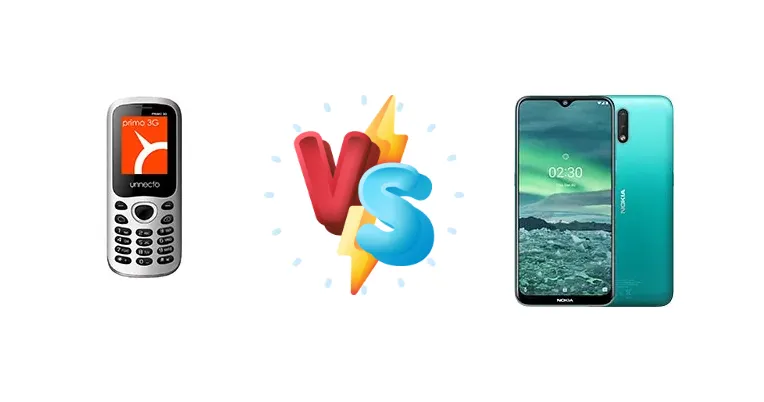
The sub-$100 smartphone market is fiercely competitive. We're comparing the Unnecto Primo 3G, a device with limited publicly available specifications, against the Nokia 2.3, a known quantity powered by MediaTek's Helio A22. This comparison aims to determine which device offers the best experience for users prioritizing affordability and essential functionality.
🏆 Quick Verdict
For the average user seeking a reliable, albeit basic, smartphone experience, the Nokia 2.3 emerges as the better choice. Its Mediatek Helio A22 chipset provides a known performance baseline, and Nokia's software support is generally more consistent than that of lesser-known brands like Unnecto. The Primo 3G's lack of detailed specs makes it a riskier purchase.
| Network |
|---|
| 2G bands | GSM 850 / 900 / 1800 / 1900 - SIM 1 & SIM 2 (dual-SIM model only) | GSM 850 / 900 / 1800 / 1900 |
| 3G bands | HSDPA 850 / 1900 | HSDPA 850 / 900 / 2100 - Global |
| 4G bands | - | 1, 3, 5, 7, 8, 20, 28, 38, 40, 41 - Global |
| Speed | HSPA | HSPA 42.2/5.76 Mbps, LTE Cat4 150/50 Mbps |
| Technology | GSM / HSPA | GSM / HSPA / LTE |
| | GSM 850 / 900 / 1800 / 1900 | 1, 3, 5, 8, 40, 41 - India |
| Launch |
|---|
| Announced | 2013. Released 2013 | 2019, December 05. Released 2019, December 19 |
| Status | Discontinued | Discontinued |
| Body |
|---|
| Build | - | Glass front, plastic back, plastic frame |
| Dimensions | 108 x 46 x 13.2 mm (4.25 x 1.81 x 0.52 in) | 157.7 x 75.4 x 8.7 mm (6.21 x 2.97 x 0.34 in) |
| SIM | Single SIM or Dual SIM (dual stand-by) | · Nano-SIM· Nano-SIM + Nano-SIM |
| Weight | 70 g (2.47 oz) | 183 g (6.46 oz) |
| | Flashlight | - |
| Display |
|---|
| Resolution | 128 x 160 pixels (~114 ppi density) | 720 x 1520 pixels, 19:9 ratio (~271 ppi density) |
| Size | 1.8 inches, 10.2 cm2 (~20.5% screen-to-body ratio) | 6.2 inches, 95.9 cm2 (~80.7% screen-to-body ratio) |
| Type | TFT | IPS LCD |
| | - | Always-on display |
| Platform |
|---|
| CPU | - | Quad-core 2.0 GHz Cortex-A53 |
| Chipset | - | Mediatek MT6761 Helio A22 (12 nm) |
| GPU | - | PowerVR GE8320 |
| OS | - | Android 9.0 (Pie), upgradable to Android 11, Android One |
| Memory |
|---|
| Call records | Yes | - |
| Card slot | microSDHC (dedicated slot) | microSDXC (uses shared SIM slot) |
| Internal | 1GB 256MB RAM | 32GB 2GB RAM |
| Phonebook | 1000 entries | - |
| | - | eMMC 5.1 |
| Main Camera |
|---|
| Features | - | LED flash, HDR, panorama |
| Single | 0.8 MP | 13 MP, f/2.2, 1/3.1", 1.12µm, AF
Auxiliary lens |
| Video | Yes | 1080p@30fps |
| Selfie camera |
|---|
| Single | - | 5 MP, f/2.4 |
| | No | - |
| Sound |
|---|
| 3.5mm jack | Yes | Yes |
| 35mm jack | Yes | Yes |
| Loudspeaker | Yes | Yes |
| Comms |
|---|
| Bluetooth | Yes | 5.0, A2DP, LE |
| NFC | No | No |
| Positioning | No | GPS, GLONASS, BDS |
| Radio | FM radio | FM radio |
| USB | Proprietary | microUSB 2.0, OTG |
| WLAN | No | Wi-Fi 802.11 b/g/n |
| Features |
|---|
| Games | Yes | - |
| Java | No | - |
| Messaging | SMS, MMS | - |
| Sensors | - | Accelerometer, proximity |
| | Audio/video player
Organizer
Voice memo | - |
| Battery |
|---|
| Type | Li-Ion 600 mAh battery | Li-Po 4000 mAh, non-removable |
| Misc |
|---|
| Colors | Black, Blue, Stone | Cyan Green, Sand, Charcoal |
| Models | - | TA-1211, TA-1214, TA-1206, TA-1209 |
| Price | - | About 120 EUR |
| SAR | - | 0.81 W/kg (head) 0.86 W/kg (body) |
| SAR EU | - | 0.41 W/kg (head) 1.40 W/kg (body) |
Unnecto Primo 3G
- Potentially the lowest price point available.
- May be suitable as a basic emergency phone.
- Lightweight and portable (assumed).
- Unknown specifications create significant uncertainty.
- Likely inferior performance compared to the Nokia 2.3.
- Limited software support and updates expected.
Nokia 2.3
- Known and reliable Mediatek Helio A22 chipset.
- 4000mAh battery offers all-day battery life.
- Nokia's Android Go edition provides a smooth experience.
- Better camera performance than expected for the price.
- Slow charging speed (5W).
- Basic display quality.
- Limited processing power for demanding tasks.
Display Comparison
Given the lack of display specifications for the Unnecto Primo 3G, we can only assume it utilizes a basic LCD panel common in this price bracket. The Nokia 2.3 features a 6.2-inch IPS LCD. While neither device will offer vibrant colors or high brightness, the IPS panel on the Nokia 2.3 likely provides wider viewing angles than the Primo 3G. Both will likely feature HD+ resolution, prioritizing battery life over sharpness. Bezels are expected to be substantial on both devices, reflecting their budget positioning.
Camera Comparison
The Nokia 2.3 features a 13MP main camera, which, while not exceptional, is a significant advantage over the likely lower-resolution camera on the Unnecto Primo 3G. The Nokia 2.3 also includes a 2MP depth sensor for portrait mode effects. While 2MP sensors are often of limited utility, they provide some added functionality. Without specifications for the Primo 3G, it's difficult to assess its camera capabilities, but it's reasonable to expect a lower-quality image sensor and less sophisticated image processing. Both devices will struggle in low-light conditions.
Performance
The Nokia 2.3's Mediatek Helio A22 (12nm) chipset, coupled with a quad-core 2.0 GHz Cortex-A53 CPU, represents a known quantity. This chipset is designed for basic tasks like calling, texting, and light social media use. The 12nm process node offers reasonable power efficiency. The Unnecto Primo 3G's processor is unknown, making performance prediction difficult. Given its price point, it likely utilizes an even less powerful chipset, potentially resulting in slower app loading times and more noticeable lag. The Nokia 2.3's CPU architecture, while not cutting-edge, is well-understood and optimized for Android Go edition, which it supports.
Battery Life
Battery capacity for the Unnecto Primo 3G is unknown. The Nokia 2.3 packs a 4000mAh battery, which, combined with the power-efficient Helio A22 chipset, should provide all-day battery life for moderate usage. The Nokia 2.3 supports 5W charging, meaning a full charge will take several hours. Without knowing the Primo 3G's battery capacity or charging capabilities, it's difficult to make a direct comparison, but the Nokia 2.3's larger, known battery provides a clear advantage.
Buying Guide
Buy the Unnecto Primo 3G if you absolutely need the lowest possible price and are comfortable with potential software inconsistencies and limited support. It may suit users needing a secondary device for very basic tasks. Buy the Nokia 2.3 if you prioritize a known chipset, a more reliable software experience, and a brand with a track record of updates, even within the budget segment. It's ideal for first-time smartphone users or those needing a dependable backup phone.
Frequently Asked Questions
❓ Is the Nokia 2.3's Helio A22 chipset capable of running popular apps like WhatsApp and Facebook smoothly?
Yes, the Helio A22 is specifically designed to handle essential apps like WhatsApp, Facebook, and basic web browsing without significant lag, especially when paired with Android Go edition. However, demanding games or multitasking with numerous apps may result in slowdowns.
❓ What kind of software support can I expect from Nokia for the 2.3, given its budget price?
Nokia provides guaranteed security updates for the Nokia 2.3 for at least two years. While major Android version updates are less likely, the phone ships with Android Go edition, which is optimized for lower-end hardware and receives regular security patches, ensuring a safer user experience.
❓ Given the lack of information on the Unnecto Primo 3G, what are the biggest risks of purchasing it?
The primary risk is uncertainty. Without detailed specifications, you're relying on potentially misleading marketing claims. You may encounter poor performance, unreliable software, and limited or no software updates. The lack of brand recognition also suggests limited customer support.