
Umidigi Power 7S vs. Xiaomi Redmi 10 5G: A Detailed Comparison
| Phones Images | |||||
|---|---|---|---|---|---|
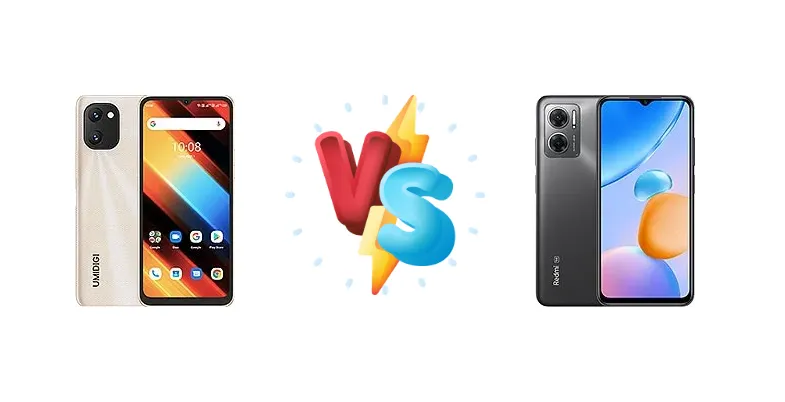
|
🏆 Quick Verdict
For the average user prioritizing consistent performance and 5G responsiveness, the Xiaomi Redmi 10 5G is the better choice. Its Mediatek Dimensity 700 chipset, built on a more efficient 7nm process, delivers a noticeable performance advantage over the Umidigi Power 7S’s Unisoc Tiger T310. However, the Power 7S offers a compelling value for those prioritizing absolute longevity and minimal cost.
| PHONES | ||
|---|---|---|
| Phone Names | Umidigi Power 7S | Xiaomi Redmi 10 5G |
| Network | ||
|---|---|---|
| 2G bands | GSM 850 / 900 / 1800 / 1900 | GSM 850 / 900 / 1800 / 1900 |
| 3G bands | HSDPA 850 / 900 / 1700(AWS) / 1900 / 2100 | HSDPA 850 / 900 / 1700(AWS) / 1900 / 2100 |
| 4G bands | 1, 2, 3, 4, 5, 7, 8, 12, 13, 17, 18, 19, 20, 25, 26, 28, 34, 38, 39, 40, 41, 66 | 1, 2, 3, 4, 5, 7, 8, 20, 28, 38, 40, 41 |
| 5G bands | - | 1, 3, 5, 7, 8, 20, 28, 38, 40, 41, 77, 78 SA/NSA |
| Speed | HSPA, LTE | HSPA, LTE, 5G |
| Technology | GSM / HSPA / LTE | GSM / HSPA / LTE / 5G |
| Launch | ||
|---|---|---|
| Announced | 2022 | 2022, March 29 |
| Status | Available. Released 2022 | Available. Released 2022, September 23 |
| Body | ||
|---|---|---|
| Dimensions | 169 x 77 x 10 mm (6.65 x 3.03 x 0.39 in) | 164 x 76.1 x 8.9 mm (6.46 x 3.00 x 0.35 in) |
| SIM | Nano-SIM + Nano-SIM | Nano-SIM + Nano-SIM |
| Weight | 216 g (7.62 oz) | 200 g (7.05 oz) |
| Display | ||
|---|---|---|
| Protection | - | Corning Gorilla Glass 3 |
| Resolution | 720 x 1650 pixels (~269 ppi density) | 1080 x 2408 pixels, 20:9 ratio (~401 ppi density) |
| Size | 6.7 inches, 106.2 cm2 (~81.6% screen-to-body ratio) | 6.58 inches, 104.3 cm2 (~83.6% screen-to-body ratio) |
| Type | IPS LCD | IPS LCD, 90Hz |
| Platform | ||
|---|---|---|
| CPU | Quad-core (1x2.0 GHz Cortex-A75 & 3x1.8 GHz Cortex-A55) | Octa-core (2x2.2 GHz Cortex-A76 & 6x2.0 GHz Cortex-A55) |
| Chipset | Unisoc Tiger T310 (12 nm) | Mediatek Dimensity 700 (7 nm) |
| GPU | PowerVR GE8300 | Mali-G57 MC2 |
| OS | Android 11 | Android 12, MIUI 13 |
| Memory | ||
|---|---|---|
| Card slot | microSDXC (uses shared SIM slot) | microSDXC (dedicated slot) |
| Internal | 64GB 4GB RAM | 64GB 4GB RAM, 128GB 4GB RAM, 128GB 6GB RAM |
| - | UFS 2.2 | |
| Main Camera | ||
|---|---|---|
| Dual | 16 MP, f/2.2, (wide), AF 8 MP, f/2.2, 120˚ (ultrawide) | 50 MP, f/1.8, (wide), PDAF Auxiliary lens |
| Features | Dual-LED flash, HDR, panorama | LED flash, HDR, panorama |
| Single | - | 5 MP, f/2.2 |
| Video | 1080p@30fps | 1080p@30fps |
| Selfie camera | ||
|---|---|---|
| Features | - | HDR |
| Single | 8 MP, f/2.2, (wide) | 5 MP, f/2.2 |
| Video | 1080p@30fps | 1080p@30fps |
| Sound | ||
|---|---|---|
| 3.5mm jack | - | Yes |
| 35mm jack | Yes | Yes |
| Loudspeaker | Yes | Yes |
| - | 24-bit/192kHz audio | |
| Comms | ||
|---|---|---|
| Bluetooth | 5.0, A2DP, LE | 5.1, A2DP, LE |
| Infrared port | - | Yes |
| NFC | No | Yes (market/region dependent) |
| Positioning | GPS, GALILEO, GLONASS, BDS | GPS, GLONASS, BDS, GALILEO |
| Radio | Wireless FM radio | FM radio |
| USB | USB Type-C, OTG | USB Type-C 2.0, OTG |
| WLAN | Wi-Fi 802.11 b/g/n/ac, dual-band, Wi-Fi Direct | Wi-Fi 802.11 a/b/g/n/ac, dual-band, Wi-Fi Direct |
| Features | ||
|---|---|---|
| Sensors | Accelerometer, proximity, compass | Fingerprint (side-mounted), accelerometer, proximity, compass |
| Battery | ||
|---|---|---|
| Charging | 10W wired | 18W wired |
| Type | 6150 mAh | Li-Po 5000 mAh |
| Misc | ||
|---|---|---|
| Colors | Reef Gray, Atlantic Blue, Sunbeam Gold | Graphite Gray, Chrome Silver, Aurora Green |
| Models | - | 22041219G, 22041219NY |
| Price | - | About 100 EUR |
| SAR | - | 1.09 W/kg (head) 1.09 W/kg (body) |
| SAR EU | - | 0.60 W/kg (head) 0.99 W/kg (body) |
Umidigi Power 7S
- Potentially longer battery life due to larger capacity (inferred)
- Lower price point, offering excellent value for basic users
- Reliable performance for everyday tasks like calling and messaging
- Significantly slower processor compared to the Redmi 10 5G
- Slow 10W charging
- Less responsive user experience
Xiaomi Redmi 10 5G
- Faster and more efficient Mediatek Dimensity 700 chipset
- 18W fast charging for quicker top-ups
- Smoother multitasking and gaming performance
- Potentially shorter battery life compared to the Power 7S (though offset by efficiency)
- Slightly higher price point
- May experience more heat under heavy load
Display Comparison
Neither device boasts a standout display. While specific panel details (like peak brightness or color gamut coverage) are unavailable, the focus here is on the underlying performance. Both likely utilize IPS LCD panels, common in this price bracket. The difference lies in how the chipsets drive them; the Redmi 10 5G’s Dimensity 700 will likely provide smoother scrolling and faster response times when navigating the UI due to its superior GPU.
Camera Comparison
Camera performance is difficult to assess without detailed sample images. However, we can infer some differences based on the chipsets’ image signal processors (ISPs). The Dimensity 700 generally offers more advanced ISP capabilities, potentially leading to better image processing, noise reduction, and dynamic range in the Redmi 10 5G. While both phones likely feature a primary camera, the Redmi 10 5G’s chipset is better equipped to handle complex computational photography tasks. The presence of a 2MP macro camera on both devices is largely a marketing gimmick and unlikely to deliver significant improvements in image quality.
Performance
The core difference between these phones is the chipset. The Xiaomi Redmi 10 5G’s Mediatek Dimensity 700, fabricated on a 7nm process, is a significant upgrade over the Umidigi Power 7S’s Unisoc Tiger T310 (12nm). The Dimensity 700’s octa-core configuration (2x2.2 GHz Cortex-A76 & 6x2.0 GHz Cortex-A55) provides a substantial performance boost over the Power 7S’s quad-core setup (1x2.0 GHz Cortex-A75 & 3x1.8 GHz Cortex-A55). This translates to faster app loading times, smoother multitasking, and a more enjoyable gaming experience on the Redmi 10 5G. The 7nm process also contributes to better thermal efficiency, reducing the likelihood of performance throttling under sustained load.
Battery Life
The Umidigi Power 7S’s focus on ‘Power’ in its name is reflected in its battery endurance. While the exact battery capacity isn’t specified, the 10W charging suggests a larger battery is needed to compensate for the slower charging speed. The Redmi 10 5G, with its 18W charging, can replenish its battery much faster. The Dimensity 700’s 7nm efficiency also contributes to better battery life per watt consumed. While the Power 7S might offer slightly longer screen-on time in some scenarios, the Redmi 10 5G’s faster charging and more efficient processor provide a more convenient and balanced experience.
Buying Guide
Buy the Umidigi Power 7S if you need a phone that will reliably last through a full day of moderate use and prioritize affordability above all else. It’s ideal for users who primarily browse, message, and make calls. Buy the Xiaomi Redmi 10 5G if you prefer a smoother, more responsive experience for multitasking, streaming, and light gaming, and value the benefits of a more powerful and efficient processor.