
Umidigi Power 7S vs Samsung Galaxy A14 5G: A Deep Dive into Budget 5G
| Phones Images | |||||
|---|---|---|---|---|---|
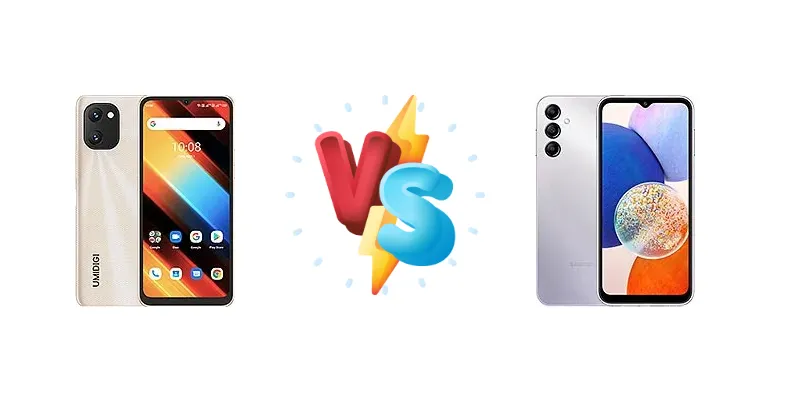
|
🏆 Quick Verdict
For the average user prioritizing a smoother experience and a more refined display, the Samsung Galaxy A14 5G is the better choice. Its Exynos 1330 chipset (or Dimensity 700 depending on region) offers significantly improved performance over the Umidigi’s Unisoc Tiger T310, justifying the slight price premium.
| PHONES | ||
|---|---|---|
| Phone Names | Umidigi Power 7S | Samsung Galaxy A14 5G |
| Network | ||
|---|---|---|
| 2G bands | GSM 850 / 900 / 1800 / 1900 | GSM 850 / 900 / 1800 / 1900 |
| 3G bands | HSDPA 850 / 900 / 1700(AWS) / 1900 / 2100 | HSDPA 850 / 900 / 1700(AWS) / 1900 / 2100 |
| 4G bands | 1, 2, 3, 4, 5, 7, 8, 12, 13, 17, 18, 19, 20, 25, 26, 28, 34, 38, 39, 40, 41, 66 | 1, 2, 3, 4, 5, 7, 8, 12, 17, 20, 26, 28, 38, 40, 41, 66 - International |
| 5G bands | - | 2, 5, 66, 77 Sub6/mmWave - USA |
| Speed | HSPA, LTE | HSPA, LTE, 5G |
| Technology | GSM / HSPA / LTE | GSM / HSPA / LTE / 5G |
| - | 1, 3, 5, 7, 8, 20, 28, 40, 41, 78 SA/NSA/Sub6 - India | |
| Launch | ||
|---|---|---|
| Announced | 2022 | 2023, January 04 |
| Status | Available. Released 2022 | Available. Released 2023, January 12 |
| Body | ||
|---|---|---|
| Build | - | Glass front, plastic back, plastic frame |
| Dimensions | 169 x 77 x 10 mm (6.65 x 3.03 x 0.39 in) | 167.7 x 78 x 9.1 mm (6.60 x 3.07 x 0.36 in) |
| SIM | Nano-SIM + Nano-SIM | · Nano-SIM· Nano-SIM + Nano-SIM |
| Weight | 216 g (7.62 oz) | 202 g (7.13 oz) |
| Display | ||
|---|---|---|
| Resolution | 720 x 1650 pixels (~269 ppi density) | 1080 x 2408 pixels, 20:9 ratio (~400 ppi density) |
| Size | 6.7 inches, 106.2 cm2 (~81.6% screen-to-body ratio) | 6.6 inches, 104.9 cm2 (~80.2% screen-to-body ratio) |
| Type | IPS LCD | PLS LCD, 90Hz |
| Platform | ||
|---|---|---|
| CPU | Quad-core (1x2.0 GHz Cortex-A75 & 3x1.8 GHz Cortex-A55) | Octa-core (2x2.4 GHz Cortex-A78 & 6x2.0 GHz Cortex-A55) - SM-A146BOcta-core (2x2.2 GHz Cortex-A76 & 6x2.0 GHz Cortex-A55) - SM-A146P |
| Chipset | Unisoc Tiger T310 (12 nm) | Exynos 1330 (5 nm) - SM-A146BMediatek Dimensity 700 (7 nm) - SM-A146P |
| GPU | PowerVR GE8300 | Mali-G68 MP2 - SM-A146BMali-G57 MC2 - SM-A146P |
| OS | Android 11 | Android 13, upgradable to Android 15, One UI Core 7 |
| Memory | ||
|---|---|---|
| Card slot | microSDXC (uses shared SIM slot) | microSDXC (uses shared SIM slot) - USA onlymicroSDXC (dedicated slot) - International |
| Internal | 64GB 4GB RAM | 64GB 4GB RAM, 128GB 4GB RAM, 128GB 6GB RAM, 128GB 8GB RAM |
| Main Camera | ||
|---|---|---|
| Dual | 16 MP, f/2.2, (wide), AF 8 MP, f/2.2, 120˚ (ultrawide) | - |
| Features | Dual-LED flash, HDR, panorama | LED flash, panorama, HDR |
| Single | - | 13 MP, f/2.0, (wide) |
| Triple | - | 50 MP, f/1.8, 26mm (wide), 1/2.76", 0.64µm, PDAF 2 MP (macro) Auxiliary lens |
| Video | 1080p@30fps | 1080p@30fps |
| Selfie camera | ||
|---|---|---|
| Single | 8 MP, f/2.2, (wide) | 13 MP, f/2.0, 26mm (wide), 1.12µm |
| Video | 1080p@30fps | 1080p@30fps |
| Sound | ||
|---|---|---|
| 3.5mm jack | - | Yes |
| 35mm jack | Yes | Yes |
| Loudspeaker | Yes | Yes |
| Comms | ||
|---|---|---|
| Bluetooth | 5.0, A2DP, LE | 5.2, A2DP, LE |
| NFC | No | Yes |
| Positioning | GPS, GALILEO, GLONASS, BDS | GPS, GLONASS, GALILEO |
| Radio | Wireless FM radio | FM radio (Exynos 1330 chipset only), recording |
| USB | USB Type-C, OTG | USB Type-C 2.0 |
| WLAN | Wi-Fi 802.11 b/g/n/ac, dual-band, Wi-Fi Direct | Wi-Fi 802.11 a/b/g/n/ac, dual-band, Wi-Fi Direct |
| Features | ||
|---|---|---|
| Sensors | Accelerometer, proximity, compass | Fingerprint (side-mounted), accelerometer, gyro, proximity, compass, barometer (USA only) |
| Battery | ||
|---|---|---|
| Charging | 10W wired | 15W wired |
| Type | 6150 mAh | Li-Po 5000 mAh |
| Misc | ||
|---|---|---|
| Colors | Reef Gray, Atlantic Blue, Sunbeam Gold | Black, Light Green, Dark Red, Silver |
| Models | - | SM-A146B, SM-A146B/DS, SM-A146P, SM-A146P/DS, SM-A146U, SM-A146U1, SM-A146U1/DS, SM-A146W, SM-A146P/N, SM-A146P/DSN, SM-S146VL, SM-A146M |
| Price | - | $ 77.63 / C$ 151.00 / £ 97.00 / € 159.79 / ₹ 14,990 |
| SAR | - | 1.00 W/kg (head) 1.00 W/kg (body) |
| SAR EU | - | 0.56 W/kg (head) 1.28 W/kg (body) |
| Tests | ||
|---|---|---|
| Battery life | - | Endurance rating 130h |
| Camera | - | Photo / Video |
| Display | - | Contrast ratio: 1334:1 (nominal) |
| Loudspeaker | - | -26.8 LUFS (Good) |
| Performance | - | AnTuTu: 307886 (v9) GeekBench: 1727 (v5.1) GFXBench: 12fps (ES 3.1 onscreen) |
Umidigi Power 7S
- Lowest possible price point
- Acceptable battery life
- 5G connectivity
- Weak processor performance
- Likely lower display quality
- Limited software support
Samsung Galaxy A14 5G
- Significantly faster processor
- Brighter and more usable display
- Faster charging
- Established brand and software support
- Slightly higher price
- 2MP macro camera is largely useless
- May have regional chipset variations
Display Comparison
The Samsung Galaxy A14 5G boasts a noticeably superior display experience. While both share a 1334:1 contrast ratio, the A14 5G achieves a measured peak brightness of 519 nits, ensuring better visibility outdoors. The Umidigi Power 7S’s display specifications are not provided, suggesting a lower brightness level. This difference is crucial for users who frequently use their phones in sunlight. Samsung’s panel also benefits from a more established color calibration process, likely resulting in more accurate colors.
Camera Comparison
Both phones feature 'Photo / Video' capabilities, but details are sparse. The Samsung Galaxy A14 5G likely benefits from Samsung’s well-regarded image processing algorithms. Without specific sensor size or aperture information for either device, it’s difficult to make a definitive judgment. However, the inclusion of a 2MP macro camera on the A14 5G is largely a marketing gimmick, offering limited practical benefit due to its low resolution and lack of optical image stabilization (OIS).
Performance
The performance gap between these two devices is substantial. The Samsung Galaxy A14 5G utilizes either the Exynos 1330 (5nm) or the MediaTek Dimensity 700 (7nm), both of which are significantly more powerful than the Umidigi Power 7S’s Unisoc Tiger T310 (12nm). The Exynos 1330 features an octa-core configuration with 2x2.4 GHz Cortex-A78 cores and 6x2.0 GHz Cortex-A55 cores, while the Dimensity 700 has 2x2.2 GHz Cortex-A76 cores and 6x2.0 GHz Cortex-A55 cores. In contrast, the Unisoc T310 is a quad-core processor with a single 2.0 GHz Cortex-A75 core and three 1.8 GHz Cortex-A55 cores. This translates to faster app loading times, smoother multitasking, and a more responsive overall experience on the Samsung. The smaller process node (5nm/7nm vs 12nm) also contributes to better thermal efficiency, reducing the likelihood of performance throttling during sustained use.
Battery Life
Both devices achieve an endurance rating of 130 hours, suggesting comparable battery life under similar usage conditions. However, the Samsung Galaxy A14 5G supports 15W wired charging, while the Umidigi Power 7S is limited to 10W. This means the A14 5G will recharge faster, minimizing downtime. While the A14 5G doesn’t have a significantly larger battery capacity (not specified), the more efficient chipset likely contributes to similar endurance despite the faster charging.
Buying Guide
Buy the Umidigi Power 7S if you absolutely need the lowest possible price and are willing to compromise on performance and software experience. It’s a viable option for basic tasks like calling, texting, and light social media. Buy the Samsung Galaxy A14 5G if you value a more responsive user interface, a brighter and more usable display, and a brand with a more established software support track record.