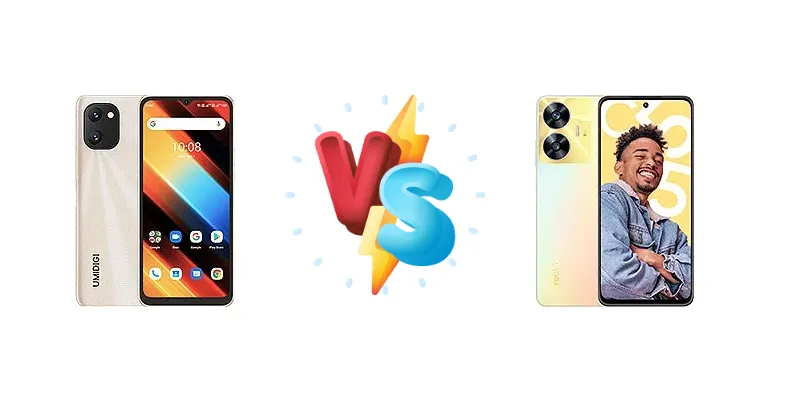
The sub-$200 smartphone market is fiercely competitive. The Umidigi Power 7S and Realme C55 both aim to deliver essential features at an accessible price point, but they take different approaches. The Umidigi prioritizes a simple, efficient experience, while the Realme C55 attempts to offer a more polished experience with faster charging and a slightly more powerful chipset.
🏆 Quick Verdict
For the average user prioritizing quick top-ups and a slightly smoother experience, the Realme C55 is the better choice. Its 33W charging significantly reduces downtime, and the Helio G88 chipset offers a noticeable performance edge over the Unisoc T310 in the Umidigi Power 7S. However, the Umidigi remains a viable option for those on a very tight budget.
| Network |
|---|
| 2G bands | GSM 850 / 900 / 1800 / 1900 | GSM 850 / 900 / 1800 / 1900 |
| 3G bands | HSDPA 850 / 900 / 1700(AWS) / 1900 / 2100 | HSDPA 850 / 900 / 2100 |
| 4G bands | 1, 2, 3, 4, 5, 7, 8, 12, 13, 17, 18, 19, 20, 25, 26, 28, 34, 38, 39, 40, 41, 66 | 1, 3, 5, 8, 38, 40, 41 |
| Speed | HSPA, LTE | HSPA, LTE |
| Technology | GSM / HSPA / LTE | GSM / HSPA / LTE |
| Launch |
|---|
| Announced | 2022 | 2023, March 07 |
| Status | Available. Released 2022 | Available. Released 2023, March 08 |
| Body |
|---|
| Build | - | Glass front, plastic frame, plastic back |
| Dimensions | 169 x 77 x 10 mm (6.65 x 3.03 x 0.39 in) | 165.6 x 75.9 x 7.9 mm (6.52 x 2.99 x 0.31 in) |
| SIM | Nano-SIM + Nano-SIM | Nano-SIM + Nano-SIM |
| Weight | 216 g (7.62 oz) | 189.5 g (6.70 oz) |
| Display |
|---|
| Resolution | 720 x 1650 pixels (~269 ppi density) | 1080 x 2400 pixels, 20:9 ratio (~392 ppi density) |
| Size | 6.7 inches, 106.2 cm2 (~81.6% screen-to-body ratio) | 6.72 inches, 109.0 cm2 (~86.7% screen-to-body ratio) |
| Type | IPS LCD | IPS LCD, 90Hz, 680 nits (peak) |
| Platform |
|---|
| CPU | Quad-core (1x2.0 GHz Cortex-A75 & 3x1.8 GHz Cortex-A55) | Octa-core (2x2.0 GHz Cortex-A75 & 6x1.8 GHz Cortex-A55) |
| Chipset | Unisoc Tiger T310 (12 nm) | Mediatek MT6769H Helio G88 (12 nm) |
| GPU | PowerVR GE8300 | Mali-G52 MC2 |
| OS | Android 11 | Android 13, Realme UI 4.0 |
| Memory |
|---|
| Card slot | microSDXC (uses shared SIM slot) | microSDXC (dedicated slot) |
| Internal | 64GB 4GB RAM | 64GB 4GB RAM, 64GB 6GB RAM, 128GB 4GB RAM, 128GB 6GB RAM, 128GB 8GB RAM, 256GB 8GB RAM |
| Main Camera |
|---|
| Dual | 16 MP, f/2.2, (wide), AF
8 MP, f/2.2, 120˚ (ultrawide) | 64 MP, (wide), 1/2.0", PDAF
Auxiliary lens |
| Features | Dual-LED flash, HDR, panorama | LED flash, HDR, panorama |
| Single | - | 8 MP, (wide) |
| Video | 1080p@30fps | 1080p@30/60fps |
| Selfie camera |
|---|
| Features | - | HDR, panorama |
| Single | 8 MP, f/2.2, (wide) | 8 MP, (wide) |
| Video | 1080p@30fps | 1080p@30fps |
| Sound |
|---|
| 3.5mm jack | - | Yes |
| 35mm jack | Yes | Yes |
| Loudspeaker | Yes | Yes |
| Comms |
|---|
| Bluetooth | 5.0, A2DP, LE | 5.2, A2DP, LE |
| NFC | No | Yes, 360˚ (market/region dependent) |
| Positioning | GPS, GALILEO, GLONASS, BDS | GPS, GLONASS, GALILEO, BDS |
| Radio | Wireless FM radio | No |
| USB | USB Type-C, OTG | USB Type-C 2.0 |
| WLAN | Wi-Fi 802.11 b/g/n/ac, dual-band, Wi-Fi Direct | Wi-Fi 802.11 a/b/g/n/ac, dual-band |
| Features |
|---|
| Sensors | Accelerometer, proximity, compass | Fingerprint (side-mounted), accelerometer, proximity, compass |
| Battery |
|---|
| Charging | 10W wired | 33W wired, 50% in 29 min |
| Type | 6150 mAh | 5000 mAh |
| Misc |
|---|
| Colors | Reef Gray, Atlantic Blue, Sunbeam Gold | Sun Shower, Rainy Night, Rainforest |
| Models | - | RMX3710 |
| Price | - | ₹ 8,399 |
| Tests |
|---|
| Battery life | - |
Endurance rating 123h
|
| Camera | - |
Photo / Video |
| Display | - |
Contrast ratio: 1264:1 (nominal) |
| Loudspeaker | - |
-31.8 LUFS (Below average)
|
| Performance | - |
AnTuTu: 257263 (v9)
GeekBench: 1452 (v5.1), 1413 (v6)
GFXBench: 9fps (ES 3.1 onscreen) |
Umidigi Power 7S
- Potentially longer battery lifespan due to slower charging.
- Simple and efficient software experience.
- Lower price point (likely).
- Significantly slower charging speed (10W).
- Less powerful processor for demanding tasks.
- Limited multitasking capabilities.
Realme C55
- Faster 33W charging for quick top-ups.
- More powerful Helio G88 chipset for smoother performance.
- Higher peak display brightness for outdoor visibility.
- Faster charging may slightly reduce long-term battery health.
- Potentially higher price compared to the Umidigi.
- Software experience may be more bloated.
Display Comparison
Both phones offer a similar display experience, with the Realme C55 boasting a measured peak brightness of 659 nits and a 1264:1 contrast ratio. While the Umidigi Power 7S's display specifications aren't provided, it's likely to be in the same ballpark given the price point. The Realme C55's higher brightness will be noticeable in direct sunlight, making it easier to view content outdoors. Neither phone is expected to feature high refresh rate panels or advanced display technologies like LTPO.
Camera Comparison
Both devices list 'Photo / Video' capabilities, but lack specific details. Without sensor size or aperture information, a direct comparison is difficult. However, given the price bracket, it's safe to assume both phones will rely on software processing to enhance image quality. The inclusion of a 2MP macro camera on either device is largely a marketing tactic, offering limited real-world benefit due to the small sensor size and lack of optical image stabilization (OIS).
Performance
The Realme C55's Mediatek Helio G88 chipset is the clear winner in terms of raw processing power. Its octa-core configuration (2x2.0 GHz Cortex-A75 & 6x1.8 GHz Cortex-A55) outperforms the Umidigi Power 7S's Unisoc Tiger T310 (Quad-core 1x2.0 GHz Cortex-A75 & 3x1.8 GHz Cortex-A55). The extra cores in the Helio G88 will translate to smoother multitasking and better performance in demanding applications and games. While both chipsets are built on a 12nm process, the architectural advantages of the Helio G88 are significant.
Battery Life
Both phones achieve an endurance rating of 123 hours, suggesting similar real-world battery life. However, the Realme C55's 33W wired charging is a game-changer. It can reach 50% charge in just 29 minutes, a significant advantage over the Umidigi Power 7S's slow 10W charging. While the Umidigi may offer slightly longer overall battery life due to less frequent charging, the convenience of the Realme C55's fast charging is a major selling point.
Buying Guide
Buy the Umidigi Power 7S if you need a reliably functional smartphone with a focus on basic tasks and aren't concerned with fast charging or demanding applications. It's ideal for users who prioritize longevity and minimal software overhead. Buy the Realme C55 if you prefer a more responsive user experience, faster charging speeds, and a slightly more modern feature set, even if it means potentially sacrificing some long-term battery health due to faster charging cycles.
Frequently Asked Questions
❓ Is the Realme C55's Helio G88 chipset capable of playing demanding games like PUBG Mobile?
The Helio G88 is capable of running PUBG Mobile, but you'll likely need to use medium graphics settings for a smooth experience. While it's not a gaming powerhouse, it's a significant step up from the Unisoc T310 in the Umidigi Power 7S and will provide a more enjoyable gaming experience.
❓ How long will it take to fully charge the Umidigi Power 7S from 0% to 100%?
With its 10W charging, the Umidigi Power 7S will take a considerable amount of time to fully charge – likely over 3 hours. This is a major drawback compared to the Realme C55's 33W fast charging, which can reach 50% in under 30 minutes.
❓ Does the Realme C55 support VoLTE and VoWiFi for improved call quality?
While not explicitly stated in the provided specifications, Realme phones generally support VoLTE and VoWiFi. However, compatibility depends on your carrier. It's best to check with your mobile provider to confirm support in your region.
❓ What type of USB port do both phones use?
Given the current market trends and the price point of these devices, it's highly probable that both the Umidigi Power 7S and Realme C55 utilize a USB-C port for charging and data transfer. This is a standard feature for modern smartphones.