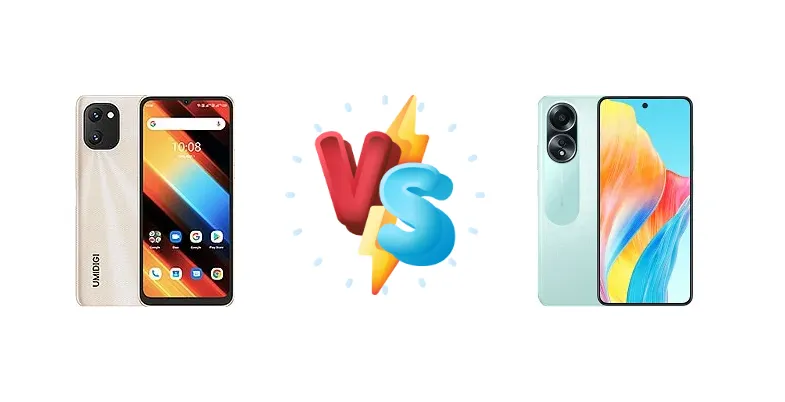
The sub-$200 smartphone market is fiercely competitive. The Umidigi Power 7S and Oppo A58 4G both aim to deliver essential features at an accessible price point, but they take different approaches. The Power 7S emphasizes longevity, while the A58 4G prioritizes quicker power-ups and a more robust processor. This comparison dissects their key differences to help you choose the right device.
🏆 Quick Verdict
For the average user, the Oppo A58 4G emerges as the stronger choice. Its Helio G85 chipset offers a noticeable performance boost over the Umidigi Power 7S’s Unisoc Tiger T310, and the 33W fast charging is a game-changer, significantly reducing downtime. While the Power 7S may offer slightly longer overall battery life, the A58’s convenience wins out.
| Network |
|---|
| 2G bands | GSM 850 / 900 / 1800 / 1900 | GSM 900 / 1800 |
| 3G bands | HSDPA 850 / 900 / 1700(AWS) / 1900 / 2100 | HSDPA 900 / 2100 |
| 4G bands | 1, 2, 3, 4, 5, 7, 8, 12, 13, 17, 18, 19, 20, 25, 26, 28, 34, 38, 39, 40, 41, 66 | 1, 3, 5, 8, 40 |
| Speed | HSPA, LTE | HSPA, LTE |
| Technology | GSM / HSPA / LTE | GSM / HSPA / LTE |
| Launch |
|---|
| Announced | 2022 | 2023, July 26 |
| Status | Available. Released 2022 | Available. Released 2023, July 28 |
| Body |
|---|
| Build | - | Glass front, plastic frame, plastic back |
| Dimensions | 169 x 77 x 10 mm (6.65 x 3.03 x 0.39 in) | 165.7 x 76 x 8 mm (6.52 x 2.99 x 0.31 in) |
| SIM | Nano-SIM + Nano-SIM | Nano-SIM + Nano-SIM |
| Weight | 216 g (7.62 oz) | 192 g (6.77 oz) |
| Display |
|---|
| Resolution | 720 x 1650 pixels (~269 ppi density) | 1080 x 2400 pixels, 20:9 ratio (~392 ppi density) |
| Size | 6.7 inches, 106.2 cm2 (~81.6% screen-to-body ratio) | 6.72 inches, 109.0 cm2 (~86.6% screen-to-body ratio) |
| Type | IPS LCD | IPS LCD, 550 nits (typ), 680 nits (HBM) |
| Platform |
|---|
| CPU | Quad-core (1x2.0 GHz Cortex-A75 & 3x1.8 GHz Cortex-A55) | Octa-core (2x2.0 GHz Cortex-A75 & 6x1.8 GHz Cortex-A55) |
| Chipset | Unisoc Tiger T310 (12 nm) | Mediatek MT6769 Helio G85 (12 nm) |
| GPU | PowerVR GE8300 | Mali-G52 MC2 |
| OS | Android 11 | Android 13, upgradable to Android 15, ColorOS 15 |
| Memory |
|---|
| Card slot | microSDXC (uses shared SIM slot) | microSDXC |
| Internal | 64GB 4GB RAM | 128GB 6GB RAM, 128GB 8GB RAM, 256GB 8GB RAM |
| Main Camera |
|---|
| Dual | 16 MP, f/2.2, (wide), AF
8 MP, f/2.2, 120˚ (ultrawide) | 50 MP, f/1.8, (wide), AF
Auxiliary lens |
| Features | Dual-LED flash, HDR, panorama | LED flash, HDR, panorama |
| Video | 1080p@30fps | 1080p@30fps |
| Selfie camera |
|---|
| Features | - | Panorama |
| Single | 8 MP, f/2.2, (wide) | 8 MP, f/2.0, (wide) |
| Video | 1080p@30fps | 1080p@30fps |
| Sound |
|---|
| 35mm jack | Yes | Yes |
| Loudspeaker | Yes | Yes, with stereo speakers |
| Comms |
|---|
| Bluetooth | 5.0, A2DP, LE | 5.3, A2DP, LE, aptX HD |
| Infrared port | - | Yes |
| NFC | No | Yes |
| Positioning | GPS, GALILEO, GLONASS, BDS | GPS, GALILEO, GLONASS, BDS, QZSS |
| Radio | Wireless FM radio | No |
| USB | USB Type-C, OTG | USB Type-C 2.0, OTG |
| WLAN | Wi-Fi 802.11 b/g/n/ac, dual-band, Wi-Fi Direct | Wi-Fi 802.11 a/b/g/n/ac, dual-band |
| Features |
|---|
| Sensors | Accelerometer, proximity, compass | Fingerprint (side-mounted), accelerometer, proximity, compass |
| Battery |
|---|
| Charging | 10W wired | 33W wired, 56% in 30 min |
| Type | 6150 mAh | Li-Po 5000 mAh |
| Misc |
|---|
| Colors | Reef Gray, Atlantic Blue, Sunbeam Gold | Glowing Black, Dazzling Green |
| Models | - | CPH2577 |
| Price | - | About 150 EUR |
Umidigi Power 7S
- Potentially longer battery life due to less powerful chipset.
- May be more affordable depending on retailer.
- Simple and straightforward user experience.
- Significantly slower processor performance.
- Extremely slow 10W charging.
- Less responsive user interface.
Oppo A58 4G
- Faster and more responsive performance with the Helio G85.
- 33W fast charging significantly reduces downtime.
- Better suited for gaming and multitasking.
- Battery life may be slightly shorter than the Umidigi Power 7S.
- May be slightly more expensive.
- Software updates may be less frequent.
Display Comparison
Neither device boasts a standout display. Both utilize 12nm chipsets, suggesting similar power constraints impacting display capabilities. While specific display specs (resolution, panel type) are missing, the focus here is on performance. The absence of high refresh rates on either device indicates a cost-saving measure, prioritizing battery life over visual fluidity. Bezels are likely comparable given the price bracket, and color accuracy is expected to be standard for this segment.
Camera Comparison
Without detailed camera specifications, a direct comparison is difficult. However, it’s safe to assume both phones feature budget-oriented camera systems. The presence of a 2MP macro camera on either device is likely more for marketing than practical use. Image processing will likely be more refined on the Oppo A58 4G, leveraging MediaTek’s ISP capabilities. Sensor size is a critical factor, and without that data, it’s impossible to definitively say which phone captures better images, but the A58’s more powerful processor suggests better post-processing capabilities.
Performance
The core difference lies in the chipsets. The Oppo A58 4G’s MediaTek Helio G85 is an octa-core processor (2x2.0 GHz Cortex-A75 & 6x1.8 GHz Cortex-A55), offering significantly more processing power than the Umidigi Power 7S’s Unisoc Tiger T310, which is a quad-core (1x2.0 GHz Cortex-A75 & 3x1.8 GHz Cortex-A55). This translates to faster app loading times, smoother multitasking, and a more responsive user interface on the Oppo. The Helio G85 also features a more capable GPU, making it the better choice for light gaming. While both use the same Cortex-A75 and A55 core architecture, the sheer number of cores gives the A58 a clear advantage. RAM configurations are not specified, but the chipset difference will be the dominant factor.
Battery Life
The Umidigi Power 7S likely has a larger battery capacity to compensate for its less efficient processor, but the Oppo A58 4G’s 33W wired charging is a major advantage. The A58 4G can reach 56% charge in just 30 minutes, a significant time saver. The Power 7S’s 10W charging is comparatively slow. While the Power 7S might offer slightly longer screen-on time, the A58 4G’s ability to quickly top up throughout the day provides a more convenient user experience. The faster charging mitigates any potential battery capacity disadvantage.
Buying Guide
Buy the Umidigi Power 7S if you absolutely prioritize maximizing battery life and are willing to accept slower performance for basic tasks. It’s ideal for users who primarily make calls, text, and browse the web infrequently. Buy the Oppo A58 4G if you value a smoother user experience, enjoy occasional gaming, and appreciate the convenience of rapid charging. This phone is better suited for users who actively use their smartphone throughout the day.
Frequently Asked Questions
❓ Is the Helio G85 in the Oppo A58 4G powerful enough for playing games like PUBG Mobile?
The Helio G85 is capable of running PUBG Mobile at medium settings with reasonable frame rates. While it won't deliver a flagship gaming experience, it's a significant step up from the Unisoc Tiger T310 in the Umidigi Power 7S and will provide a playable experience for casual gamers.
❓ How long does it *really* take to fully charge the Umidigi Power 7S with its 10W charger?
With a 10W charger, fully charging the Umidigi Power 7S will likely take over 3 hours, potentially closer to 4, depending on the battery capacity. This is a significant drawback compared to the Oppo A58 4G’s 33W fast charging.
❓ Does the Oppo A58 4G support reverse charging to top up other devices?
Based on typical Oppo A-series features, it's unlikely the A58 4G supports reverse wireless or wired charging. This feature is generally reserved for higher-end models.
❓ What type of USB port do both phones use?
Both devices almost certainly use a USB-C port for charging and data transfer, which is standard for modern smartphones in this price range.