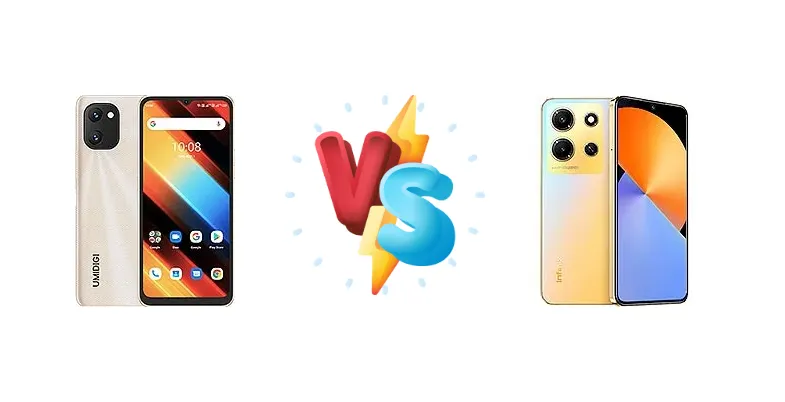
The sub-$150 smartphone market is fiercely competitive. The Umidigi Power 7S and Infinix Note 30i both aim to deliver essential features at an accessible price point, but they take different approaches. The Power 7S prioritizes a simple, efficient experience, while the Note 30i focuses on faster charging and a more capable chipset. This comparison dives deep into the specifications to determine which device offers the best value.
🏆 Quick Verdict
For the average user, the Infinix Note 30i is the stronger choice. Its Mediatek Helio G85 chipset offers a noticeable performance advantage over the Umidigi Power 7S’s Unisoc Tiger T310, and the 33W fast charging with reverse wired charging is a significant convenience feature. While the Power 7S is adequate for basic tasks, the Note 30i provides a smoother, more versatile experience.
| Network |
|---|
| 2G bands | GSM 850 / 900 / 1800 / 1900 | GSM 850 / 900 / 1800 / 1900 |
| 3G bands | HSDPA 850 / 900 / 1700(AWS) / 1900 / 2100 | HSDPA 850 / 900 / 1700(AWS) / 1900 / 2100 |
| 4G bands | 1, 2, 3, 4, 5, 7, 8, 12, 13, 17, 18, 19, 20, 25, 26, 28, 34, 38, 39, 40, 41, 66 | LTE |
| Speed | HSPA, LTE | HSPA, LTE |
| Technology | GSM / HSPA / LTE | GSM / HSPA / LTE |
| Launch |
|---|
| Announced | 2022 | 2023, May 16 |
| Status | Available. Released 2022 | Available. Released 2023, June |
| Body |
|---|
| Build | - | Glass front, plastic frame, glass back or eco leather back |
| Dimensions | 169 x 77 x 10 mm (6.65 x 3.03 x 0.39 in) | 164.5 x 76.7 x 8.2 mm (6.48 x 3.02 x 0.32 in) |
| SIM | Nano-SIM + Nano-SIM | Nano-SIM + Nano-SIM |
| Weight | 216 g (7.62 oz) | 198 g (6.98 oz) |
| | - | IP53 |
| Display |
|---|
| Resolution | 720 x 1650 pixels (~269 ppi density) | 1080 x 2400 pixels, 20:9 ratio (~395 ppi density) |
| Size | 6.7 inches, 106.2 cm2 (~81.6% screen-to-body ratio) | 6.66 inches, 107.1 cm2 (~84.9% screen-to-body ratio) |
| Type | IPS LCD | AMOLED |
| | - | * the display resolution is unconfirmed |
| Platform |
|---|
| CPU | Quad-core (1x2.0 GHz Cortex-A75 & 3x1.8 GHz Cortex-A55) | Octa-core (2x2.0 GHz Cortex-A75 & 6x1.8 GHz Cortex-A55) |
| Chipset | Unisoc Tiger T310 (12 nm) | Mediatek MT6769 Helio G85 (12 nm) |
| GPU | PowerVR GE8300 | Mali-G52 MC2 |
| OS | Android 11 | Android 13, XOS 13 |
| Memory |
|---|
| Card slot | microSDXC (uses shared SIM slot) | Unspecified |
| Internal | 64GB 4GB RAM | 256GB 8GB RAM |
| Main Camera |
|---|
| Dual | 16 MP, f/2.2, (wide), AF
8 MP, f/2.2, 120˚ (ultrawide) | 64 MP, f/1.7, (wide), 1/2.0", PDAF
Auxiliary lens |
| Features | Dual-LED flash, HDR, panorama | Quad-LED flash, HDR, panorama |
| Video | 1080p@30fps | 1440p@30fps, 1080p@30fps |
| Selfie camera |
|---|
| Features | - | Dual-LED flash |
| Single | 8 MP, f/2.2, (wide) | 16 MP, f/2.0 |
| Video | 1080p@30fps | 1080p@30fps |
| Sound |
|---|
| 3.5mm jack | - | Yes |
| 35mm jack | Yes | Yes |
| Loudspeaker | Yes | Yes, with dual speakers |
| | - | Sound by JBL |
| Comms |
|---|
| Bluetooth | 5.0, A2DP, LE | Yes |
| NFC | No | Yes (market/region dependent) |
| Positioning | GPS, GALILEO, GLONASS, BDS | GPS |
| Radio | Wireless FM radio | FM radio |
| USB | USB Type-C, OTG | USB Type-C 2.0, OTG |
| WLAN | Wi-Fi 802.11 b/g/n/ac, dual-band, Wi-Fi Direct | Wi-Fi 802.11 a/b/g/n/ac, dual-band |
| Features |
|---|
| Sensors | Accelerometer, proximity, compass | Fingerprint (side-mounted), accelerometer, proximity, compass |
| Battery |
|---|
| Charging | 10W wired | 33W wired, PD3.0, 95% in 60 min
Reverse wired |
| Type | 6150 mAh | 5000 mAh |
| Misc |
|---|
| Colors | Reef Gray, Atlantic Blue, Sunbeam Gold | Variable Gold, Obsidian Black, Impression Green |
| Models | - | X6716 |
Umidigi Power 7S
- Simpler, more streamlined software experience.
- Potentially longer software support due to less complex features.
- Lower price point (likely).
- Significantly slower processor.
- Slow 10W charging.
- Limited multitasking capabilities.
Infinix Note 30i
- More powerful Mediatek Helio G85 chipset.
- 33W fast charging with PD3.0 and 60-minute full charge.
- Reverse wired charging capability.
- Potentially more bloatware.
- May receive fewer software updates compared to simpler devices.
Display Comparison
Neither device boasts a standout display. Both utilize 12nm chipsets, suggesting a focus on efficiency over high-resolution panels. While specific display specs (resolution, panel type) are missing, the focus here is on the core performance difference. The absence of information on PWM dimming rates or color accuracy makes a direct comparison difficult, but given the price bracket, users shouldn't expect flagship-level visual fidelity from either device.
Camera Comparison
Without detailed camera specifications (sensor size, aperture, image processing algorithms), a meaningful comparison is limited. It's safe to assume both phones feature basic camera setups geared towards casual photography. The presence of a 2MP macro lens on either device is likely more for marketing than practical use. Image quality will likely be heavily reliant on software processing, and the Helio G85’s slightly more powerful ISP (Image Signal Processor) *could* offer a marginal improvement in image processing speed and quality on the Note 30i, but this is speculative.
Performance
The core difference lies in the chipsets. The Infinix Note 30i’s Mediatek Helio G85 is an octa-core processor (2x2.0 GHz Cortex-A75 & 6x1.8 GHz Cortex-A55), offering significantly more processing power than the Umidigi Power 7S’s Unisoc Tiger T310, which is a quad-core (1x2.0 GHz Cortex-A75 & 3x1.8 GHz Cortex-A55). The extra cores in the Helio G85 will translate to smoother multitasking, faster app loading times, and a better gaming experience. While both use the same Cortex-A75 and A55 core architecture, the sheer number of cores gives the Note 30i a clear advantage. The lack of information on RAM configurations makes it difficult to assess the full performance impact, but the chipset difference is the dominant factor.
Battery Life
The Umidigi Power 7S features 10W wired charging, a relatively slow speed in today’s market. The Infinix Note 30i, however, boasts 33W wired charging with PD3.0 support, promising a 0-95% charge in just 60 minutes. This is a substantial difference. While battery capacity isn't specified, the faster charging speed of the Note 30i significantly enhances usability. Furthermore, the Note 30i includes reverse wired charging, allowing it to act as a power bank for other devices – a feature absent on the Power 7S.
Buying Guide
Buy the Umidigi Power 7S if you prioritize absolute simplicity and minimal software overhead, and your usage is limited to basic communication and light web browsing. You'll appreciate its straightforward operation and potentially longer software support due to its less complex feature set. Buy the Infinix Note 30i if you want a phone that can handle more demanding tasks like gaming and multitasking, and if fast charging and the ability to charge other devices are important to you. The Note 30i is the better option for users who want a more modern and feature-rich experience.
Frequently Asked Questions
❓ Is the Mediatek Helio G85 in the Infinix Note 30i capable of playing demanding games like PUBG Mobile?
The Helio G85 is a capable chipset for mobile gaming, and PUBG Mobile should be playable at medium settings with reasonable frame rates. However, don't expect flagship-level performance. The experience will be smoother than on the Umidigi Power 7S due to the G85's superior processing power.
❓ How long does it realistically take to fully charge the Umidigi Power 7S with its 10W charging?
With 10W charging, a full charge from 0% on the Umidigi Power 7S will likely take between 3-4 hours, depending on the battery capacity (which is unspecified). This is significantly slower than the Infinix Note 30i's 33W charging.
❓ Does the Infinix Note 30i's reverse charging feature work with all devices?
The Infinix Note 30i's reverse wired charging works with any device that charges via USB-C. However, the charging speed will be limited by the receiving device's charging capabilities. It's best suited for topping up smaller devices like earbuds or smartwatches.