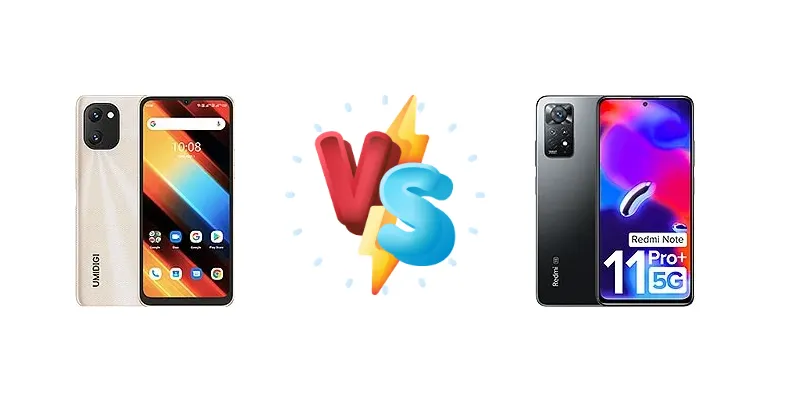
The sub-$300 smartphone market is fiercely competitive. The Umidigi Power 7 aims to deliver long-lasting battery life and essential features at an incredibly low price point. Conversely, the Xiaomi Redmi Note 11 Pro+ 5G (India) prioritizes faster performance and significantly quicker charging, albeit at a slightly higher cost. This comparison dissects the core differences to help you choose the right phone for your needs.
🏆 Quick Verdict
For the average user prioritizing speed and convenience, the Xiaomi Redmi Note 11 Pro+ 5G is the clear winner. Its Snapdragon 695 chipset and 67W charging drastically outperform the Umidigi Power 7’s Unisoc T610 and 10W charging. However, the Power 7 remains a viable option for those on an extremely tight budget who value battery longevity above all else.
| Network |
|---|
| 2G bands | GSM 850 / 900 / 1800 / 1900 | GSM 850 / 900 / 1800 / 1900 - SIM 1 & SIM 2 |
| 3G bands | HSDPA 850 / 900 / 1700(AWS) / 1900 / 2100 | HSDPA 850 / 900 / 1900 / 2100 |
| 4G bands | 1, 2, 3, 4, 5, 7, 8, 12, 13, 17, 18, 19, 20, 25, 26, 28, 34, 38, 39, 40, 41, 66 | 1, 3, 5, 8, 40, 41 |
| 5G bands | - | 1, 3, 5, 8, 28, 40, 78 SA/NSA |
| Speed | HSPA, LTE | HSPA, LTE-A (CA), 5G |
| Technology | GSM / HSPA / LTE | GSM / HSPA / LTE / 5G |
| Launch |
|---|
| Announced | 2022 | 2022, March 09 |
| Status | Available. Released 2022 | Available. Released 2022, March 15 |
| Body |
|---|
| Build | - | Glass front (Gorilla Glass 5), glass back |
| Dimensions | 169 x 77 x 10 mm (6.65 x 3.03 x 0.39 in) | 164.2 x 76.1 x 8.1 mm (6.46 x 3.00 x 0.32 in) |
| SIM | Nano-SIM + Nano-SIM | Hybrid Dual SIM (Nano-SIM, dual stand-by) |
| Weight | 216 g (7.62 oz) | 202 g (7.13 oz) |
| | - | IP53, dust and splash resistant |
| Display |
|---|
| Protection | - | Corning Gorilla Glass 5 |
| Resolution | 720 x 1650 pixels (~269 ppi density) | 1080 x 2400 pixels, 20:9 ratio (~395 ppi density) |
| Size | 6.7 inches, 106.2 cm2 (~81.6% screen-to-body ratio) | 6.67 inches, 107.4 cm2 (~86.0% screen-to-body ratio) |
| Type | IPS LCD | Super AMOLED, 120Hz, 700 nits, 1200 nits (peak) |
| Platform |
|---|
| CPU | Octa-core (2x1.8 GHz Cortex-A75 & 6x1.8 GHz Cortex-A55) | Octa-core (2x2.2 GHz Kryo 660 Gold & 6x1.7 GHz Kryo 660 Silver) |
| Chipset | Unisoc T610 (12 nm) | Qualcomm SM6375 Snapdragon 695 5G (6 nm) |
| GPU | Mali-G52 MP2 | Adreno 619 |
| OS | Android 11 | Android 11, MIUI 13 |
| Memory |
|---|
| Card slot | microSDXC (uses shared SIM slot) | microSDXC (uses shared SIM slot) |
| Internal | 128GB 4GB RAM | 64GB 6GB RAM, 128GB 6GB RAM, 128GB 8GB RAM, 256GB 8GB RAM |
| | - | UFS 2.2 |
| Main Camera |
|---|
| Features | Dual-LED flash, HDR, panorama | LED flash, HDR, panorama |
| Triple | 20 MP, f/1.8, (wide), AF
8 MP, f/2.2, 120˚ (ultrawide)
5 MP (macro) | 108 MP, f/1.9, 26mm (wide), 1/1.52", 0.7µm, PDAF
8 MP, f/2.2, 118˚ (ultrawide)
2 MP, f/2.4, (macro) |
| Video | 1080p@30fps | 1080p@30fps |
| Selfie camera |
|---|
| Single | 8 MP, f/2.2, (wide) | 16 MP, f/2.5, (wide), 1/3.06" 1.0µm |
| Video | 1080p@30fps | 1080p@30fps |
| Sound |
|---|
| 3.5mm jack | - | Yes |
| 35mm jack | Yes | - |
| Loudspeaker | Yes | Yes, with stereo speakers |
| | - | 24-bit/192kHz audio |
| Comms |
|---|
| Bluetooth | 5.0, A2DP, LE | 5.1, A2DP, LE |
| Infrared port | - | Yes |
| NFC | No | No |
| Positioning | GPS, GALILEO, GLONASS, BDS | GPS, GLONASS, BDS, GALILEO |
| Radio | Wireless FM radio | Unspecified |
| USB | USB Type-C, OTG | USB Type-C 2.0, OTG |
| WLAN | Wi-Fi 802.11 b/g/n/ac, dual-band, Wi-Fi Direct | Wi-Fi 802.11 a/b/g/n/ac, dual-band, Wi-Fi Direct |
| Features |
|---|
| Sensors | Fingerprint (side-mounted), accelerometer, proximity, compass | Fingerprint (side-mounted), accelerometer, gyro, proximity, compass |
| Battery |
|---|
| Charging | 10W wired | 67W wired, PD3.0, QC3, 50% in 15 min, 100% in 42 min (advertised) |
| Type | 6150 mAh | Li-Po 5000 mAh, non-removable |
| Misc |
|---|
| Colors | Reef Gray, Atlantic Blue, Sunbeam Gold | Mirage Blue, Phantom White, Stealth Black |
| Models | - | 2201116SI |
| Price | - | About 250 EUR |
Umidigi Power 7
- Potentially longer battery life due to less powerful chipset.
- Significantly lower price point.
- May be more durable due to simpler construction.
- Slow 10W charging.
- Substantially weaker performance.
- Likely inferior camera quality.
Xiaomi Redmi Note 11 Pro+ 5G (India)
- 67W fast charging (0-100% in 42 mins).
- Faster and more efficient Snapdragon 695 chipset.
- Likely superior camera system.
- 5G connectivity.
- Higher price than the Umidigi Power 7.
- Potentially shorter battery life compared to the Power 7.
Display Comparison
Neither device boasts a flagship-level display. While specific display specs (resolution, refresh rate) are missing for the Umidigi Power 7, its price point suggests a basic LCD panel. The Redmi Note 11 Pro+ 5G, while not confirmed, likely features an AMOLED panel common in the Redmi Note series, offering superior contrast and color vibrancy. The key differentiator, however, is charging speed, not display quality. Both will likely suffice for everyday use, but the Redmi Note 11 Pro+ 5G will offer a more visually pleasing experience.
Camera Comparison
Without detailed camera specifications for the Umidigi Power 7, a direct comparison is limited. However, the Redmi Note 11 Pro+ 5G is expected to feature a more sophisticated camera system, potentially including a higher-resolution main sensor and optical image stabilization (OIS). While megapixel counts aren't everything, a larger sensor generally captures more light, resulting in better low-light performance. The Redmi Note 11 Pro+ 5G’s image processing capabilities, powered by the Snapdragon 695’s ISP, will likely be more advanced, offering better dynamic range and detail. We can assume the Umidigi Power 7 will have a more basic camera setup geared towards casual snapshots.
Performance
The performance gap is significant. The Xiaomi Redmi Note 11 Pro+ 5G’s Qualcomm Snapdragon 695 (6nm) is built on a more advanced manufacturing process than the Umidigi Power 7’s Unisoc T610 (12nm). This translates to better power efficiency and higher sustained performance. The Snapdragon 695’s Kryo 660 Gold cores, clocked at 2.2 GHz, offer a substantial CPU performance advantage over the Unisoc T610’s Cortex-A75 cores at 1.8 GHz. For gaming and demanding applications, the Redmi Note 11 Pro+ 5G will provide a noticeably smoother experience. The 6nm process also implies better thermal management, reducing the likelihood of throttling during extended use.
Battery Life
The Umidigi Power 7 likely prioritizes battery capacity to compensate for its less efficient chipset. However, the Xiaomi Redmi Note 11 Pro+ 5G’s 67W charging is a game-changer. While the exact battery capacity of both devices is unknown, the Redmi Note 11 Pro+ 5G can reportedly charge from 0-100% in just 42 minutes. The Umidigi Power 7’s 10W charging is comparatively slow, requiring several hours for a full charge. This difference in charging speed significantly impacts usability, allowing the Redmi Note 11 Pro+ 5G to quickly top up its battery when needed, even if its overall battery life isn’t dramatically longer.
Buying Guide
Buy the Umidigi Power 7 if you need a phone that can reliably last through multiple days on a single charge and your usage primarily consists of basic tasks like calls, texts, and light social media. Buy the Xiaomi Redmi Note 11 Pro+ 5G (India) if you prefer a smoother, more responsive experience for gaming, streaming, and multitasking, and if you value the convenience of incredibly fast charging to minimize downtime.
Frequently Asked Questions
❓ Is the Snapdragon 695 in the Redmi Note 11 Pro+ 5G capable of handling demanding games like PUBG Mobile?
Yes, the Snapdragon 695 is capable of running PUBG Mobile at medium to high settings with reasonable frame rates. While it's not a flagship gaming chip, it provides a significantly better gaming experience than the Unisoc T610 in the Umidigi Power 7, offering smoother gameplay and reduced lag.
❓ How much faster is the 67W charging on the Redmi Note 11 Pro+ 5G compared to the 10W charging on the Umidigi Power 7 in real-world use?
The difference is substantial. The Redmi Note 11 Pro+ 5G can gain several hours of usage from a 15-minute charge, while the Umidigi Power 7 will barely see a noticeable increase in battery percentage during the same timeframe. The Redmi Note 11 Pro+ 5G’s 67W charging is ideal for users who frequently need to quickly top up their battery.
❓ Will the Unisoc T610 in the Umidigi Power 7 struggle with multitasking or running multiple apps simultaneously?
Yes, the Unisoc T610 is a relatively low-end chipset and may exhibit noticeable lag when multitasking or running several apps concurrently. Switching between apps will be slower, and demanding apps may take longer to load compared to the Redmi Note 11 Pro+ 5G.