
Umidigi Power 7 vs Samsung Galaxy A53 5G: A Detailed Comparison
| Phones Images | |||||
|---|---|---|---|---|---|
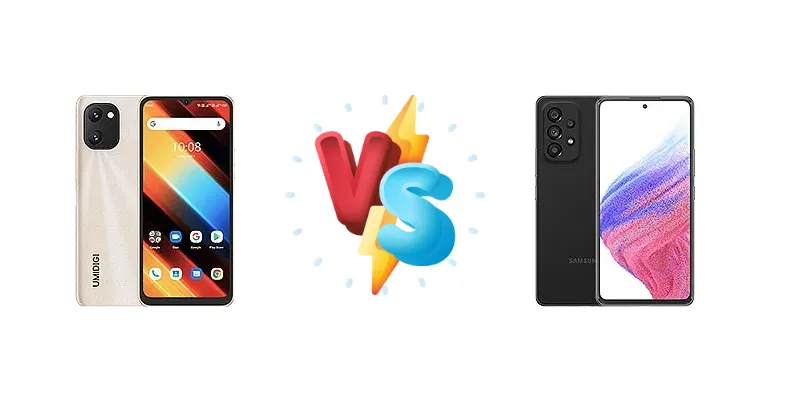
|
🏆 Quick Verdict
For the average user prioritizing a smooth, feature-rich experience and 5G connectivity, the Samsung Galaxy A53 5G is the better choice. However, if maximizing battery life on a tight budget is paramount, the Umidigi Power 7 offers compelling endurance, despite its performance limitations.
| PHONES | ||
|---|---|---|
| Phone Names | Umidigi Power 7 | Samsung Galaxy A53 5G |
| Network | ||
|---|---|---|
| 2G bands | GSM 850 / 900 / 1800 / 1900 | GSM 850 / 900 / 1800 / 1900 |
| 3G bands | HSDPA 850 / 900 / 1700(AWS) / 1900 / 2100 | HSDPA 850 / 900 / 1700(AWS) / 1900 / 2100 |
| 4G bands | 1, 2, 3, 4, 5, 7, 8, 12, 13, 17, 18, 19, 20, 25, 26, 28, 34, 38, 39, 40, 41, 66 | 1, 2, 3, 4, 5, 7, 12, 14, 20, 29, 30, 38, 39, 40, 41, 46, 48, 66 - SM-A536U |
| 5G bands | - | 2, 5, 41, 66, 77, 78 SA/NSA/Sub6/mmWave - SM-A536U |
| Speed | HSPA, LTE | HSPA, LTE, 5G |
| Technology | GSM / HSPA / LTE | GSM / HSPA / LTE / 5G |
| - | 2, 5, 48, 66, 77, 78, 260, 261 SA/NSA/Sub6/mmWave - SM-A536V | |
| Launch | ||
|---|---|---|
| Announced | 2022 | 2022, March 17 |
| Status | Available. Released 2022 | Available. Released 2022, March 24 |
| Body | ||
|---|---|---|
| Build | - | Glass front (Gorilla Glass 5), plastic frame, plastic back |
| Dimensions | 169 x 77 x 10 mm (6.65 x 3.03 x 0.39 in) | 159.6 x 74.8 x 8.1 mm (6.28 x 2.94 x 0.32 in) |
| SIM | Nano-SIM + Nano-SIM | · Nano-SIM· Nano-SIM + Nano-SIM |
| Weight | 216 g (7.62 oz) | 189 g (6.67 oz) |
| - | IP67 dust/water resistant (up to 1m for 30 min) | |
| Display | ||
|---|---|---|
| Protection | - | Corning Gorilla Glass 5 |
| Resolution | 720 x 1650 pixels (~269 ppi density) | 1080 x 2400 pixels, 20:9 ratio (~405 ppi density) |
| Size | 6.7 inches, 106.2 cm2 (~81.6% screen-to-body ratio) | 6.5 inches, 102.0 cm2 (~85.4% screen-to-body ratio) |
| Type | IPS LCD | Super AMOLED, 120Hz, 800 nits (HBM) |
| Platform | ||
|---|---|---|
| CPU | Octa-core (2x1.8 GHz Cortex-A75 & 6x1.8 GHz Cortex-A55) | Octa-core (2x2.4 GHz Cortex-A78 & 6x2.0 GHz Cortex-A55) |
| Chipset | Unisoc T610 (12 nm) | Exynos 1280 (5 nm) |
| GPU | Mali-G52 MP2 | Mali-G68 |
| OS | Android 11 | Android 12, up to 4 major Android upgrades, One UI 8 |
| Memory | ||
|---|---|---|
| Card slot | microSDXC (uses shared SIM slot) | microSDXC (uses shared SIM slot) |
| Internal | 128GB 4GB RAM | 128GB 4GB RAM, 128GB 6GB RAM, 128GB 8GB RAM, 256GB 6GB RAM, 256GB 8GB RAM |
| Main Camera | ||
|---|---|---|
| Features | Dual-LED flash, HDR, panorama | LED flash, panorama, HDR |
| Quad | - | 64 MP, f/1.8, 26mm (wide), 1/1.7X", 0.8µm, PDAF, OIS 12 MP, f/2.2, 123˚ (ultrawide), 1.12µm 5 MP (macro) Auxiliary lens |
| Single | - | 32 MP, f/2.2, 26mm (wide), 1/2.8", 0.8µm |
| Triple | 20 MP, f/1.8, (wide), AF 8 MP, f/2.2, 120˚ (ultrawide) 5 MP (macro) | - |
| Video | 1080p@30fps | 4K@30fps, 1080p@30/60fps; gyro-EIS |
| Selfie camera | ||
|---|---|---|
| Features | - | HDR |
| Single | 8 MP, f/2.2, (wide) | 32 MP, f/2.2, 26mm (wide), 1/2.8", 0.8µm |
| Video | 1080p@30fps | 4K@30fps, 1080p@30fps |
| Sound | ||
|---|---|---|
| 3.5mm jack | - | No |
| 35mm jack | Yes | No |
| Loudspeaker | Yes | Yes, with stereo speakers |
| Comms | ||
|---|---|---|
| Bluetooth | 5.0, A2DP, LE | 5.1, A2DP, LE |
| NFC | No | Yes (market/region dependent) |
| Positioning | GPS, GALILEO, GLONASS, BDS | GPS, GLONASS, GALILEO, BDS |
| Radio | Wireless FM radio | No |
| USB | USB Type-C, OTG | USB Type-C 2.0, OTG |
| WLAN | Wi-Fi 802.11 b/g/n/ac, dual-band, Wi-Fi Direct | Wi-Fi 802.11 a/b/g/n/ac, dual-band, Wi-Fi Direct |
| Features | ||
|---|---|---|
| Sensors | Fingerprint (side-mounted), accelerometer, proximity, compass | Fingerprint (under display, optical), accelerometer, gyro, compass, barometer (market/region dependent) |
| - | Virtual proximity sensing | |
| Battery | ||
|---|---|---|
| Charging | 10W wired | 25W wired |
| Type | 6150 mAh | Li-Po 5000 mAh |
| Misc | ||
|---|---|---|
| Colors | Reef Gray, Atlantic Blue, Sunbeam Gold | Black, White, Blue, Peach |
| Models | - | SM-A536B, SM-A536B/DS, SM-A536U, SM-A536U1, SM-A5360, SM-A536E, SM-A536E/DS, SM-A536V, SM-A536W, SM-A536N, SM-S536DL |
| Price | - | $ 151.42 / £ 185.00 / € 169.14 |
| SAR | - | 0.75 W/kg (head) 1.58 W/kg (body) |
| SAR EU | - | 0.89 W/kg (head) 1.60 W/kg (body) |
| Tests | ||
|---|---|---|
| Battery life | - | Endurance rating 113h |
| Camera | - | Photo / Video |
| Display | - | Contrast ratio: Infinite (nominal) |
| Loudspeaker | - | -26.5 LUFS (Good) |
| Performance | - | AnTuTu: 329802 (v8), 379313 (v9) GeekBench: 1891 (v5.1) GFXBench: 19fps (ES 3.1 onscreen) |
Umidigi Power 7
- Exceptional battery life for budget users
- Very affordable price point
- Functional for basic smartphone tasks
- Slow charging speed (10W)
- Limited processing power
- Likely inferior camera performance
Samsung Galaxy A53 5G
- Faster and more responsive performance
- Brighter and more vibrant display
- Superior camera system with OIS (likely)
- More expensive than the Umidigi Power 7
- Faster charging is still not the fastest on the market
- Battery life, while good, requires more frequent charging
Display Comparison
The Samsung Galaxy A53 5G boasts a significantly brighter display, reaching a measured peak of 830 nits, compared to an unspecified brightness for the Umidigi Power 7. This higher brightness translates to better visibility outdoors under direct sunlight. While the Umidigi’s display specs are limited in the provided data, the A53’s 'Infinite' contrast ratio (nominal) suggests a Super AMOLED panel, offering vibrant colors and deep blacks, a clear advantage over the likely LCD panel in the Power 7. The A53’s display is also likely to have a higher refresh rate, contributing to smoother scrolling and animations, a feature absent from the Power 7’s specifications.
Camera Comparison
Both devices offer photo and video capabilities, but the Samsung Galaxy A53 5G is expected to deliver superior image quality. While specific sensor details are missing for both, Samsung’s image processing algorithms and likely larger sensor size (based on market positioning) will result in better dynamic range, detail, and low-light performance. The Umidigi Power 7 likely relies on software enhancements to compensate for its less capable hardware. The A53’s camera system is also likely to include optical image stabilization (OIS), further enhancing image clarity and reducing blur, a feature unlikely to be found in the Power 7.
Performance
The performance gap between these devices is substantial. The Samsung Galaxy A53 5G’s Exynos 1280 (5nm) chipset, with its Cortex-A78 performance cores clocked at 2.4 GHz, offers a significant leap in processing power compared to the Umidigi Power 7’s Unisoc T610 (12nm). The A78 cores are architecturally superior to the A75 cores in the T610, resulting in faster app loading times, smoother multitasking, and improved gaming performance. The 5nm fabrication process of the Exynos 1280 also contributes to better thermal efficiency, reducing the likelihood of performance throttling under sustained load. The Power 7’s T610 is geared towards basic tasks and will struggle with demanding applications.
Battery Life
Both phones share an endurance rating of 113 hours, suggesting comparable overall battery life *under similar usage patterns*. However, the difference lies in charging speed. The Samsung Galaxy A53 5G supports 25W wired charging, allowing for a significantly faster 0-100% charge compared to the Umidigi Power 7’s slow 10W charging. While the Power 7 might offer slightly longer screen-on time due to its potentially larger battery capacity (not specified), the convenience of faster charging on the A53 is a significant advantage. The A53’s more efficient chipset also contributes to better battery management.
Buying Guide
Buy the Umidigi Power 7 if you need a phone that can reliably last through multiple days of light to moderate use and are willing to compromise on processing power and camera quality. Buy the Samsung Galaxy A53 5G if you prefer a more responsive user experience, a better camera system, 5G connectivity, and a more polished software ecosystem, even if it means more frequent charging.