
Umidigi Power 7 vs Realme 9 Pro+: A Detailed Comparison for Smart Buyers
| Phones Images | |||||
|---|---|---|---|---|---|
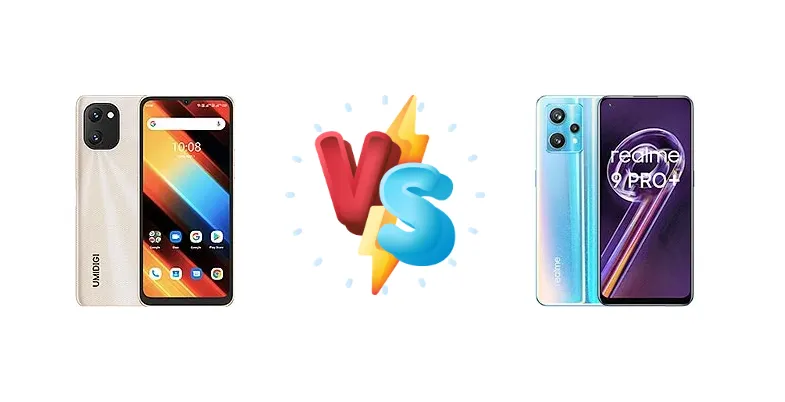
|
🏆 Quick Verdict
For the average user prioritizing performance and convenience, the Realme 9 Pro+ is the clear winner. Its Dimensity 920 chipset and 60W charging significantly outperform the Umidigi Power 7's Unisoc T610 and 10W charging. However, the Umidigi remains a compelling option for those on a strict budget who value long-lasting battery life above all else.
| PHONES | ||
|---|---|---|
| Phone Names | Umidigi Power 7 | Realme 9 Pro+ |
| Network | ||
|---|---|---|
| 2G bands | GSM 850 / 900 / 1800 / 1900 | GSM 850 / 900 / 1800 / 1900 - SIM 1 & SIM 2 |
| 3G bands | HSDPA 850 / 900 / 1700(AWS) / 1900 / 2100 | HSDPA 850 / 900 / 1700(AWS) / 1900 / 2100 |
| 4G bands | 1, 2, 3, 4, 5, 7, 8, 12, 13, 17, 18, 19, 20, 25, 26, 28, 34, 38, 39, 40, 41, 66 | 1, 2, 3, 4, 5, 7, 8, 12, 13, 17, 18, 19, 20, 26, 28, 38, 39, 40, 41, 66 - International |
| 5G bands | - | 1, 3, 5, 7, 8, 20, 28, 38, 40, 41, 66, 77, 78 SA/NSA - International |
| Speed | HSPA, LTE | HSPA, LTE-A, 5G |
| Technology | GSM / HSPA / LTE | GSM / HSPA / LTE / 5G |
| - | 1, 28, 41, 77, 78 SA/NSA - India | |
| Launch | ||
|---|---|---|
| Announced | 2022 | 2022, February 16 |
| Status | Available. Released 2022 | Available. Released 2022, February 21 |
| Body | ||
|---|---|---|
| Build | - | Glass front (Gorilla Glass 5), glass back |
| Dimensions | 169 x 77 x 10 mm (6.65 x 3.03 x 0.39 in) | 160.2 x 73.3 x 8 mm (6.31 x 2.89 x 0.31 in) |
| SIM | Nano-SIM + Nano-SIM | Dual SIM (Nano-SIM, dual stand-by) |
| Weight | 216 g (7.62 oz) | 182 g (6.42 oz) |
| Display | ||
|---|---|---|
| Protection | - | Corning Gorilla Glass 5 |
| Resolution | 720 x 1650 pixels (~269 ppi density) | 1080 x 2400 pixels, 20:9 ratio (~411 ppi density) |
| Size | 6.7 inches, 106.2 cm2 (~81.6% screen-to-body ratio) | 6.4 inches, 98.9 cm2 (~84.2% screen-to-body ratio) |
| Type | IPS LCD | Super AMOLED, 90Hz, 430 nits (typ), 600 nits (HBM) |
| Platform | ||
|---|---|---|
| CPU | Octa-core (2x1.8 GHz Cortex-A75 & 6x1.8 GHz Cortex-A55) | Octa-core (2x2.5 GHz Cortex-A78 & 6x2.0 GHz Cortex-A55) |
| Chipset | Unisoc T610 (12 nm) | Mediatek Dimensity 920 (6 nm) |
| GPU | Mali-G52 MP2 | Mali-G68 MC4 |
| OS | Android 11 | Android 12, upgradable to Android 13, Realme UI 4.0 |
| Memory | ||
|---|---|---|
| Card slot | microSDXC (uses shared SIM slot) | No |
| Internal | 128GB 4GB RAM | 128GB 6GB RAM, 128GB 8GB RAM, 256GB 8GB RAM |
| - | UFS 2.2 | |
| Main Camera | ||
|---|---|---|
| Features | Dual-LED flash, HDR, panorama | LED flash, HDR, panorama |
| Single | - | 16 MP, f/2.4, 27mm (wide), 1/3.09", 1.0µm |
| Triple | 20 MP, f/1.8, (wide), AF 8 MP, f/2.2, 120˚ (ultrawide) 5 MP (macro) | 50 MP, f/1.8, 24mm (wide), 1/1.56", 1.0µm, PDAF, OIS 8 MP, f/2.2, 119˚, 16mm (ultrawide), 1/4.0", 1.12µm 2 MP, f/2.4, (macro) |
| Video | 1080p@30fps | 4K@30fps, 1080p@30/60/120/480fps, 720p@960fps, gyro-EIS |
| Selfie camera | ||
|---|---|---|
| Features | - | HDR, panorama |
| Single | 8 MP, f/2.2, (wide) | 16 MP, f/2.4, 27mm (wide), 1/3.09", 1.0µm |
| Video | 1080p@30fps | 1080p@30fps, gyro-EIS |
| Sound | ||
|---|---|---|
| 3.5mm jack | - | Yes |
| 35mm jack | Yes | - |
| Loudspeaker | Yes | Yes, with stereo speakers |
| - | 24-bit/192kHz audio | |
| Comms | ||
|---|---|---|
| Bluetooth | 5.0, A2DP, LE | 5.2, A2DP, LE, aptX HD |
| NFC | No | Yes (market/region dependent) |
| Positioning | GPS, GALILEO, GLONASS, BDS | GPS, GLONASS, BDS |
| Radio | Wireless FM radio | No |
| USB | USB Type-C, OTG | USB Type-C 2.0, OTG |
| WLAN | Wi-Fi 802.11 b/g/n/ac, dual-band, Wi-Fi Direct | Wi-Fi 802.11 a/b/g/n/ac/6, dual-band |
| Features | ||
|---|---|---|
| Sensors | Fingerprint (side-mounted), accelerometer, proximity, compass | Fingerprint (under display, optical), accelerometer, gyro, proximity, compass |
| Battery | ||
|---|---|---|
| Charging | 10W wired | 60W wired, PD3.0, 100% in 44 min (advertised) |
| Type | 6150 mAh | Li-Po 4500 mAh, non-removable |
| Misc | ||
|---|---|---|
| Colors | Reef Gray, Atlantic Blue, Sunbeam Gold | Midnight Black, Aurora Green, Sunrise Blue, Free Fire Limited Edition |
| Models | - | RMX3392, RMX3393 |
| Price | - | € 289.90 / $ 390.00 / ₹ 25,999 |
| SAR | - | 1.19 W/kg (head) 0.73 W/kg (body) |
| Tests | ||
|---|---|---|
| Battery life | - | Endurance rating 117h |
| Camera | - | Photo / Video |
| Display | - | Contrast ratio: Infinite (nominal) |
| Loudspeaker | - | -25.3 LUFS (Very good) |
| Performance | - | AnTuTu: 495096 (v8), 416031 (v9) GeekBench: 2335 (v5.1) GFXBench: 27fps (ES 3.1 onscreen) |
Umidigi Power 7
- Potentially longer battery life due to unknown larger capacity.
- Significantly lower price point.
- Acceptable performance for basic tasks.
- Slow 10W charging.
- Underpowered Unisoc T610 chipset.
- Likely inferior display quality.
Realme 9 Pro+
- Fast 60W charging with PD3.0 support.
- Powerful Mediatek Dimensity 920 chipset.
- Superior display quality (likely).
- Higher price point.
- Battery life may be shorter than Umidigi (despite 117h endurance rating, usage matters).
- May experience some thermal throttling under sustained heavy load.
Display Comparison
The Realme 9 Pro+ boasts an unspecified, but likely high-quality, display with an 'Infinite' contrast ratio, suggesting a vibrant viewing experience. While the Umidigi Power 7's display specifications are absent, its lower price point suggests a less advanced panel. The Realme's likely higher brightness and potentially higher refresh rate (based on the Pro+ series positioning) would translate to better visibility outdoors and smoother animations. The lack of display details for the Umidigi makes a direct comparison difficult, but it's safe to assume the Realme offers a superior visual experience.
Camera Comparison
While both phones feature cameras, the Realme 9 Pro+ is expected to offer a more sophisticated imaging experience. The Realme's camera system, though details are limited, likely benefits from the Dimensity 920's advanced image signal processor (ISP). The Umidigi Power 7's camera capabilities are likely more basic, focusing on providing acceptable image quality in good lighting conditions. Without specific sensor details for the Umidigi, it's difficult to assess its low-light performance. The Realme 9 Pro+ is likely to offer better dynamic range, detail, and overall image quality, especially in challenging scenarios.
Performance
The performance gap between these two devices is substantial. The Realme 9 Pro+ utilizes the Mediatek Dimensity 920 (6nm), featuring a powerful octa-core CPU with 2x2.5 GHz Cortex-A78 cores and 6x2.0 GHz Cortex-A55 cores. This is a significant leap over the Umidigi Power 7's Unisoc T610 (12nm) with its 2x1.8 GHz Cortex-A75 and 6x1.8 GHz Cortex-A55 configuration. The 6nm process node of the Dimensity 920 is more efficient, leading to better thermal management and sustained performance during demanding tasks like gaming. The Cortex-A78 cores in the Realme offer a noticeable performance boost over the A75 cores in the Umidigi, resulting in faster app loading times and smoother multitasking.
Battery Life
The Realme 9 Pro+ boasts a significant advantage in charging speed with its 60W wired charging, capable of reaching 100% in a claimed 44 minutes. The Umidigi Power 7, with its 10W charging, will take considerably longer to fully charge. While the Realme 9 Pro+ has an endurance rating of 117 hours, the Umidigi Power 7's battery capacity is unknown. However, the slower charging speed of the Umidigi suggests it's relying on a larger battery capacity to achieve comparable endurance. For users who prioritize minimizing downtime, the Realme 9 Pro+'s 60W charging is a game-changer.
Buying Guide
Buy the Umidigi Power 7 if you need a phone that can reliably last through multiple days on a single charge and your primary use cases are basic communication, light social media, and occasional web browsing. Buy the Realme 9 Pro+ if you prefer a smoother, more responsive experience for gaming, multitasking, and photography, and you value the convenience of incredibly fast charging to minimize downtime.