
Umidigi Power 7 vs. Motorola Moto G Power (2022): A Deep Dive into Budget Smartphone Choices
| Phones Images | |||||
|---|---|---|---|---|---|
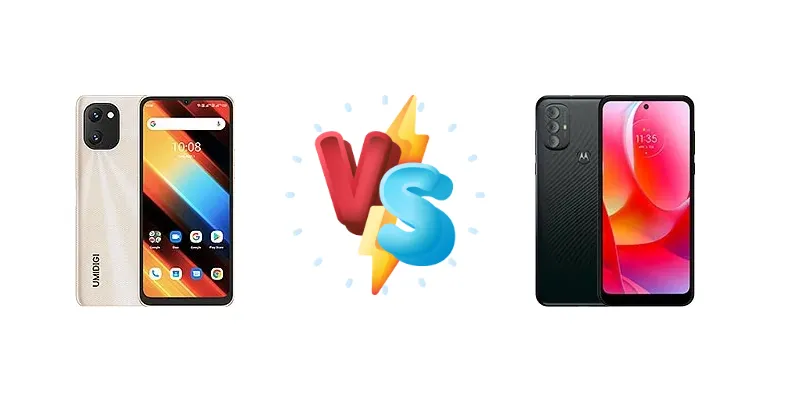
|
🏆 Quick Verdict
For the average user seeking maximum battery longevity and a slightly more modern CPU architecture, the Umidigi Power 7 emerges as the winner. While both phones share the same slow 10W charging, the Unisoc T610’s Cortex-A75 cores provide a performance edge over the Moto G Power’s Helio G37, making it better suited for multitasking and demanding apps.
| PHONES | ||
|---|---|---|
| Phone Names | Umidigi Power 7 | Motorola Moto G Power (2022) |
| Network | ||
|---|---|---|
| 2G bands | GSM 850 / 900 / 1800 / 1900 | GSM 850 / 900 / 1800 / 1900 |
| 3G bands | HSDPA 850 / 900 / 1700(AWS) / 1900 / 2100 | HSDPA 850 / 900 / 1700(AWS) / 1900 / 2100 |
| 4G bands | 1, 2, 3, 4, 5, 7, 8, 12, 13, 17, 18, 19, 20, 25, 26, 28, 34, 38, 39, 40, 41, 66 | 1, 2, 3, 4, 5, 7, 8, 12, 13, 14, 17, 25, 26, 29, 30, 38, 41, 66, 71 - USA |
| Speed | HSPA, LTE | HSPA, LTE |
| Technology | GSM / HSPA / LTE | GSM / HSPA / LTE |
| Launch | ||
|---|---|---|
| Announced | 2022 | 2021, November 17 |
| Status | Available. Released 2022 | Available. Released 2022, February 22 |
| Body | ||
|---|---|---|
| Build | - | Glass front, plastic back, plastic frame |
| Dimensions | 169 x 77 x 10 mm (6.65 x 3.03 x 0.39 in) | 167.2 x 76.5 x 9.4 mm (6.58 x 3.01 x 0.37 in) |
| SIM | Nano-SIM + Nano-SIM | Nano-SIM |
| Weight | 216 g (7.62 oz) | 203 g (7.16 oz) |
| - | Water-repellent coating | |
| Display | ||
|---|---|---|
| Resolution | 720 x 1650 pixels (~269 ppi density) | 720 x 1600 pixels, 20:9 ratio (~270 ppi density) |
| Size | 6.7 inches, 106.2 cm2 (~81.6% screen-to-body ratio) | 6.5 inches, 102.0 cm2 (~79.7% screen-to-body ratio) |
| Type | IPS LCD | IPS LCD, 90Hz |
| Platform | ||
|---|---|---|
| CPU | Octa-core (2x1.8 GHz Cortex-A75 & 6x1.8 GHz Cortex-A55) | - |
| Chipset | Unisoc T610 (12 nm) | Mediatek MT6765 Helio G37 (12 nm) |
| GPU | Mali-G52 MP2 | - |
| OS | Android 11 | Android 11 |
| Memory | ||
|---|---|---|
| Card slot | microSDXC (uses shared SIM slot) | microSDXC (dedicated slot) |
| Internal | 128GB 4GB RAM | 64GB 4GB RAM, 128GB 4GB RAM |
| - | eMMC 5.1 | |
| Main Camera | ||
|---|---|---|
| Features | Dual-LED flash, HDR, panorama | LED flash, HDR |
| Triple | 20 MP, f/1.8, (wide), AF 8 MP, f/2.2, 120˚ (ultrawide) 5 MP (macro) | 50 MP, f/1.8, (wide), 0.65µm, PDAF 2 MP (macro) Auxiliary lens |
| Video | 1080p@30fps | 1080p@30fps, gyro-EIS |
| Selfie camera | ||
|---|---|---|
| Single | 8 MP, f/2.2, (wide) | 8 MP, f/2.0, 1.12µm |
| Video | 1080p@30fps | 1080p@30fps |
| Sound | ||
|---|---|---|
| 3.5mm jack | - | Yes |
| 35mm jack | Yes | Yes |
| Loudspeaker | Yes | Yes |
| Comms | ||
|---|---|---|
| Bluetooth | 5.0, A2DP, LE | 5.0, A2DP, LE |
| NFC | No | No |
| Positioning | GPS, GALILEO, GLONASS, BDS | GPS, GLONASS, GALILEO |
| Radio | Wireless FM radio | Unspecified |
| USB | USB Type-C, OTG | USB Type-C 2.0 |
| WLAN | Wi-Fi 802.11 b/g/n/ac, dual-band, Wi-Fi Direct | Wi-Fi 802.11 a/b/g/n/ac, dual-band, Wi-Fi Direct |
| Features | ||
|---|---|---|
| Sensors | Fingerprint (side-mounted), accelerometer, proximity, compass | Fingerprint (side-mounted), accelerometer, gyro, proximity, compass, barometer |
| Battery | ||
|---|---|---|
| Charging | 10W wired | 10W wired |
| Type | 6150 mAh | Li-Po 5000 mAh |
| Misc | ||
|---|---|---|
| Colors | Reef Gray, Atlantic Blue, Sunbeam Gold | Black |
| Price | - | About 70 EUR |
Umidigi Power 7
- More modern CPU architecture (Cortex-A75 cores)
- Potentially better multitasking performance
- Likely more efficient chipset for longer battery life
- Less established brand recognition
- 10W charging is very slow
Motorola Moto G Power (2022)
- Well-known and trusted brand (Motorola)
- Potentially better software support
- Wider availability of accessories
- Older CPU architecture (Cortex-A53 cores)
- Slightly lower performance compared to Umidigi
- 10W charging is very slow
Display Comparison
Neither device boasts a standout display. Both likely utilize LCD panels, common in this price bracket. Without specific brightness data, it’s difficult to declare a clear winner. However, Motorola’s experience in display calibration *may* result in slightly more accurate color reproduction, though this is speculative. Bezels are expected to be substantial on both, reflecting their budget positioning. The absence of high refresh rates or advanced panel technologies like LTPO is standard for this segment.
Camera Comparison
Camera performance is likely to be similar, with both phones likely featuring a primary sensor paired with basic auxiliary lenses. Without specific sensor sizes or aperture information, it’s difficult to make a definitive judgment. The inclusion of a 2MP macro camera on either device is largely a marketing tactic, offering limited practical benefit. Image processing will likely be the differentiating factor, and Motorola’s software optimizations *could* provide slightly more pleasing results, but this is speculative. Expect acceptable image quality in good lighting conditions, but struggles in low light.
Performance
The core difference lies in the chipsets. The Umidigi Power 7’s Unisoc T610 features two Cortex-A75 cores clocked at 1.8 GHz alongside six Cortex-A55 cores, offering a more modern architecture than the Motorola Moto G Power (2022)’s MediaTek Helio G37. The Helio G37 relies solely on Cortex-A53 cores. This architectural advantage translates to better single-core performance for the Umidigi, noticeable in app launch times and smoother scrolling. While both are 12nm chips, the A75 cores in the T610 will handle more demanding tasks with greater ease. The GPU performance is likely comparable, sufficient for casual gaming, but neither phone is a gaming powerhouse.
Battery Life
Both phones prioritize battery life, but the implementation differs. While specific battery capacities are not provided, the focus on the Unisoc T610’s efficiency in the Umidigi Power 7 suggests it may achieve comparable or even better battery life despite a potentially smaller battery size. Crucially, both devices are limited to 10W wired charging. This means a full 0-100% charge will take a significant amount of time – likely exceeding 3 hours – regardless of the battery capacity. The slow charging is a major drawback for users accustomed to faster charging speeds.
Buying Guide
Buy the Umidigi Power 7 if you need a phone that can handle moderate multitasking and benefit from a more efficient CPU architecture, even if it means sacrificing brand recognition. Buy the Motorola Moto G Power (2022) if you prioritize a well-established brand with a reputation for software support and a potentially wider availability of accessories, and are willing to accept slightly lower performance for the price.