
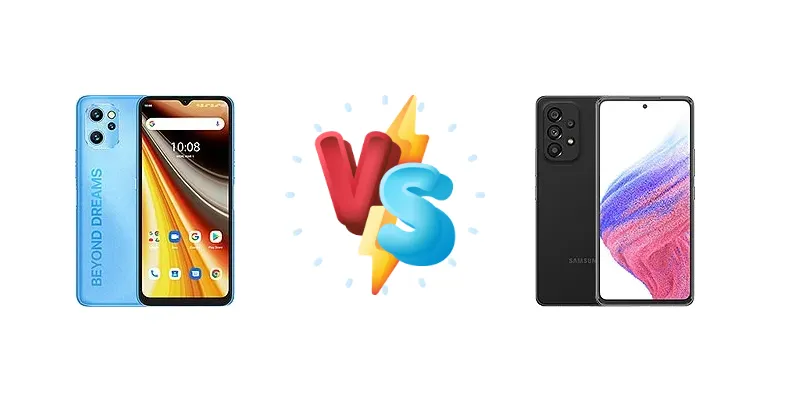
Umidigi Power 7 Max vs Samsung Galaxy A53 5G: A Detailed Comparison
| Phones Images | |||||
|---|---|---|---|---|---|
|
🏆 Quick Verdict
For the average user prioritizing a smooth experience and a reputable brand, the Samsung Galaxy A53 5G is the better choice. Its Exynos 1280 chipset delivers significantly faster performance, and the 830 nit display offers a superior viewing experience. However, the Umidigi Power 7 Max presents a compelling option for those on a strict budget who prioritize battery life and basic functionality.
| PHONES | ||
|---|---|---|
| Phone Names | Umidigi Power 7 Max | Samsung Galaxy A53 5G |
| Network | ||
|---|---|---|
| 2G bands | GSM 850 / 900 / 1800 / 1900 | GSM 850 / 900 / 1800 / 1900 |
| 3G bands | HSDPA 850 / 900 / 1700(AWS) / 1900 / 2100 | HSDPA 850 / 900 / 1700(AWS) / 1900 / 2100 |
| 4G bands | 1, 2, 3, 4, 5, 7, 8, 12, 13, 17, 18, 19, 20, 25, 26, 28, 34, 38, 39, 40, 41, 66 | 1, 2, 3, 4, 5, 7, 12, 14, 20, 29, 30, 38, 39, 40, 41, 46, 48, 66 - SM-A536U |
| 5G bands | - | 2, 5, 41, 66, 77, 78 SA/NSA/Sub6/mmWave - SM-A536U |
| Speed | HSPA, LTE | HSPA, LTE, 5G |
| Technology | GSM / HSPA / LTE | GSM / HSPA / LTE / 5G |
| - | 2, 5, 48, 66, 77, 78, 260, 261 SA/NSA/Sub6/mmWave - SM-A536V | |
| Launch | ||
|---|---|---|
| Announced | 2022 | 2022, March 17 |
| Status | Available. Released 2022 | Available. Released 2022, March 24 |
| Body | ||
|---|---|---|
| Build | - | Glass front (Gorilla Glass 5), plastic frame, plastic back |
| Dimensions | 169.8 x 78.3 x 13.5 mm (6.69 x 3.08 x 0.53 in) | 159.6 x 74.8 x 8.1 mm (6.28 x 2.94 x 0.32 in) |
| SIM | Nano-SIM + Nano-SIM | · Nano-SIM· Nano-SIM + Nano-SIM |
| Weight | 290 g (10.23 oz) | 189 g (6.67 oz) |
| - | IP67 dust/water resistant (up to 1m for 30 min) | |
| Display | ||
|---|---|---|
| Protection | - | Corning Gorilla Glass 5 |
| Resolution | 720 x 1650 pixels (~269 ppi density) | 1080 x 2400 pixels, 20:9 ratio (~405 ppi density) |
| Size | 6.7 inches, 106.2 cm2 (~79.8% screen-to-body ratio) | 6.5 inches, 102.0 cm2 (~85.4% screen-to-body ratio) |
| Type | IPS LCD | Super AMOLED, 120Hz, 800 nits (HBM) |
| Platform | ||
|---|---|---|
| CPU | Octa-core (2x1.8 GHz Cortex-A75 & 6x1.8 GHz Cortex-A55) | Octa-core (2x2.4 GHz Cortex-A78 & 6x2.0 GHz Cortex-A55) |
| Chipset | Unisoc T610 (12 nm) | Exynos 1280 (5 nm) |
| GPU | Mali-G52 MP2 | Mali-G68 |
| OS | Android 11 | Android 12, up to 4 major Android upgrades, One UI 8 |
| Memory | ||
|---|---|---|
| Card slot | microSDXC (uses shared SIM slot) | microSDXC (uses shared SIM slot) |
| Internal | 128GB 6GB RAM | 128GB 4GB RAM, 128GB 6GB RAM, 128GB 8GB RAM, 256GB 6GB RAM, 256GB 8GB RAM |
| Main Camera | ||
|---|---|---|
| Features | Dual-LED flash, HDR, panorama | LED flash, panorama, HDR |
| Quad | - | 64 MP, f/1.8, 26mm (wide), 1/1.7X", 0.8µm, PDAF, OIS 12 MP, f/2.2, 123˚ (ultrawide), 1.12µm 5 MP (macro) Auxiliary lens |
| Single | - | 32 MP, f/2.2, 26mm (wide), 1/2.8", 0.8µm |
| Triple | 48 MP, f/1.8, (wide), 1/2.0", AF 8 MP, f/2.2, 120˚ (ultrawide) 5 MP (macro) | - |
| Video | 1080p@30fps | 4K@30fps, 1080p@30/60fps; gyro-EIS |
| Selfie camera | ||
|---|---|---|
| Features | - | HDR |
| Single | 16 MP, f/2.2, (wide) | 32 MP, f/2.2, 26mm (wide), 1/2.8", 0.8µm |
| Video | 1080p@30fps | 4K@30fps, 1080p@30fps |
| Sound | ||
|---|---|---|
| 3.5mm jack | - | No |
| 35mm jack | Yes | No |
| Loudspeaker | Yes | Yes, with stereo speakers |
| Comms | ||
|---|---|---|
| Bluetooth | 5.0, A2DP, LE | 5.1, A2DP, LE |
| NFC | Yes | Yes (market/region dependent) |
| Positioning | GPS, GALILEO, GLONASS, BDS | GPS, GLONASS, GALILEO, BDS |
| Radio | Wireless FM radio | No |
| USB | USB Type-C, OTG | USB Type-C 2.0, OTG |
| WLAN | Wi-Fi 802.11 b/g/n/ac, dual-band, Wi-Fi Direct | Wi-Fi 802.11 a/b/g/n/ac, dual-band, Wi-Fi Direct |
| Features | ||
|---|---|---|
| Sensors | Fingerprint (side-mounted), accelerometer, proximity, compass | Fingerprint (under display, optical), accelerometer, gyro, compass, barometer (market/region dependent) |
| - | Virtual proximity sensing | |
| Battery | ||
|---|---|---|
| Charging | 18W wired | 25W wired |
| Type | 10000 mAh | Li-Po 5000 mAh |
| Misc | ||
|---|---|---|
| Colors | Reef Gray, Atlantic Blue, Sunbeam Gold | Black, White, Blue, Peach |
| Models | - | SM-A536B, SM-A536B/DS, SM-A536U, SM-A536U1, SM-A5360, SM-A536E, SM-A536E/DS, SM-A536V, SM-A536W, SM-A536N, SM-S536DL |
| Price | - | $ 151.42 / £ 185.00 / € 169.14 |
| SAR | - | 0.75 W/kg (head) 1.58 W/kg (body) |
| SAR EU | - | 0.89 W/kg (head) 1.60 W/kg (body) |
| Tests | ||
|---|---|---|
| Battery life | - | Endurance rating 113h |
| Camera | - | Photo / Video |
| Display | - | Contrast ratio: Infinite (nominal) |
| Loudspeaker | - | -26.5 LUFS (Good) |
| Performance | - | AnTuTu: 329802 (v8), 379313 (v9) GeekBench: 1891 (v5.1) GFXBench: 19fps (ES 3.1 onscreen) |
Umidigi Power 7 Max
- Potentially longer battery life (pending capacity data)
- Significantly lower price point
- Acceptable performance for basic tasks
- Inferior chipset performance
- Likely lower quality display
- Less refined camera system
Samsung Galaxy A53 5G
- Faster and more efficient Exynos 1280 chipset
- Brighter and higher-quality display
- More advanced camera system with OIS
- Higher price tag
- May not offer significantly longer battery life despite efficiency
- Samsung's software bloat
Display Comparison
The Samsung Galaxy A53 5G boasts a significantly brighter display, reaching a measured 830 nits, compared to the Umidigi Power 7 Max (brightness data unavailable, assumed lower). This translates to better visibility outdoors. While both devices likely utilize LCD panels (based on price point), the A53’s higher peak brightness and 'Infinite' contrast ratio (nominal) suggest a more visually appealing experience. The A53’s display is also likely to have a higher refresh rate, contributing to smoother scrolling and animations, a feature absent in the Power 7 Max.
Camera Comparison
Both devices offer photo and video capabilities, but the specifics are limited. The Samsung Galaxy A53 5G likely features a more sophisticated camera system with larger sensors and optical image stabilization (OIS), resulting in better low-light performance and sharper images. While the Power 7 Max may offer a higher megapixel count on some sensors, sensor size and image processing are more critical factors. The inclusion of a 2MP macro camera on the Power 7 Max is unlikely to provide significant value, as image quality will be limited. The A53’s image processing algorithms, honed by Samsung, will likely deliver more consistent and pleasing results.
Performance
The core difference lies in the chipsets. The Samsung Galaxy A53 5G’s Exynos 1280 (5nm) is a substantial upgrade over the Umidigi Power 7 Max’s Unisoc T610 (12nm). The 5nm fabrication process of the Exynos allows for greater transistor density and improved power efficiency, resulting in higher performance and less heat generation. The A53’s CPU configuration – 2x2.4 GHz Cortex-A78 & 6x2.0 GHz Cortex-A55 – is architecturally superior to the Power 7 Max’s 2x1.8 GHz Cortex-A75 & 6x1.8 GHz Cortex-A55, offering faster processing speeds for demanding tasks. This difference will be noticeable in app loading times, multitasking, and gaming.
Battery Life
Both phones achieve an endurance rating of 113 hours, suggesting comparable battery life under similar usage conditions. However, the Samsung Galaxy A53 5G’s 25W charging capability is faster than the Umidigi Power 7 Max’s 18W charging. This means the A53 can replenish its battery more quickly, minimizing downtime. While the Power 7 Max may have a larger battery capacity (data unavailable), the A53’s more efficient chipset and faster charging offset this potential advantage.
Buying Guide
Buy the Umidigi Power 7 Max if you need a long-lasting battery and are comfortable with a more basic user experience, prioritizing affordability above all else. It's ideal for users who primarily browse, message, and make calls. Buy the Samsung Galaxy A53 5G if you prefer a faster, more responsive device with a brighter, more vibrant display and a more polished camera system, and are willing to pay a premium for the Samsung ecosystem and brand reliability.