
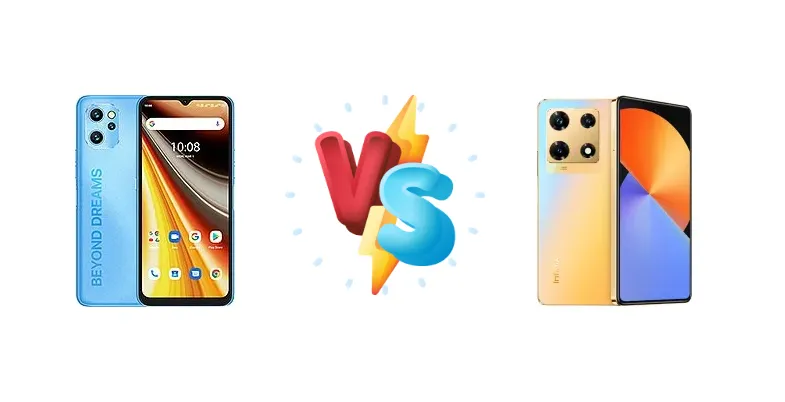
Umidigi Power 7 Max vs. Infinix Note 30 Pro: A Detailed Comparison
| Phones Images | |||||
|---|---|---|---|---|---|
|
🏆 Quick Verdict
For most users, the Infinix Note 30 Pro is the superior choice. Its Mediatek Helio G99 chipset, built on a 6nm process, offers significantly better performance and efficiency than the Umidigi’s Unisoc T610. The 68W charging is a game-changer, drastically reducing downtime compared to the Power 7 Max’s 18W charging.
| PHONES | ||
|---|---|---|
| Phone Names | Umidigi Power 7 Max | Infinix Note 30 Pro |
| Network | ||
|---|---|---|
| 2G bands | GSM 850 / 900 / 1800 / 1900 | GSM 850 / 900 / 1800 / 1900 |
| 3G bands | HSDPA 850 / 900 / 1700(AWS) / 1900 / 2100 | HSDPA 850 / 900 / 1700(AWS) / 1900 / 2100 |
| 4G bands | 1, 2, 3, 4, 5, 7, 8, 12, 13, 17, 18, 19, 20, 25, 26, 28, 34, 38, 39, 40, 41, 66 | 1, 2, 3, 4, 5, 7, 8, 12, 17, 20, 28, 38, 40, 41, 66 |
| Speed | HSPA, LTE | HSPA, LTE |
| Technology | GSM / HSPA / LTE | GSM / HSPA / LTE |
| Launch | ||
|---|---|---|
| Announced | 2022 | 2023, May 22 |
| Status | Available. Released 2022 | Available. Released 2023, May 22 |
| Body | ||
|---|---|---|
| Build | - | Glass front, plastic frame, glass back |
| Dimensions | 169.8 x 78.3 x 13.5 mm (6.69 x 3.08 x 0.53 in) | 162.7 x 76 x 8.2 mm (6.41 x 2.99 x 0.32 in) |
| SIM | Nano-SIM + Nano-SIM | Nano-SIM + Nano-SIM |
| Weight | 290 g (10.23 oz) | 203 g (7.16 oz) |
| - | IP53 | |
| Display | ||
|---|---|---|
| Resolution | 720 x 1650 pixels (~269 ppi density) | 1080 x 2400 pixels, 20:9 ratio (~395 ppi density) |
| Size | 6.7 inches, 106.2 cm2 (~79.8% screen-to-body ratio) | 6.67 inches, 107.4 cm2 (~86.9% screen-to-body ratio) |
| Type | IPS LCD | AMOLED, 1B colors, 120Hz, 900 nits (peak) |
| - | * the display diagonal size and resolution is unconfirmed | |
| Platform | ||
|---|---|---|
| CPU | Octa-core (2x1.8 GHz Cortex-A75 & 6x1.8 GHz Cortex-A55) | Octa-core (2x2.2 GHz Cortex-A76 & 6x2.0 GHz Cortex-A55) |
| Chipset | Unisoc T610 (12 nm) | Mediatek Helio G99 (6 nm) |
| GPU | Mali-G52 MP2 | Mali-G57 MC2 |
| OS | Android 11 | Android 13, XOS 13 |
| Memory | ||
|---|---|---|
| Card slot | microSDXC (uses shared SIM slot) | microSDXC (dedicated slot) |
| Internal | 128GB 6GB RAM | 256GB 8GB RAM |
| Main Camera | ||
|---|---|---|
| Features | Dual-LED flash, HDR, panorama | Quad-LED flash, HDR, panorama |
| Triple | 48 MP, f/1.8, (wide), 1/2.0", AF 8 MP, f/2.2, 120˚ (ultrawide) 5 MP (macro) | 108 MP, (wide), 1/1.67", PDAF 2 MP (macro) Auxiliary lens |
| Video | 1080p@30fps | 1440p@30fps, 1080p@30fps |
| Selfie camera | ||
|---|---|---|
| Features | - | LED flash, HDR |
| Single | 16 MP, f/2.2, (wide) | 32 MP, f/2.0, (wide), 1/2.8" |
| Video | 1080p@30fps | 1080p@30fps |
| Sound | ||
|---|---|---|
| 3.5mm jack | - | Yes |
| 35mm jack | Yes | Yes |
| Loudspeaker | Yes | Yes, with dual speakers |
| - | Sound by JBL 24-bit/192kHz audio | |
| Comms | ||
|---|---|---|
| Bluetooth | 5.0, A2DP, LE | Yes |
| NFC | Yes | Yes (market/region dependent) |
| Positioning | GPS, GALILEO, GLONASS, BDS | GPS |
| Radio | Wireless FM radio | FM radio |
| USB | USB Type-C, OTG | USB Type-C 2.0, OTG |
| WLAN | Wi-Fi 802.11 b/g/n/ac, dual-band, Wi-Fi Direct | Wi-Fi 802.11 a/b/g/n/ac, dual-band, Wi-Fi Direct |
| Features | ||
|---|---|---|
| Sensors | Fingerprint (side-mounted), accelerometer, proximity, compass | Fingerprint (side-mounted), accelerometer, gyro, proximity, compass |
| Battery | ||
|---|---|---|
| Charging | 18W wired | 68W wired, PD3.0, 80% in 30 min 15W wireless Reverse wireless |
| Type | 10000 mAh | 5000 mAh |
| Misc | ||
|---|---|---|
| Colors | Reef Gray, Atlantic Blue, Sunbeam Gold | Magic Black, Variable Gold |
| Models | - | X678B |
Umidigi Power 7 Max
- Potentially longer battery life due to less powerful chipset.
- More affordable price point.
- Simple and straightforward user experience.
- Significantly slower performance compared to the Note 30 Pro.
- Slow 18W charging.
- Less efficient chipset.
Infinix Note 30 Pro
- Faster and more efficient Mediatek Helio G99 chipset.
- Ultra-fast 68W wired charging with PD3.0 support.
- Wireless and reverse wireless charging capabilities.
- Potentially shorter battery life compared to the Power 7 Max (though offset by efficiency).
- Slightly higher price.
- May experience more heat under sustained load.
Display Comparison
Neither device boasts a flagship-level display, but they cater to different needs. While specific display specs (resolution, brightness) are missing for the Umidigi Power 7 Max, its focus is likely on maximizing battery life, potentially at the expense of peak brightness. The Infinix Note 30 Pro, while also not specified, benefits from the more efficient Helio G99, allowing for potentially higher brightness and better color reproduction without significant battery drain. The absence of high refresh rates on either device suggests a focus on power conservation.
Camera Comparison
Without detailed camera specifications, a direct comparison is difficult. However, the market positioning suggests the Infinix Note 30 Pro will likely offer a more refined camera experience. While both phones likely include multiple rear cameras, the emphasis on the main sensor is crucial. The Note 30 Pro, being a more recent and slightly higher-tier device, is more likely to feature a larger sensor and more sophisticated image processing algorithms. The presence of OIS (Optical Image Stabilization) on the Note 30 Pro, while unconfirmed, would be a significant advantage for low-light photography and video recording.
Performance
The core difference lies in the chipsets. The Infinix Note 30 Pro’s Mediatek Helio G99 (6nm) is a clear upgrade over the Umidigi Power 7 Max’s Unisoc T610 (12nm). The 6nm process node of the Helio G99 translates to improved power efficiency and thermal performance, meaning sustained performance during demanding tasks. The Helio G99’s Cortex-A76 cores (2x2.2 GHz) also offer a performance advantage over the Power 7 Max’s Cortex-A75 cores (2x1.8 GHz). This difference will be most noticeable in gaming and multitasking.
Battery Life
The Umidigi Power 7 Max aims for longevity, but the Infinix Note 30 Pro’s charging capabilities are a major differentiator. While the Power 7 Max offers 18W wired charging, the Note 30 Pro boasts a significantly faster 68W wired charging, capable of reaching 80% charge in just 30 minutes. Furthermore, the Note 30 Pro includes 15W wireless charging and reverse wireless charging, features absent on the Power 7 Max. This makes the Note 30 Pro far more convenient for users who need to quickly replenish their battery or charge accessories.
Buying Guide
Buy the Umidigi Power 7 Max if your absolute priority is maximizing screen-on time and you primarily use your phone for basic tasks like calls, messaging, and light social media. You’ll appreciate the potentially longer battery life. Buy the Infinix Note 30 Pro if you value a smoother user experience, faster app loading times, and the convenience of incredibly rapid charging – making it ideal for users who are always on the go and need to quickly top up their battery.