
Umidigi Power 5S vs Samsung Galaxy A32: A Detailed Comparison for Budget Shoppers
| Phones Images | |||||
|---|---|---|---|---|---|
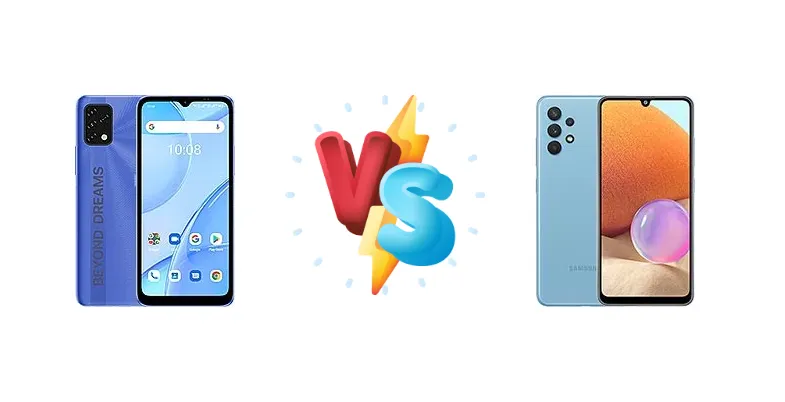
|
🏆 Quick Verdict
For most users, the Samsung Galaxy A32 is the better choice. While the Umidigi Power 5S offers a compelling price, the A32’s superior display brightness (814 nits) and more powerful Helio G80 chipset provide a noticeably smoother and more enjoyable user experience, justifying the slight price premium.
| PHONES | ||
|---|---|---|
| Phone Names | Umidigi Power 5S | Samsung Galaxy A32 |
| Network | ||
|---|---|---|
| 2G bands | GSM 850 / 900 / 1800 / 1900 | GSM 850 / 900 / 1800 / 1900 |
| 3G bands | HSDPA 800 / 850 / 900 / 1700(AWS) / 1900 / 2100 | HSDPA 850 / 900 / 1900 / 2100 |
| 4G bands | 1, 2, 3, 4, 5, 7, 8, 12, 13, 17, 18, 19, 20, 26, 28, 34, 38, 39, 40, 41, 66 | 1, 2, 3, 5, 7, 8, 20, 28, 38, 40, 41 |
| Speed | HSPA, LTE | HSPA, LTE |
| Technology | GSM / HSPA / LTE | GSM / HSPA / LTE |
| Launch | ||
|---|---|---|
| Announced | 2021. Released 2021 | 2021, February 25 |
| Status | Discontinued | Available. Released 2021, February 25 |
| Body | ||
|---|---|---|
| Build | - | Glass front (Gorilla Glass 5), plastic frame, plastic back |
| Dimensions | 164.8 x 76.9 x 9.9 mm (6.49 x 3.03 x 0.39 in) | 158.9 x 73.6 x 8.4 mm (6.26 x 2.90 x 0.33 in) |
| SIM | Nano-SIM + Nano-SIM | · Nano-SIM· Nano-SIM + Nano-SIM |
| Weight | 215 g (7.58 oz) | 184 g (6.49 oz) |
| Display | ||
|---|---|---|
| Protection | - | Corning Gorilla Glass 5 |
| Resolution | 720 x 1600 pixels, 20:9 ratio (~269 ppi density) | 1080 x 2400 pixels, 20:9 ratio (~411 ppi density) |
| Size | 6.53 inches, 102.9 cm2 (~81.2% screen-to-body ratio) | 6.4 inches, 98.9 cm2 (~84.6% screen-to-body ratio) |
| Type | IPS LCD | Super AMOLED, 90Hz, 800 nits (HBM) |
| Platform | ||
|---|---|---|
| CPU | Quad-core (1x2.0 GHz Cortex-A75 & 3x1.8 GHz Cortex-A55) | Octa-core (2x2.0 GHz Cortex-A75 & 6x1.8 GHz Cortex-A55) |
| Chipset | Unisoc Tiger T310 (12nm) | Mediatek MT6769V/CU Helio G80 (12 nm) |
| GPU | PowerVR GE8300 | Mali-G52 MC2 |
| OS | Android 11 | Android 11, upgradable to Android 13, One UI 5 |
| Memory | ||
|---|---|---|
| Card slot | microSDXC (dedicated slot) | microSDXC (dedicated slot) |
| Internal | 32GB 4GB RAM, 64GB 4GB RAM | 64GB 4GB RAM, 64GB 6GB RAM, 128GB 4GB RAM, 128GB 6GB RAM, 128GB 8GB RAM |
| Main Camera | ||
|---|---|---|
| Features | Dual-LED flash, HDR, panorama | LED flash, panorama, HDR |
| Quad | - | 64 MP, f/1.8, 26mm (wide), PDAF 8 MP, f/2.2, 123˚, (ultrawide), 1/4.0", 1.12µm 5 MP (macro) Auxiliary lens |
| Single | - | 20 MP, f/2.2, (wide) |
| Triple | 16 MP, f/2.0, (wide), AF 8 MP, 120˚ (ultrawide) 5 MP (macro) | - |
| Video | 1080p@30fps | 1080p@30fps |
| Selfie camera | ||
|---|---|---|
| Single | 8 MP, f/2.2, (wide) | 20 MP, f/2.2, (wide) |
| Video | 1080p@30fps | 1080p@30fps |
| Sound | ||
|---|---|---|
| 3.5mm jack | - | Yes |
| 35mm jack | Yes | Yes |
| Loudspeaker | Yes | Yes |
| Comms | ||
|---|---|---|
| Bluetooth | 5.0, A2DP, LE | 5.0, A2DP, LE |
| NFC | No | Yes (market/region dependent) |
| Positioning | GPS, GLONASS, GALILEO | GPS, GLONASS, BDS, GALILEO |
| Radio | No | FM radio, RDS, recording |
| USB | USB Type-C, OTG | USB Type-C 2.0, OTG |
| WLAN | Wi-Fi 802.11 a/b/g/n/ac, dual-band, Wi-Fi Direct | Wi-Fi 802.11 a/b/g/n/ac, dual-band, Wi-Fi Direct |
| Features | ||
|---|---|---|
| Sensors | Accelerometer, proximity, compass | Fingerprint (under display, optical), accelerometer, gyro, compass |
| - | Virtual proximity sensing | |
| Battery | ||
|---|---|---|
| Charging | 10W wired | 15W wired |
| Type | 6150 mAh | Li-Ion 5000 mAh |
| Misc | ||
|---|---|---|
| Colors | Carbon Grey, Jade Green, Sapphire Blue | Awesome Black, Awesome White, Awesome Blue, Awesome Violet |
| Models | - | SM-A325F, SM-A325F/DS, SM-A325M, SM-A325N |
| Price | - | € 124.99 / £ 89.38 |
| SAR EU | - | 0.45 W/kg (head) 1.30 W/kg (body) |
| Tests | ||
|---|---|---|
| Battery life | - | Endurance rating 119h |
| Camera | - | Photo / Video |
| Display | - | Contrast ratio: Infinite (nominal) |
| Loudspeaker | - | -30.3 LUFS (Below average) |
| Performance | - | AnTuTu: 286666 (v8) GeekBench: 1277 (v5.1) GFXBench: 8.1fps (ES 3.1 onscreen) |
Umidigi Power 5S
- Potentially lower price point
- Acceptable battery life (119h endurance)
- Functional for basic tasks
- Less powerful Unisoc Tiger T310 chipset
- Likely inferior display quality
- Slower 10W charging
Samsung Galaxy A32
- Brighter and higher-quality display (814 nits)
- More powerful Mediatek Helio G80 chipset
- Faster 15W charging
- Slightly higher price
- Similar battery endurance to Power 5S
- Camera specs are not exceptional
Display Comparison
The Samsung Galaxy A32 boasts a significant advantage in display quality, achieving a measured peak brightness of 814 nits. This translates to excellent visibility outdoors, a common pain point for budget phones. While the Umidigi Power 5S’s display specifications are not provided, it’s reasonable to assume it falls considerably short of this figure. The A32’s ‘Infinite’ contrast ratio (nominal) suggests a VA panel, offering deeper blacks than the IPS panels typically found in this price range. This impacts media consumption and overall visual clarity. The lack of detailed display specs for the Power 5S makes a direct comparison difficult, but the A32 clearly leads in this category.
Camera Comparison
Both devices are listed as having Photo/Video capabilities, but detailed camera specifications are absent. Given the price point, it’s safe to assume both rely on relatively basic camera sensors. The presence of a 2MP macro camera on many phones in this segment is likely, but its utility is questionable. Without sensor size or aperture information, it’s difficult to assess image quality. Samsung’s image processing algorithms generally offer more consistent results, even with similar hardware. The A32 likely benefits from Samsung’s software optimizations, providing a more polished camera experience.
Performance
The Samsung Galaxy A32’s Mediatek Helio G80 (octa-core with 2x2.0 GHz Cortex-A75 & 6x1.8 GHz Cortex-A55) offers a clear performance edge over the Umidigi Power 5S’s Unisoc Tiger T310 (quad-core with 1x2.0 GHz Cortex-A75 & 3x1.8 GHz Cortex-A55). The G80’s octa-core configuration, with more efficiency cores, allows for smoother multitasking and better sustained performance. While both chipsets are built on a 12nm process, the G80’s architecture is more refined. The Power 5S’s quad-core setup will likely struggle with demanding applications and heavier multitasking. This difference is particularly noticeable in gaming, where the G80 will deliver a more playable experience.
Battery Life
Both the Umidigi Power 5S and Samsung Galaxy A32 achieve an endurance rating of 119 hours, suggesting comparable battery life under similar usage conditions. However, charging speeds differ. The Galaxy A32 supports 15W wired charging, while the Power 5S is limited to 10W. This means the A32 will recharge significantly faster, reducing downtime. While both offer adequate battery life, the faster charging of the A32 is a practical advantage for users who need to quickly top up their device.
Buying Guide
Buy the Umidigi Power 5S if you prioritize absolute affordability and are willing to compromise on performance and display quality. It’s ideal for basic communication and light tasks. Buy the Samsung Galaxy A32 if you value a brighter, more vibrant display, smoother performance for everyday apps and casual gaming, and the reliability of the Samsung brand. It’s a better all-rounder for most users.