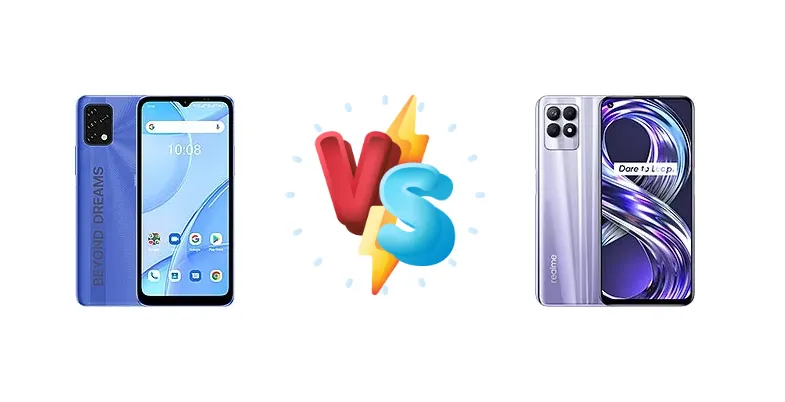
The sub-$200 smartphone market is fiercely competitive. The Umidigi Power 5S and Realme 8i both aim to deliver a solid experience without breaking the bank, but they take different approaches. The Power 5S prioritizes a simple, efficient experience, while the Realme 8i focuses on boosting performance with a more powerful chipset and faster charging.
🏆 Quick Verdict
For most users, the Realme 8i is the better choice. Its MediaTek Helio G96 chipset provides a significantly more responsive experience for gaming and multitasking, and the 18W charging is a welcome upgrade over the Umidigi's 10W. While battery endurance is similar, the Realme 8i's overall performance justifies the slight price premium.
| Network |
|---|
| 2G bands | GSM 850 / 900 / 1800 / 1900 | GSM 850 / 900 / 1800 / 1900 |
| 3G bands | HSDPA 800 / 850 / 900 / 1700(AWS) / 1900 / 2100 | HSDPA 850 / 900 / 2100 |
| 4G bands | 1, 2, 3, 4, 5, 7, 8, 12, 13, 17, 18, 19, 20, 26, 28, 34, 38, 39, 40, 41, 66 | 1, 3, 5, 8, 38, 40, 41 |
| Speed | HSPA, LTE | HSPA, LTE |
| Technology | GSM / HSPA / LTE | GSM / HSPA / LTE |
| Launch |
|---|
| Announced | 2021. Released 2021 | 2021, September 09 |
| Status | Discontinued | Available. Released 2021, September 14 |
| Body |
|---|
| Build | - | Glass front, plastic frame, plastic back |
| Dimensions | 164.8 x 76.9 x 9.9 mm (6.49 x 3.03 x 0.39 in) | 164.1 x 75.5 x 8.5 mm (6.46 x 2.97 x 0.33 in) |
| SIM | Nano-SIM + Nano-SIM | Nano-SIM + Nano-SIM |
| Weight | 215 g (7.58 oz) | 194 g (6.84 oz) |
| Display |
|---|
| Resolution | 720 x 1600 pixels, 20:9 ratio (~269 ppi density) | 1080 x 2412 pixels, 20:9 ratio (~400 ppi density) |
| Size | 6.53 inches, 102.9 cm2 (~81.2% screen-to-body ratio) | 6.6 inches, 104.8 cm2 (~84.6% screen-to-body ratio) |
| Type | IPS LCD | IPS LCD, 120Hz, 600 nits (peak) |
| Platform |
|---|
| CPU | Quad-core (1x2.0 GHz Cortex-A75 & 3x1.8 GHz Cortex-A55) | Octa-core (2x2.05 GHz Cortex-A76 & 6x2.0 GHz Cortex-A55) |
| Chipset | Unisoc Tiger T310 (12nm) | Mediatek MT6781 Helio G96 (12 nm) |
| GPU | PowerVR GE8300 | Mali-G57 MC2 |
| OS | Android 11 | Android 11, Realme UI 2.0 |
| Memory |
|---|
| Card slot | microSDXC (dedicated slot) | microSDXC (dedicated slot) |
| Internal | 32GB 4GB RAM, 64GB 4GB RAM | 64GB 4GB RAM, 128GB 4GB RAM, 128GB 6GB RAM |
| | - | UFS 2.1 |
| Main Camera |
|---|
| Features | Dual-LED flash, HDR, panorama | LED flash, HDR, panorama |
| Single | - | 16 MP, f/2.1, (wide), 1/3.0", 1.0µm |
| Triple | 16 MP, f/2.0, (wide), AF
8 MP, 120˚ (ultrawide)
5 MP (macro) | 50 MP, f/1.8, 26mm (wide), 1/2.76", 0.64µm, PDAF
2 MP (macro)
Auxiliary lens |
| Video | 1080p@30fps | 1080p@30fps |
| Selfie camera |
|---|
| Features | - | Panorama |
| Single | 8 MP, f/2.2, (wide) | 16 MP, f/2.1, (wide), 1/3.0", 1.0µm |
| Video | 1080p@30fps | 1080p@30fps |
| Sound |
|---|
| 3.5mm jack | - | Yes |
| 35mm jack | Yes | Yes |
| Loudspeaker | Yes | Yes |
| Comms |
|---|
| Bluetooth | 5.0, A2DP, LE | 5.1, A2DP, LE |
| NFC | No | Yes (market/region dependent) |
| Positioning | GPS, GLONASS, GALILEO | GPS, GLONASS, GALILEO, BDS |
| Radio | No | No |
| USB | USB Type-C, OTG | USB Type-C 2.0, OTG |
| WLAN | Wi-Fi 802.11 a/b/g/n/ac, dual-band, Wi-Fi Direct | Wi-Fi 802.11 a/b/g/n/ac, dual-band |
| Features |
|---|
| Sensors | Accelerometer, proximity, compass | Fingerprint (side-mounted), accelerometer, gyro, proximity, compass |
| Battery |
|---|
| Charging | 10W wired | 18W wired |
| Type | 6150 mAh | 5000 mAh |
| Misc |
|---|
| Colors | Carbon Grey, Jade Green, Sapphire Blue | Space Black, Space Purple |
| Models | - | RMX3151 |
| Price | - | About 440 EUR |
| Tests |
|---|
| Battery life | - |
Endurance rating 131h
|
| Camera | - |
Photo / Video |
| Loudspeaker | - |
-28.4 LUFS (Average)
|
Umidigi Power 5S
- Potentially more affordable
- Simple and stable software experience
- Decent battery life
- Significantly slower processor
- Slow charging speed (10W)
- Likely a basic display
Realme 8i
- Faster and more responsive performance
- Faster charging (18W)
- Brighter and higher contrast display
- May be slightly more expensive
- Software can be feature-rich but potentially bloated
- Similar battery life to the Umidigi
Display Comparison
The Realme 8i boasts a measured peak brightness of 540 nits and a 1244:1 contrast ratio, suggesting a more vibrant and visible display in outdoor conditions compared to the Umidigi Power 5S, for which display specifications are not provided. While the Power 5S likely utilizes an IPS panel, the Realme 8i’s higher brightness and contrast will result in a superior viewing experience, particularly for media consumption. The lack of detailed display information for the Umidigi suggests a more basic display implementation.
Camera Comparison
Both devices are listed as having Photo/Video capabilities, but detailed camera specifications are absent. Given the price point, it’s reasonable to assume both utilize primary sensors around the 13-50MP range. However, the Realme 8i, being a slightly more premium offering, likely benefits from better image processing algorithms and potentially a larger sensor size, resulting in improved low-light performance and dynamic range. The presence of a dedicated night mode on the Realme 8i (based on typical Realme implementations) would further enhance its camera capabilities. The Umidigi’s camera is likely more basic, focusing on adequate performance in good lighting conditions.
Performance
The Realme 8i’s MediaTek Helio G96, with its octa-core configuration (2x2.05 GHz Cortex-A76 & 6x2.0 GHz Cortex-A55), represents a substantial performance leap over the Umidigi Power 5S’s Unisoc Tiger T310 (Quad-core, 1x2.0 GHz Cortex-A75 & 3x1.8 GHz Cortex-A55). The G96’s Cortex-A76 cores offer significantly higher single-core performance, crucial for app launch speeds and responsiveness. The G96 also benefits from a more modern GPU, translating to smoother gaming experiences. The T310, while efficient, is geared towards basic tasks and will struggle with graphically intensive applications. Both chipsets are built on a 12nm process, but the architectural advantages of the G96 are clear.
Battery Life
Both the Umidigi Power 5S and Realme 8i achieve an endurance rating of 131 hours, indicating comparable battery life under similar usage scenarios. However, the Realme 8i’s 18W wired charging is a significant advantage over the Umidigi’s 10W charging. This translates to a much faster 0-100% charge time, reducing downtime. While both phones offer all-day battery life for moderate users, the Realme 8i’s faster charging provides greater convenience and flexibility.
Buying Guide
Buy the Umidigi Power 5S if you prioritize absolute simplicity and a consistently stable, if slower, experience. It's ideal for users who primarily need a phone for calls, texts, and light social media. Buy the Realme 8i if you value performance, enjoy mobile gaming, or frequently multitask between apps. The faster processor and charging make it a more versatile device for demanding users.
Frequently Asked Questions
❓ Is the Unisoc Tiger T310 in the Umidigi Power 5S capable of running popular games like PUBG Mobile?
While the Unisoc Tiger T310 can *launch* PUBG Mobile, expect significantly reduced graphics settings and potential frame rate drops. It's not optimized for demanding gaming and will likely provide a sub-optimal experience compared to the Realme 8i's Helio G96.
❓ How long does it realistically take to fully charge the Realme 8i with the 18W charger?
With the included 18W charger, the Realme 8i should fully charge from 0% to 100% in approximately 1 hour and 45 minutes to 2 hours, depending on background app activity. This is considerably faster than the Umidigi Power 5S's 10W charging, which could take over 3 hours.
❓ Does the Realme 8i's software include a lot of pre-installed bloatware?
Realme's UI (based on Android) historically includes some pre-installed apps, often referred to as bloatware. However, many of these can be uninstalled, and the overall software experience is generally considered user-friendly, though potentially less 'clean' than the Umidigi's likely stock Android approach.