
Umidigi Power 5S vs. Motorola Moto G Power (2021): A Deep Dive into Budget Smartphone Performance
| Phones Images | |||||
|---|---|---|---|---|---|
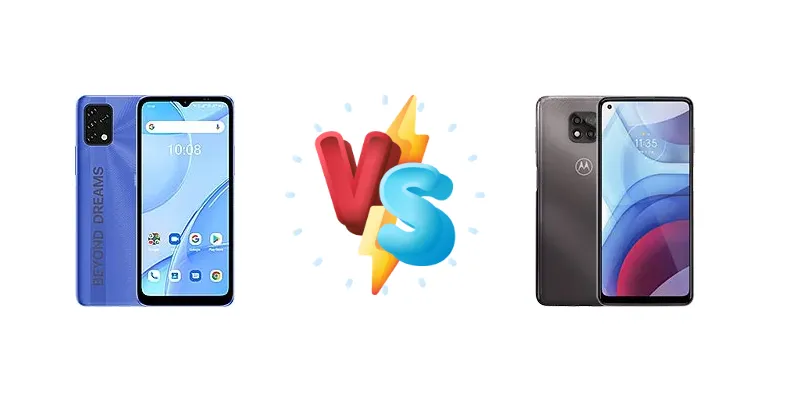
|
🏆 Quick Verdict
For the average user prioritizing consistent performance and a more refined software experience, the Motorola Moto G Power (2021) is the better choice. Its Snapdragon 662 chipset, built on an 11nm process, provides a noticeable advantage in multitasking and app responsiveness compared to the Umidigi Power 5S’s Unisoc Tiger T310.
| PHONES | ||
|---|---|---|
| Phone Names | Umidigi Power 5S | Motorola Moto G Power (2021) |
| Network | ||
|---|---|---|
| 2G bands | GSM 850 / 900 / 1800 / 1900 | GSM 850 / 900 / 1800 / 1900 |
| 3G bands | HSDPA 800 / 850 / 900 / 1700(AWS) / 1900 / 2100 | HSDPA 850 / 900 / 1700(AWS) / 1900 / 2100 |
| 4G bands | 1, 2, 3, 4, 5, 7, 8, 12, 13, 17, 18, 19, 20, 26, 28, 34, 38, 39, 40, 41, 66 | 1, 2, 3, 4, 5, 7, 8, 12, 13, 14, 17, 25, 26, 29, 30, 38, 41, 66, 71 |
| Speed | HSPA, LTE | HSPA, LTE |
| Technology | GSM / HSPA / LTE | GSM / CDMA / HSPA / EVDO / LTE |
| - | CDMA2000 1xEV-DO | |
| Launch | ||
|---|---|---|
| Announced | 2021. Released 2021 | 2021, January 08 |
| Status | Discontinued | Available. Released 2021, January 14 |
| Body | ||
|---|---|---|
| Build | - | Glass front, plastic back, plastic frame |
| Dimensions | 164.8 x 76.9 x 9.9 mm (6.49 x 3.03 x 0.39 in) | 165.3 x 75.9 x 9.5 mm (6.51 x 2.99 x 0.37 in) |
| SIM | Nano-SIM + Nano-SIM | Nano-SIM |
| Weight | 215 g (7.58 oz) | 206.5 g (7.30 oz) |
| - | Water-repellent coating | |
| Display | ||
|---|---|---|
| Resolution | 720 x 1600 pixels, 20:9 ratio (~269 ppi density) | 720 x 1600 pixels, 20:9 ratio (~266 ppi density) |
| Size | 6.53 inches, 102.9 cm2 (~81.2% screen-to-body ratio) | 6.6 inches, 105.2 cm2 (~83.8% screen-to-body ratio) |
| Type | IPS LCD | IPS LCD |
| Platform | ||
|---|---|---|
| CPU | Quad-core (1x2.0 GHz Cortex-A75 & 3x1.8 GHz Cortex-A55) | Octa-core (4x2.0 GHz Kryo 260 Gold & 4x1.8 GHz Kryo 260 Silver) |
| Chipset | Unisoc Tiger T310 (12nm) | Qualcomm SM6115 Snapdragon 662 (11 nm) |
| GPU | PowerVR GE8300 | Adreno 610 |
| OS | Android 11 | Android 10 |
| Memory | ||
|---|---|---|
| Card slot | microSDXC (dedicated slot) | microSDXC (dedicated slot) |
| Internal | 32GB 4GB RAM, 64GB 4GB RAM | 32GB 3GB RAM, 64GB 4GB RAM |
| - | eMMC 5.1 | |
| Main Camera | ||
|---|---|---|
| Features | Dual-LED flash, HDR, panorama | LED flash, HDR, panorama |
| Triple | 16 MP, f/2.0, (wide), AF 8 MP, 120˚ (ultrawide) 5 MP (macro) | 48 MP, f/1.7, (wide), 1/2.0", 0.8µm, PDAF 2 MP (macro) Auxiliary lens |
| Video | 1080p@30fps | 1080p@30/60fps, gyro-EIS |
| Selfie camera | ||
|---|---|---|
| Features | - | HDR |
| Single | 8 MP, f/2.2, (wide) | 8 MP, f/2.0, 1.12µm |
| Video | 1080p@30fps | 1080p@30fps, gyro-EIS |
| Sound | ||
|---|---|---|
| 3.5mm jack | - | Yes |
| 35mm jack | Yes | Yes |
| Loudspeaker | Yes | Yes |
| Comms | ||
|---|---|---|
| Bluetooth | 5.0, A2DP, LE | 5.0, A2DP, LE |
| NFC | No | No |
| Positioning | GPS, GLONASS, GALILEO | GPS, GLONASS, GALILEO |
| Radio | No | FM radio |
| USB | USB Type-C, OTG | USB Type-C 2.0 |
| WLAN | Wi-Fi 802.11 a/b/g/n/ac, dual-band, Wi-Fi Direct | Wi-Fi 802.11 a/b/g/n/ac, dual-band, Wi-Fi Direct |
| Features | ||
|---|---|---|
| Sensors | Accelerometer, proximity, compass | Fingerprint (side-mounted), accelerometer, gyro, proximity, compass, barometer |
| Battery | ||
|---|---|---|
| Charging | 10W wired | 15W wired |
| Type | 6150 mAh | Li-Po 5000 mAh |
| Misc | ||
|---|---|---|
| Colors | Carbon Grey, Jade Green, Sapphire Blue | Flash Gray, Polar Silver |
| Price | - | About 60 EUR |
Umidigi Power 5S
- Potentially lower price point
- Large battery capacity (likely)
- Simple and straightforward software experience
- Significantly weaker processor performance
- Slower 10W charging
- Likely lower build quality
Motorola Moto G Power (2021)
- More powerful Snapdragon 662 processor
- Faster 15W charging
- More refined software experience
- Slightly higher price
- Lower resolution display
- May not have the absolute longest battery life
Display Comparison
Neither device boasts a standout display. Both likely utilize LCD panels, common in this price bracket. The key difference lies under the hood. While specific display specs are unavailable for the Umidigi Power 5S, the Moto G Power (2021) features a 6.6-inch 720p+ display. The lower resolution, while helping battery life, results in a pixel density of around 266 PPI, which isn't particularly sharp. Neither phone is expected to offer high brightness levels or wide color gamuts, making them best suited for indoor use.
Camera Comparison
Both phones likely feature basic camera setups geared towards casual photography. Without detailed sensor information for the Umidigi Power 5S, it’s difficult to make a direct comparison. The Moto G Power (2021) features a 16MP main sensor, which, while not exceptional, is a reasonable performer in good lighting conditions. Image processing on the Motorola is generally more refined, producing more natural-looking photos. Expect both phones to struggle in low-light scenarios, and avoid relying on any included 2MP macro or depth sensors, as their image quality is typically poor.
Performance
The core of the difference lies in the chipsets. The Motorola Moto G Power (2021) utilizes the Qualcomm Snapdragon 662, an octa-core processor built on an 11nm process. This configuration – 4x2.0 GHz Kryo 260 Gold & 4x1.8 GHz Kryo 260 Silver – provides a significant advantage in multi-core performance compared to the Umidigi Power 5S’s Unisoc Tiger T310. The T310, a quad-core processor (1x2.0 GHz Cortex-A75 & 3x1.8 GHz Cortex-A55) built on a 12nm process, will struggle with demanding applications and multitasking. The Snapdragon 662’s more efficient 11nm process also contributes to better thermal management, reducing the likelihood of throttling during sustained use. Users who play mobile games or frequently switch between apps will find the Moto G Power (2021) a far more responsive experience.
Battery Life
Both phones prioritize battery life, but achieve it differently. The Motorola Moto G Power (2021) typically features a 5000mAh battery and supports 15W wired charging. The Umidigi Power 5S also likely has a large battery, but only supports 10W charging. While the Umidigi’s larger battery *might* translate to slightly longer screen-on time, the slower charging speed is a significant drawback. The Moto G Power (2021) can replenish its battery more quickly, minimizing downtime. A full charge from 0-100% on the Motorola will be noticeably faster than on the Umidigi.
Buying Guide
Buy the Umidigi Power 5S if you absolutely need the lowest possible price and are willing to accept compromises in performance for basic tasks like calls, texts, and light social media use. Buy the Motorola Moto G Power (2021) if you prioritize smoother multitasking, a more responsive user interface, and a generally more polished experience, even if it means spending slightly more.