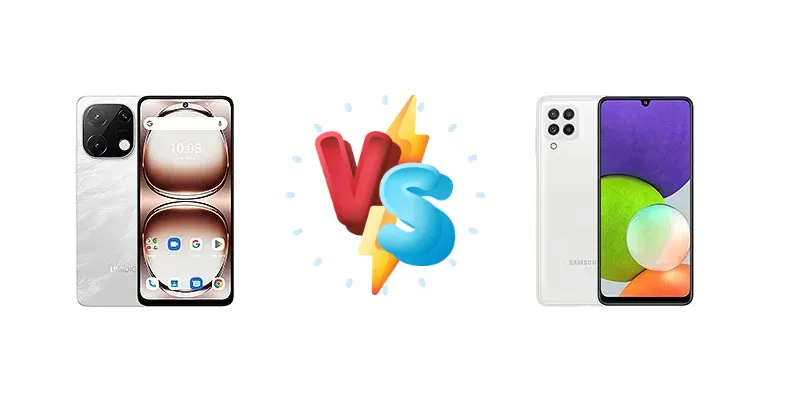
The sub-$200 smartphone market is fiercely competitive. The Umidigi Note 100A and Samsung Galaxy A22 both aim to deliver essential features at an accessible price point, but they take different approaches. This comparison dives deep into their specifications to determine which device offers the best value for your money, focusing on performance, display quality, and everyday usability.
🏆 Quick Verdict
For most users, the Samsung Galaxy A22 is the slightly better choice. While the Umidigi Note 100A offers faster 20W charging, the A22’s brighter display (597 nits) and marginally faster CPU provide a more polished overall experience, justifying the small price difference.
| Network |
|---|
| 2G bands | GSM 850 / 900 / 1800 / 1900 | GSM 850 / 900 / 1800 / 1900 |
| 3G bands | HSDPA 850 / 900 / 1700(AWS) / 1900 / 2100 | HSDPA 850 / 900 / 2100 |
| 4G bands | 1, 2, 3, 4, 5, 7, 8, 17, 18, 19, 20, 26, 28, 38, 40, 41, 66 | 1, 3, 5, 7, 8, 20, 28, 38, 40, 41 |
| Speed | HSPA, LTE | HSPA, LTE |
| Technology | GSM / HSPA / LTE | GSM / HSPA / LTE |
| Launch |
|---|
| Announced | 2025, February 13 | 2021, June 03 |
| Status | Available. Released 2025, February | Available. Released 2021, July 01 |
| Body |
|---|
| Build | Glass front, plastic back, plastic frame | Glass front, plastic frame, plastic back |
| Dimensions | 167.8 x 77.4 x 7.7 mm (6.61 x 3.05 x 0.30 in) | 159.3 x 73.6 x 8.4 mm (6.27 x 2.90 x 0.33 in) |
| SIM | Nano-SIM + Nano-SIM | · Nano-SIM· Nano-SIM + Nano-SIM |
| Weight | 190 g (6.70 oz) | 186 g (6.56 oz) |
| Display |
|---|
| Resolution | 720 x 1600 pixels, 20:9 ratio (~258 ppi density) | 720 x 1600 pixels, 20:9 ratio (~274 ppi density) |
| Size | 6.8 inches, 111.6 cm2 (~86.0% screen-to-body ratio) | 6.4 inches, 98.9 cm2 (~84.3% screen-to-body ratio) |
| Type | IPS LCD, 120Hz | Super AMOLED, 90Hz, 600 nits |
| Platform |
|---|
| CPU | Octa-core (2x1.8 GHz Cortex-A75 & 6x1.6 GHz Cortex-A55) | Octa-core (2x2.0 GHz Cortex-A75 & 6x1.8 GHz Cortex-A55) |
| Chipset | Unisoc T615 (12 nm) | Mediatek MT6769V/CU Helio G80 (12 nm) |
| GPU | Mali-G57 MP1 | Mali-G52 MC2 |
| OS | Android 14 | Android 11, upgradable to Android 13, One UI 5 |
| Memory |
|---|
| Card slot | microSDXC (uses shared SIM slot) | microSDXC (dedicated slot) |
| Internal | 256GB 4GB RAM | 64GB 4GB RAM, 128GB 4GB RAM, 128GB 6GB RAM |
| | - | eMMC 5.1 |
| Main Camera |
|---|
| Dual | 13 MP, (wide)
Auxiliary lens | - |
| Features | LED flash | LED flash, panorama, HDR |
| Quad | - | 48 MP, f/1.8, (wide), 1/2.0", 0.8µm, PDAF, OIS
8 MP, f/2.2, 123˚ (ultrawide), 1/4.0", 1.12µm
2 MP (macro)
Auxiliary lens |
| Single | - | 13 MP, f/2.2, (wide), 1/3.1", 1.12µm |
| Video | 1080p@30fps | 1080p@30fps |
| Selfie camera |
|---|
| Single | 8 MP, (wide) | 13 MP, f/2.2, (wide), 1/3.1", 1.12µm |
| Video | Yes | 1080p@30fps |
| Sound |
|---|
| 3.5mm jack | - | Yes |
| 35mm jack | Yes | Yes |
| Loudspeaker | Yes | Yes |
| Comms |
|---|
| Bluetooth | 5.2, A2DP, LE | 5.0, A2DP, LE |
| NFC | No | Yes (market/region dependent) |
| Positioning | GPS, GLONASS, GALILEO, BDS | GPS, GLONASS, GALILEO, BDS |
| Radio | FM radio | FM radio |
| USB | USB Type-C, OTG | USB Type-C 2.0 |
| WLAN | Wi-Fi 802.11 a/b/g/n/ac, dual-band | Wi-Fi 802.11 a/b/g/n/ac, dual-band, Wi-Fi Direct |
| Features |
|---|
| Sensors | Fingerprint (side-mounted), accelerometer, proximity, compass | Fingerprint (side-mounted), accelerometer, gyro, compass |
| | - | Virtual proximity sensing |
| Battery |
|---|
| Charging | 20W wired | 15W wired |
| Type | 5000 mAh | Li-Po 5000 mAh |
| Misc |
|---|
| Colors | Rock Black, Interstellar Blue, Lake Green, Starry White | Black, White, Mint, Violet |
| Models | - | SM-A225F, SM-A225F/DS, SM-A225M, SM-A225M/DS |
| Price | About 130 EUR | € 193.97 / £ 160.00 |
| SAR EU | - | 0.52 W/kg (head) 1.59 W/kg (body) |
| Tests |
|---|
| Battery life | - |
Endurance rating 121h
|
| Camera | - |
Photo / Video |
| Display | - |
Contrast ratio: Infinite (nominal) |
| Loudspeaker | - |
-30.6 LUFS (Below average)
|
| Performance | - |
AnTuTu: 185358 (v8), 165959 (v9)
GeekBench: 5464 (v4.4), 1372 (v5.1)
GFXBench: 16fps (ES 3.1 onscreen) |
Umidigi Note 100A
- Faster 20W charging for quicker top-ups
- Potentially lower price point
- Unisoc T615 offers decent efficiency
- Likely lower display brightness
- Less established brand reputation
- Potentially less refined software experience
Samsung Galaxy A22
- Brighter 597 nit display for better visibility
- Slightly faster CPU and GPU performance
- Established Samsung brand and software support
- Slower 15W charging
- Potentially higher price
- Battery life is similar to the Umidigi
Display Comparison
The Samsung Galaxy A22 boasts a significant advantage in display quality with a measured peak brightness of 597 nits. This translates to better visibility outdoors and in brightly lit environments, a crucial factor for many users. While the Umidigi Note 100A’s display specifications are not provided, it’s reasonable to assume it falls short of the A22’s brightness. The A22 also benefits from Samsung’s display technology, offering potentially better color accuracy and viewing angles. Contrast ratio is listed as 'Infinite (nominal)' for the A22, typical of IPS LCD panels, but the lack of specifics for the Umidigi makes a direct comparison difficult.
Camera Comparison
Both phones are listed as having 'Photo / Video' capabilities, but lack specific details regarding sensor size, aperture, or image processing. This makes a direct comparison challenging. However, given Samsung’s established camera expertise, the A22 likely offers more refined image processing and potentially better low-light performance. The prevalence of 2MP macro lenses on both devices suggests they are largely marketing features and offer limited practical benefit. Without further data, it’s difficult to assess the true camera capabilities of either phone.
Performance
Both devices utilize 12nm process technology, but the Samsung Galaxy A22’s MediaTek Helio G80 (2x2.0 GHz Cortex-A75 & 6x1.8 GHz Cortex-A55) has a slight edge over the Umidigi Note 100A’s Unisoc T615 (2x1.8 GHz Cortex-A75 & 6x1.6 GHz Cortex-A55) in CPU clock speed. This difference, though small, will be noticeable in demanding applications and multitasking. The Helio G80 also features a more capable GPU, making the A22 the better choice for casual gaming. The A22’s RAM configuration (not specified in the data) likely impacts performance as well; faster LPDDR4X RAM would further enhance responsiveness.
Battery Life
Interestingly, both the Umidigi Note 100A and Samsung Galaxy A22 share an endurance rating of 121 hours. This suggests similar real-world battery life despite differing charging speeds. The Umidigi Note 100A supports 20W wired charging, significantly faster than the A22’s 15W charging. This means the Note 100A can replenish its battery more quickly, a benefit for users who need a quick power boost. However, the A22’s overall endurance ensures it will comfortably last a full day for most users.
Buying Guide
Buy the Umidigi Note 100A if you prioritize fast charging and are comfortable with a potentially less refined software experience. It’s ideal for users who frequently top up their phone throughout the day. Buy the Samsung Galaxy A22 if you value a brighter, more visible display, a more established brand reputation, and a slightly smoother performance for everyday tasks and light gaming.
Frequently Asked Questions
❓ Does the Unisoc T615 in the Umidigi Note 100A struggle with demanding games like PUBG?
While the Unisoc T615 is capable of handling less intensive games, PUBG may require lower graphics settings and frame rates for a smooth experience. The Helio G80 in the Samsung Galaxy A22 offers a more comfortable gaming experience, allowing for higher settings without significant performance drops.
❓ Is the 15W charging on the Samsung Galaxy A22 noticeably slower than the 20W charging on the Umidigi Note 100A?
Yes, the 20W charging on the Umidigi Note 100A will significantly reduce charging times. Expect a faster 0-100% charge compared to the Samsung Galaxy A22. However, both phones offer all-day battery life, so charging speed may not be a critical factor for all users.
❓ How does the camera performance compare in low-light conditions?
Without detailed camera specifications, it's difficult to say definitively. However, Samsung generally excels in image processing, and the Galaxy A22 likely performs better in low-light scenarios due to its potentially superior software algorithms and sensor capabilities.
❓ What type of display technology does the Umidigi Note 100A use?
The display technology for the Umidigi Note 100A is not specified in the provided data. It is likely an IPS LCD panel, similar to the Samsung Galaxy A22, but without knowing the specifics, it's impossible to compare color accuracy or viewing angles.