
Umidigi Note 100A vs Motorola Moto G Power (2021): A Deep Dive into Budget Smartphone Choices
| Phones Images | |||||
|---|---|---|---|---|---|
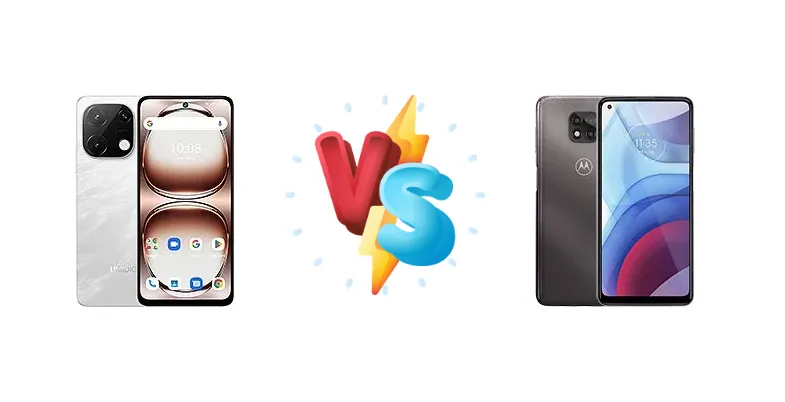
|
🏆 Quick Verdict
For the average user prioritizing consistent performance and battery optimization, the Motorola Moto G Power (2021) is the better choice. While the Umidigi Note 100A boasts a newer Unisoc T615 chip, the Snapdragon 662 in the Moto G Power offers a more refined experience and better power efficiency, translating to longer real-world usage.
| PHONES | ||
|---|---|---|
| Phone Names | Umidigi Note 100A | Motorola Moto G Power (2021) |
| Network | ||
|---|---|---|
| 2G bands | GSM 850 / 900 / 1800 / 1900 | GSM 850 / 900 / 1800 / 1900 |
| 3G bands | HSDPA 850 / 900 / 1700(AWS) / 1900 / 2100 | HSDPA 850 / 900 / 1700(AWS) / 1900 / 2100 |
| 4G bands | 1, 2, 3, 4, 5, 7, 8, 17, 18, 19, 20, 26, 28, 38, 40, 41, 66 | 1, 2, 3, 4, 5, 7, 8, 12, 13, 14, 17, 25, 26, 29, 30, 38, 41, 66, 71 |
| Speed | HSPA, LTE | HSPA, LTE |
| Technology | GSM / HSPA / LTE | GSM / CDMA / HSPA / EVDO / LTE |
| - | CDMA2000 1xEV-DO | |
| Launch | ||
|---|---|---|
| Announced | 2025, February 13 | 2021, January 08 |
| Status | Available. Released 2025, February | Available. Released 2021, January 14 |
| Body | ||
|---|---|---|
| Build | Glass front, plastic back, plastic frame | Glass front, plastic back, plastic frame |
| Dimensions | 167.8 x 77.4 x 7.7 mm (6.61 x 3.05 x 0.30 in) | 165.3 x 75.9 x 9.5 mm (6.51 x 2.99 x 0.37 in) |
| SIM | Nano-SIM + Nano-SIM | Nano-SIM |
| Weight | 190 g (6.70 oz) | 206.5 g (7.30 oz) |
| - | Water-repellent coating | |
| Display | ||
|---|---|---|
| Resolution | 720 x 1600 pixels, 20:9 ratio (~258 ppi density) | 720 x 1600 pixels, 20:9 ratio (~266 ppi density) |
| Size | 6.8 inches, 111.6 cm2 (~86.0% screen-to-body ratio) | 6.6 inches, 105.2 cm2 (~83.8% screen-to-body ratio) |
| Type | IPS LCD, 120Hz | IPS LCD |
| Platform | ||
|---|---|---|
| CPU | Octa-core (2x1.8 GHz Cortex-A75 & 6x1.6 GHz Cortex-A55) | Octa-core (4x2.0 GHz Kryo 260 Gold & 4x1.8 GHz Kryo 260 Silver) |
| Chipset | Unisoc T615 (12 nm) | Qualcomm SM6115 Snapdragon 662 (11 nm) |
| GPU | Mali-G57 MP1 | Adreno 610 |
| OS | Android 14 | Android 10 |
| Memory | ||
|---|---|---|
| Card slot | microSDXC (uses shared SIM slot) | microSDXC (dedicated slot) |
| Internal | 256GB 4GB RAM | 32GB 3GB RAM, 64GB 4GB RAM |
| - | eMMC 5.1 | |
| Main Camera | ||
|---|---|---|
| Dual | 13 MP, (wide) Auxiliary lens | - |
| Features | LED flash | LED flash, HDR, panorama |
| Triple | - | 48 MP, f/1.7, (wide), 1/2.0", 0.8µm, PDAF 2 MP (macro) Auxiliary lens |
| Video | 1080p@30fps | 1080p@30/60fps, gyro-EIS |
| Selfie camera | ||
|---|---|---|
| Features | - | HDR |
| Single | 8 MP, (wide) | 8 MP, f/2.0, 1.12µm |
| Video | Yes | 1080p@30fps, gyro-EIS |
| Sound | ||
|---|---|---|
| 3.5mm jack | - | Yes |
| 35mm jack | Yes | Yes |
| Loudspeaker | Yes | Yes |
| Comms | ||
|---|---|---|
| Bluetooth | 5.2, A2DP, LE | 5.0, A2DP, LE |
| NFC | No | No |
| Positioning | GPS, GLONASS, GALILEO, BDS | GPS, GLONASS, GALILEO |
| Radio | FM radio | FM radio |
| USB | USB Type-C, OTG | USB Type-C 2.0 |
| WLAN | Wi-Fi 802.11 a/b/g/n/ac, dual-band | Wi-Fi 802.11 a/b/g/n/ac, dual-band, Wi-Fi Direct |
| Features | ||
|---|---|---|
| Sensors | Fingerprint (side-mounted), accelerometer, proximity, compass | Fingerprint (side-mounted), accelerometer, gyro, proximity, compass, barometer |
| Battery | ||
|---|---|---|
| Charging | 20W wired | 15W wired |
| Type | 5000 mAh | Li-Po 5000 mAh |
| Misc | ||
|---|---|---|
| Colors | Rock Black, Interstellar Blue, Lake Green, Starry White | Flash Gray, Polar Silver |
| Price | About 130 EUR | About 60 EUR |
Umidigi Note 100A
- Faster 20W wired charging
- Newer Unisoc T615 chipset architecture
- Potentially lower price point
- Less efficient Unisoc T615 chipset
- Potential software optimization issues
- Unknown display quality
Motorola Moto G Power (2021)
- More efficient Snapdragon 662 chipset
- Proven battery life and optimization
- Reliable software support from Motorola
- Slower 15W wired charging
- Lower resolution display
- Older chipset design
Display Comparison
Neither device is a display standout. Both likely feature LCD panels, typical for this price bracket. The key difference lies under the hood. While specific display specs are unavailable for the Umidigi, the Moto G Power’s 720p+ resolution on a 6.6-inch display results in a lower pixel density. This isn’t a dealbreaker, but text and images won’t appear as sharp. The lack of high refresh rates on either device is expected, but the panel quality will likely be similar, leaning towards functional rather than immersive.
Camera Comparison
Camera performance is likely to be similar, with both phones focusing on affordability over image quality. Details on sensor sizes are missing, but both will likely feature a primary sensor paired with basic auxiliary lenses. The Motorola’s image processing is generally more refined, offering more consistent results in various lighting conditions. The Umidigi may attempt to enhance images through software, but this can often lead to over-sharpening or unnatural colors. Without specific sensor details, it’s difficult to declare a clear winner, but Motorola’s established camera algorithms give it a slight edge.
Performance
The core of the difference lies in the chipsets. The Motorola Moto G Power (2021) utilizes the Qualcomm Snapdragon 662 (11 nm), built on a smaller process node than the Umidigi’s Unisoc T615 (12 nm). This 11nm process generally translates to better power efficiency and thermal management. While the Unisoc T615 features newer Cortex-A75 cores (2x1.8 GHz) alongside Cortex-A55s, the Snapdragon 662’s Kryo 260 Gold cores (4x2.0 GHz) are optimized for sustained performance. The Snapdragon 662’s Adreno 610 GPU is also likely to provide a smoother gaming experience than the Unisoc’s integrated GPU. The Motorola’s chipset benefits from Qualcomm’s extensive software optimization, a crucial factor in real-world responsiveness.
Battery Life
The Motorola Moto G Power (2021) shines in battery life. While the exact capacity isn’t specified, Motorola’s ‘Power’ branding signifies a large battery, typically around 5000mAh. Coupled with the efficient Snapdragon 662 and 15W charging, users can expect all-day, and potentially multi-day, battery life with moderate usage. The Umidigi Note 100A’s 20W charging is faster on paper, but the less efficient Unisoc T615 will likely drain the battery quicker. Faster charging is less impactful if the battery depletes rapidly.
Buying Guide
Buy the Umidigi Note 100A if you need the latest chipset architecture and are comfortable potentially troubleshooting software quirks. Its Unisoc T615 offers a theoretical performance edge, but may not be fully optimized. Buy the Motorola Moto G Power (2021) if you prefer a reliable, well-supported device with excellent battery life and a proven track record. It’s the safer bet for users who value stability and longevity over raw specs.