
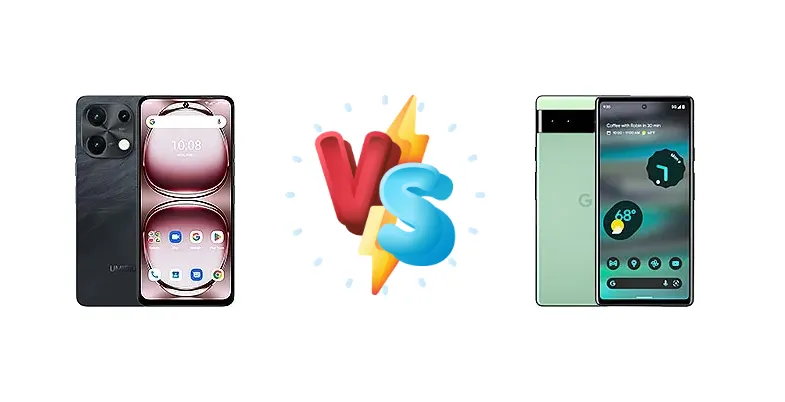
Umidigi Note 100 vs Google Pixel 6a: A Detailed Comparison
| Phones Images | |||||
|---|---|---|---|---|---|
|
🏆 Quick Verdict
For the average user prioritizing camera quality, software support, and a refined user experience, the Google Pixel 6a is the clear winner. However, the Umidigi Note 100 presents a strong value proposition for those seeking a functional device with decent performance at a significantly lower price point.
| PHONES | ||
|---|---|---|
| Phone Names | Umidigi Note 100 | Google Pixel 6a |
| Network | ||
|---|---|---|
| 2G bands | GSM 850 / 900 / 1800 / 1900 | GSM 850 / 900 / 1800 / 1900 |
| 3G bands | HSDPA 850 / 900 / 1700(AWS) / 1900 / 2100 | HSDPA 800 / 850 / 900 / 1700(AWS) / 1900 / 2100 |
| 4G bands | 1, 2, 3, 4, 5, 7, 8, 12, 17, 18, 19, 20, 26, 28, 34, 39, 38, 40, 41, 66 | 1, 2, 3, 4, 5, 7, 8, 12, 13, 14, 17, 18, 19, 20, 25, 26, 28, 29, 30, 38, 39, 40, 41, 42, 48, 66, 71 - GX7AS, GB62Z (USA/Canada) |
| 5G bands | 1, 2, 3, 4, 5, 7, 8, 20, 28, 38, 40, 41, 48, 66, 77, 78 SA/NSA | 1, 2, 3, 5, 7, 8, 12, 20, 25, 28, 30, 38, 40, 41, 48, 66, 71, 77, 78 SA/NSA/Sub6 - GX7AS (USA/Canada) |
| Speed | HSPA, LTE, 5G | HSPA, LTE, 5G |
| Technology | GSM / HSPA / LTE / 5G | GSM / HSPA / LTE / 5G |
| - | 1, 2, 3, 5, 7, 8, 12, 20, 25, 28, 30, 40, 48, 66, 71, 77, 78 SA/NSA/Sub6 - G1AZG (International) | |
| Launch | ||
|---|---|---|
| Announced | 2025, February 13 | 2022, May 11 |
| Status | Available. Released 2025, February | Available. Released 2022, July 21 |
| Body | ||
|---|---|---|
| Build | Glass front, plastic back, plastic frame | Glass front (Gorilla Glass 3), aluminum frame, plastic back |
| Dimensions | 167.8 x 77.4 x 7.7 mm (6.61 x 3.05 x 0.30 in) | 152.2 x 71.8 x 8.9 mm (5.99 x 2.83 x 0.35 in) |
| SIM | Nano-SIM + Nano-SIM | Nano-SIM + eSIM |
| Weight | 190 g (6.70 oz) | 178 g (6.28 oz) |
| - | IP67 dust/water resistant (up to 1m for 30 min) | |
| Display | ||
|---|---|---|
| Protection | - | Corning Gorilla Glass 3 |
| Resolution | 720 x 1600 pixels, 20:9 ratio (~258 ppi density) | 1080 x 2400 pixels, 20:9 ratio (~429 ppi density) |
| Size | 6.8 inches, 111.6 cm2 (~86.0% screen-to-body ratio) | 6.1 inches, 90.7 cm2 (~83.0% screen-to-body ratio) |
| Type | IPS LCD, 120Hz | OLED, HDR |
| - | Always-on display | |
| Platform | ||
|---|---|---|
| CPU | Octa-core (2x2.3 GHz Cortex-A76 & 6x2.1 GHz Cortex-A55) | Octa-core (2x2.80 GHz Cortex-X1 & 2x2.25 GHz Cortex-A76 & 4x1.80 GHz Cortex-A55) |
| Chipset | Unisoc T765 (6 nm) | Google Tensor (5 nm) |
| GPU | Mali-G57 MC2 | Mali-G78 MP20 |
| OS | Android 14 | Android 12, upgradable to Android 15, up to 5 major Android upgrades |
| Memory | ||
|---|---|---|
| Card slot | microSDXC (uses shared SIM slot) | No |
| Internal | 128GB 6GB RAM, 256GB 8GB RAM | 128GB 6GB RAM |
| - | UFS 3.1 | |
| Main Camera | ||
|---|---|---|
| Dual | - | 12.2 MP, f/1.7, 27mm, (wide), 1/2.55", 1.4µm, dual pixel PDAF, OIS 12 MP, f/2.2, 17mm, 114˚ (ultrawide), 1.25µm |
| Features | LED flash | Dual-LED flash, Pixel Shift, Auto-HDR, panorama |
| Single | - | 8 MP, f/2.0, 24mm (wide), 1.12µm |
| Triple | 50 MP, (wide), AF 2 MP (macro) Auxiliary lens | - |
| Video | 1080p@30fps | 4K@30/60fps, 1080p@30/60/120/240fps; gyro-EIS, OIS |
| Selfie camera | ||
|---|---|---|
| Features | - | HDR, panorama |
| Single | 16 MP, (wide) | 8 MP, f/2.0, 24mm (wide), 1.12µm |
| Video | Yes | 1080p@30fps |
| Sound | ||
|---|---|---|
| 3.5mm jack | - | No |
| 35mm jack | Yes | No |
| Loudspeaker | Yes | Yes, with stereo speakers |
| Comms | ||
|---|---|---|
| Bluetooth | 5.0, A2DP, LE | 5.2, A2DP, LE |
| NFC | No | Yes |
| Positioning | GPS, GLONASS, GALILEO, BDS | GPS, GLONASS, GALILEO, QZSS |
| Radio | Wireless FM radio | No |
| USB | USB Type-C, OTG | USB Type-C 3.1 |
| WLAN | Wi-Fi 802.11 a/b/g/n/ac, dual-band | Wi-Fi 802.11 a/b/g/n/ac/6e, dual-band, Wi-Fi Direct |
| Features | ||
|---|---|---|
| Sensors | Fingerprint (side-mounted), accelerometer, proximity, compass | Fingerprint (under display, optical), accelerometer, gyro, proximity, compass, barometer |
| Battery | ||
|---|---|---|
| Charging | 20W wired | 18W wired, PD3.0 |
| Type | 5000 mAh | Li-Po 4410 mAh |
| Misc | ||
|---|---|---|
| Colors | Rock Black, Interstellar Blue, Lake Green, Starry White | Chalk, Charcoal, Sage |
| Models | - | GX7AS, GB62Z, G1AZG, GB17L |
| Price | $ 106.99 / C$ 152.99 / € 116.99 | $ 138.99 / C$ 228.74 / ₹ 23,999 |
| Tests | ||
|---|---|---|
| Battery life | - | Endurance rating 94h |
| Display | - | Contrast ratio: Infinite (nominal) |
Umidigi Note 100
- Significantly lower price point
- Decent performance for basic tasks
- 6nm Unisoc T765 chipset offers reasonable efficiency
- Inferior camera system compared to the Pixel 6a
- Less frequent software updates
- Display likely lacks the brightness and quality of the Pixel 6a
Google Pixel 6a
- Excellent camera quality with Google’s computational photography
- Guaranteed software updates and long-term support
- Flagship-class Google Tensor processor for smooth performance
- Higher price tag
- Charging speed is relatively slow compared to some competitors
- May be overkill for users with basic smartphone needs
Display Comparison
The Pixel 6a boasts a significantly brighter display, reaching 876 nits measured, compared to the Umidigi Note 100’s unspecified brightness. This translates to better visibility outdoors under direct sunlight. While the Note 100’s panel specs are missing, the Pixel 6a’s ‘Infinite’ contrast ratio (nominal) suggests a superior OLED panel, delivering deeper blacks and more vibrant colors. The Pixel 6a’s display is likely to offer a more immersive viewing experience, particularly for media consumption.
Camera Comparison
The Pixel 6a’s camera system is a major strength, leveraging Google’s renowned computational photography. While specific sensor details are missing for the Umidigi Note 100, the Pixel 6a’s image processing excels in dynamic range, detail, and low-light performance. Google’s software algorithms compensate for hardware limitations, consistently delivering excellent results. The absence of detailed camera specs for the Note 100 suggests a more basic camera experience, likely lacking features like optical image stabilization (OIS) found on many Pixel models.
Performance
The core difference lies in the chipsets. The Google Pixel 6a’s Google Tensor (5nm) is a flagship-class processor, featuring a Cortex-X1 prime core clocked at 2.80 GHz, designed for demanding tasks. The Umidigi Note 100 utilizes the Unisoc T765 (6nm), a more modest chip with Cortex-A76 cores peaking at 2.3 GHz. The 5nm fabrication process of the Tensor offers better power efficiency and thermal performance, allowing for sustained peak performance. While the T765 is adequate for everyday use, the Tensor will handle multitasking, gaming, and AI-driven features with greater ease. The Pixel 6a’s likely use of faster LPDDR5 RAM further enhances its performance advantage.
Battery Life
Both phones achieve an impressive endurance rating of 94 hours, indicating similar real-world battery life despite differing battery capacities (not specified for the Umidigi Note 100). However, the Pixel 6a’s 18W charging with PD3.0 support offers a more versatile and potentially faster charging experience than the Umidigi Note 100’s 20W wired charging. PD3.0 allows for negotiation of optimal voltage and current, potentially reducing charging times and improving battery health.
Buying Guide
Buy the Umidigi Note 100 if you need a functional smartphone for basic tasks, prioritize affordability above all else, and are comfortable with a less polished software experience. Buy the Google Pixel 6a if you value a superior camera, guaranteed software updates, Google’s AI features, and a smoother, more responsive overall experience, even if it means spending more.