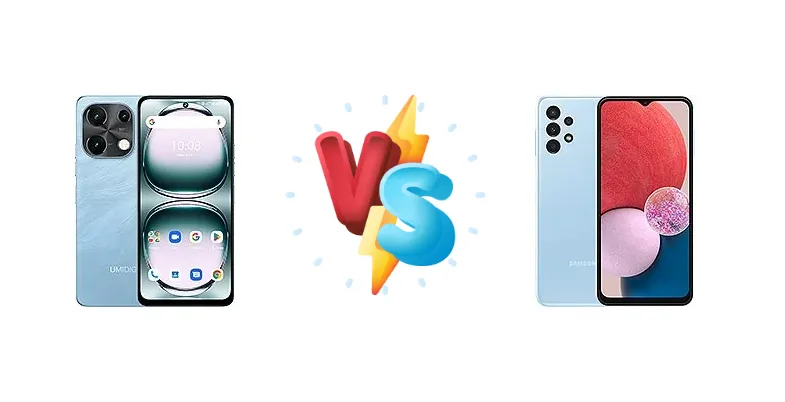
The sub-$200 smartphone market is fiercely competitive. Both the Umidigi Note 100 4G and the Samsung Galaxy A13 (SM-A137) aim to deliver essential smartphone functionality at an accessible price. However, they take different approaches to achieving this, primarily through chipset selection and charging implementation. This comparison dissects those differences to help you choose the right device.
🏆 Quick Verdict
For the average user prioritizing sustained performance and faster charging, the Umidigi Note 100 4G emerges as the better choice. While the Samsung Galaxy A13 benefits from brand recognition and software support, the Unisoc T615’s Cortex-A75 cores and 20W charging offer a tangible advantage in everyday tasks and power-user scenarios.
| Network |
|---|
| 2G bands | GSM 850 / 900 / 1800 / 1900 | GSM 850 / 900 / 1800 / 1900 |
| 3G bands | HSDPA 850 / 900 / 1700(AWS) / 1900 / 2100 | HSDPA 850 / 900 / 2100 |
| 4G bands | 1, 2, 3, 4, 5, 7, 8, 17, 18, 19, 20, 26, 28, 38, 40, 41, 66 | 1, 3, 5, 7, 8, 20, 28, 38, 40, 41 |
| Speed | HSPA, LTE | HSPA, LTE |
| Technology | GSM / HSPA / LTE | GSM / HSPA / LTE |
| Launch |
|---|
| Announced | 2025, October | 2022, June |
| Status | Available. Released 2025, October | Available. Released 2022, July |
| Body |
|---|
| Build | Glass front, plastic back, plastic frame | Glass front (Gorilla Glass 5), plastic frame, plastic back |
| Dimensions | 167.8 x 77.4 x 7.7 mm (6.61 x 3.05 x 0.30 in) | 165.1 x 76.4 x 8.8 mm (6.5 x 3.01 x 0.35 in) |
| SIM | Nano-SIM + Nano-SIM | · Nano-SIM· Nano-SIM + Nano-SIM |
| Weight | 190 g (6.70 oz) | 195 g (6.88 oz) |
| Display |
|---|
| Protection | - | Corning Gorilla Glass 5 |
| Resolution | 720 x 1600 pixels, 20:9 ratio (~258 ppi density) | 1080 x 2408 pixels, 20:9 ratio (~400 ppi density) |
| Size | 6.8 inches, 111.6 cm2 (~86.0% screen-to-body ratio) | 6.6 inches, 104.9 cm2 (~83.2% screen-to-body ratio) |
| Type | IPS LCD, 120Hz | PLS LCD |
| Platform |
|---|
| CPU | Octa-core (2x1.8 GHz Cortex-A75 & 6x1.6 GHz Cortex-A55) | Octa-core (2x2.0 GHz Cortex-A75 & 6x1.8 GHz Cortex-A55) |
| Chipset | Unisoc T615 (12 nm) | Mediatek MT6769V/CU Helio G80 (12 nm) |
| GPU | Mali-G57 MP1 | Mali-G52 MC2 |
| OS | Android 14 | Android 12, upgradable to Android 14, One UI 6.1 |
| Memory |
|---|
| Card slot | microSDXC (uses shared SIM slot) | microSDXC (dedicated slot) |
| Internal | 128GB 6GB RAM, 256GB 8GB RAM | 32GB 3GB RAM, 32GB 4GB RAM, 64GB 4GB RAM, 128GB 4GB RAM |
| | - | eMMC 5.1 |
| Main Camera |
|---|
| Features | LED flash | LED flash, panorama, HDR |
| Quad | - | 50 MP, f/1.8, (wide), PDAF
5 MP, f/2.2, 123˚ (ultrawide), 1/5.0", 1.12µm
2 MP (macro)
Auxiliary lens |
| Single | - | 8 MP, f/2.2, (wide) |
| Triple | 50 MP, (wide), AF
2 MP (macro)
Auxiliary lens | - |
| Video | 1080p@30fps | 1080p@30fps |
| Selfie camera |
|---|
| Single | 16 MP, (wide) | 8 MP, f/2.2, (wide) |
| Video | Yes | 1080p@30fps |
| Sound |
|---|
| 3.5mm jack | - | Yes |
| 35mm jack | Yes | Yes |
| Loudspeaker | Yes | Yes |
| Comms |
|---|
| Bluetooth | 5.2, A2DP, LE | 5.2, A2DP, LE |
| NFC | Yes | Yes |
| Positioning | GPS, GLONASS, GALILEO, BDS | GPS, GLONASS, GALILEO, BDS |
| Radio | FM radio | No |
| USB | USB Type-C, OTG | USB Type-C 2.0, OTG |
| WLAN | Wi-Fi 802.11 a/b/g/n/ac, dual-band | Wi-Fi 802.11 a/b/g/n/ac, dual-band, Wi-Fi Direct |
| Features |
|---|
| Sensors | Fingerprint (side-mounted), accelerometer, proximity, compass | Fingerprint (side-mounted), accelerometer, compass |
| | - | Virtual proximity sensing |
| Battery |
|---|
| Charging | 20W wired | 15W wired |
| Type | 5000 mAh | Li-Po 5000 mAh |
| Misc |
|---|
| Colors | Rock Black, Interstellar Blue, Starry White | Black, White, Blue |
| Models | - | SM-A137F, SM-A137F/DSN, SM-A137F/DS |
| Price | - | About 180 EUR |
| SAR EU | - | 0.35 W/kg (head) 1.22 W/kg (body) |
Umidigi Note 100 4G
- Faster 20W charging for quicker top-ups.
- Potentially better sustained performance due to Unisoc T615’s efficiency.
- Competitive price point offering good value.
- Less established brand recognition compared to Samsung.
- Software updates may be less frequent and slower to arrive.
Samsung Galaxy A13 (SM-A137)
- Strong brand reputation and reliability from Samsung.
- Likely more frequent and timely software updates.
- Wider availability of accessories and support.
- Slower 15W charging.
- Helio G80 may throttle under sustained load.
- Potentially higher price compared to Umidigi.
Display Comparison
Neither device boasts a standout display. Both likely utilize IPS LCD panels, common in this price bracket. However, detailed specs like resolution and peak brightness are missing. The focus here is on internal performance, not visual fidelity. Bezels are expected to be relatively substantial on both, impacting screen-to-body ratio. Color accuracy will likely be standard for the segment, prioritizing power efficiency over color calibration.
Camera Comparison
Camera performance is difficult to assess without detailed sensor information. Both phones likely feature a multi-camera setup with a primary sensor, ultra-wide, and potentially macro/depth sensors. However, the prevalence of low-resolution 2MP macro lenses in this segment suggests limited utility. The aperture of the main sensor will be the key determinant of low-light performance. Image processing algorithms will also play a significant role, and Samsung typically offers more refined software processing. Without specific sensor sizes and aperture data, it’s difficult to declare a clear winner, but Samsung’s software advantage is a likely factor.
Performance
The core difference lies in the chipsets. The Samsung Galaxy A13 features the MediaTek Helio G80, utilizing a dual-core Cortex-A75 setup clocked at 2.0 GHz, paired with six Cortex-A55 cores at 1.8 GHz. The Umidigi Note 100 4G, conversely, employs the Unisoc T615, with a dual-core Cortex-A75 clocked slightly lower at 1.8 GHz, and six Cortex-A55 cores at 1.6 GHz. While the G80 has a higher clock speed on its A75 cores, the Unisoc T615’s architecture is generally considered more efficient. This translates to potentially better sustained performance under load, as the T615 is less prone to thermal throttling. Both utilize a 12nm process, but the architectural differences give the edge to Umidigi for demanding tasks. RAM configurations are not specified, but LPDDR4X is likely standard on both.
Battery Life
Battery capacity is not specified for either device, but both likely fall in the 5000mAh range, typical for this price point. The critical difference is charging speed. The Umidigi Note 100 4G supports 20W wired charging, while the Samsung Galaxy A13 is limited to 15W. This 5W difference translates to a noticeably faster 0-100% charge time for the Umidigi, a significant benefit for users who prioritize convenience. While a larger battery capacity *could* offset the slower charging, the 20W implementation on the Umidigi provides a more immediate and tangible benefit.
Buying Guide
Buy the Umidigi Note 100 4G if you need a phone that feels responsive during multitasking and benefits from quicker charging times, even if it means sacrificing Samsung’s established software ecosystem. Buy the Samsung Galaxy A13 (SM-A137) if you prioritize brand reliability, guaranteed software updates, and a wider range of readily available accessories, and are willing to accept slightly slower performance and charging.
Frequently Asked Questions
❓ Will the Unisoc T615 in the Umidigi Note 100 4G struggle with graphically intensive games like PUBG Mobile?
While the Unisoc T615 isn't a gaming powerhouse, it should be capable of running PUBG Mobile at medium settings with reasonable frame rates. The key advantage is its efficiency, which will help prevent overheating and throttling during extended gaming sessions, offering a more consistent experience than the Helio G80 which is more prone to thermal limitations.
❓ How significant is the difference in charging speed between 15W and 20W on these phones?
The 5W difference translates to a noticeable time saving. A typical 0-100% charge on the Samsung Galaxy A13 (15W) could take around 2.5-3 hours, while the Umidigi Note 100 4G (20W) should complete the same task in approximately 1.8-2.2 hours. This is particularly beneficial for users who need to quickly top up their battery during the day.
❓ Does the Samsung Galaxy A13 offer any software features not found on the Umidigi Note 100 4G?
Samsung’s One UI offers a more polished and feature-rich software experience compared to the typically stock-Android approach of Umidigi. Features like Samsung Pay, Secure Folder, and more advanced camera modes are exclusive to Samsung devices. Software update frequency and longevity are also generally better on Samsung phones.