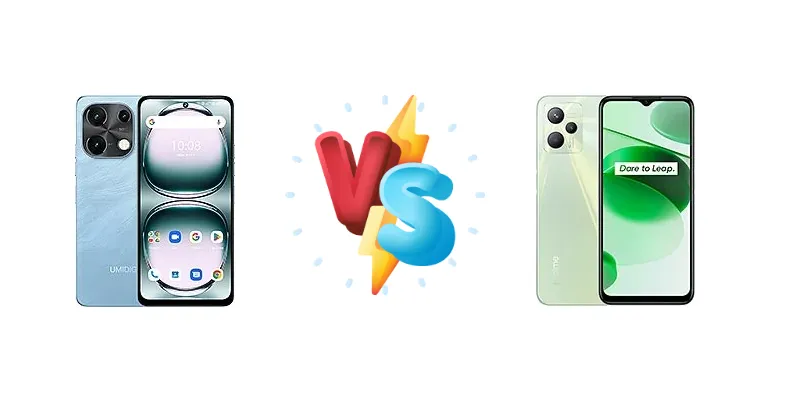
The Umidigi Note 100 4G and Realme C35 represent the fiercely competitive sub-$150 smartphone market. Both devices leverage Unisoc chipsets, but subtle differences in CPU clock speeds and charging capabilities could sway your decision. This comparison dives deep into the specifics to determine which phone delivers the best experience for your money.
🏆 Quick Verdict
For most users, the Realme C35 edges out the Umidigi Note 100 4G. While the Umidigi offers slightly faster 20W charging, the Realme C35’s marginally faster CPU clock speeds in the Unisoc Tiger T616 translate to a snappier overall experience, making it the better daily driver.
| Network |
|---|
| 2G bands | GSM 850 / 900 / 1800 / 1900 | GSM 850 / 900 / 1800 / 1900 |
| 3G bands | HSDPA 850 / 900 / 1700(AWS) / 1900 / 2100 | HSDPA 850 / 900 / 2100 |
| 4G bands | 1, 2, 3, 4, 5, 7, 8, 17, 18, 19, 20, 26, 28, 38, 40, 41, 66 | 1, 3, 5, 7, 8, 20, 28, 38, 40, 41 |
| Speed | HSPA, LTE | HSPA, LTE |
| Technology | GSM / HSPA / LTE | GSM / HSPA / LTE |
| Launch |
|---|
| Announced | 2025, October | 2022, February 10 |
| Status | Available. Released 2025, October | Available. Released 2022, February 14 |
| Body |
|---|
| Build | Glass front, plastic back, plastic frame | Glass front, plastic frame, plastic back |
| Dimensions | 167.8 x 77.4 x 7.7 mm (6.61 x 3.05 x 0.30 in) | 164.4 x 75.6 x 8.1 mm (6.47 x 2.98 x 0.32 in) |
| SIM | Nano-SIM + Nano-SIM | Nano-SIM + Nano-SIM |
| Weight | 190 g (6.70 oz) | 189 g (6.67 oz) |
| Display |
|---|
| Protection | - | Panda Glass |
| Resolution | 720 x 1600 pixels, 20:9 ratio (~258 ppi density) | 1080 x 2408 pixels, 20:9 ratio (~401 ppi density) |
| Size | 6.8 inches, 111.6 cm2 (~86.0% screen-to-body ratio) | 6.6 inches, 104.4 cm2 (~84.0% screen-to-body ratio) |
| Type | IPS LCD, 120Hz | IPS LCD, 480 nits (typ), 600 nits (HBM) |
| Platform |
|---|
| CPU | Octa-core (2x1.8 GHz Cortex-A75 & 6x1.6 GHz Cortex-A55) | Octa-core (2x2.0 GHz Cortex-A75 & 6x1.8 GHz Cortex-A55) |
| Chipset | Unisoc T615 (12 nm) | Unisoc Tiger T616 (12 nm) |
| GPU | Mali-G57 MP1 | Mali-G57 MP1 |
| OS | Android 14 | Android 11, Realme UI 2.0 |
| Memory |
|---|
| Card slot | microSDXC (uses shared SIM slot) | microSDXC (dedicated slot) |
| Internal | 128GB 6GB RAM, 256GB 8GB RAM | 64GB 4GB RAM, 64GB 6GB RAM, 128GB 4GB RAM, 128GB 6GB RAM |
| | - | UFS 2.2 |
| Main Camera |
|---|
| Features | LED flash | LED flash, HDR, panorama |
| Single | - | 8 MP, f/2.0, 26mm (wide), 1/4.0", 1.12µm |
| Triple | 50 MP, (wide), AF
2 MP (macro)
Auxiliary lens | 50 MP, f/1.8, 26mm (wide), 1/2.76", 0.64µm, PDAF
2 MP (macro)
Auxiliary lens |
| Video | 1080p@30fps | 1080p@30fps |
| Selfie camera |
|---|
| Features | - | HDR |
| Single | 16 MP, (wide) | 8 MP, f/2.0, 26mm (wide), 1/4.0", 1.12µm |
| Video | Yes | 720p@30fps |
| Sound |
|---|
| 3.5mm jack | - | Yes |
| 35mm jack | Yes | Yes |
| Loudspeaker | Yes | Yes |
| Comms |
|---|
| Bluetooth | 5.2, A2DP, LE | 5.0, A2DP, LE |
| NFC | Yes | Yes (market/region dependent) |
| Positioning | GPS, GLONASS, GALILEO, BDS | GPS, GLONASS, GALILEO, BDS |
| Radio | FM radio | FM radio |
| USB | USB Type-C, OTG | USB Type-C 2.0, OTG |
| WLAN | Wi-Fi 802.11 a/b/g/n/ac, dual-band | Wi-Fi 802.11 a/b/g/n/ac, dual-band |
| Features |
|---|
| Sensors | Fingerprint (side-mounted), accelerometer, proximity, compass | Fingerprint (side-mounted), accelerometer, gyro, proximity, compass |
| Battery |
|---|
| Charging | 20W wired | 18W wired |
| Type | 5000 mAh | 5000 mAh |
| Misc |
|---|
| Colors | Rock Black, Interstellar Blue, Starry White | Glowing Black, Glowing Green |
| Models | - | RMX3511 |
| Price | - | £ 129.99 / ₹ 7,999 |
| SAR | - | 1.19 W/kg (head) 1.13 W/kg (body) |
Umidigi Note 100 4G
- Slightly faster 20W charging
- Potentially lower price point
- Unisoc T615 is a proven chipset
- Slightly slower CPU clock speeds
- May have less optimized software
- Unknown battery capacity
Realme C35
- Marginally faster CPU (Unisoc T616)
- Potentially better software optimization
- Realme's established brand reputation
- Slower 18W charging
- May be slightly more expensive
- Unknown battery capacity
Display Comparison
Neither Umidigi nor Realme provide display specifications beyond the basic panel type. Assuming both utilize standard IPS LCDs common in this price bracket, the display experience will likely be similar. Color accuracy and peak brightness are likely to be modest. The absence of high refresh rates or advanced features like LTPO is standard for this segment, meaning users should expect a basic visual experience.
Camera Comparison
Detailed camera specifications are unavailable. Given the price point, both phones likely feature a primary camera paired with depth and macro sensors. The quality of the primary sensor will be the determining factor, but without knowing the sensor size or aperture, it’s difficult to make a definitive judgment. The 2MP macro cameras found on many phones in this class are generally of limited utility. Image processing will likely be basic, prioritizing speed over detail. Users shouldn't expect flagship-level camera performance from either device.
Performance
The core difference lies in the chipsets: the Umidigi Note 100 4G features the Unisoc T615, while the Realme C35 uses the Unisoc Tiger T616. Both are 12nm chips with an octa-core configuration (2x Cortex-A75 and 6x Cortex-A55). However, the Realme C35’s T616 boasts a slightly higher CPU clock speed – 2.0 GHz for the A75 cores versus 1.8 GHz on the Umidigi. This 0.2 GHz difference, while seemingly small, can result in a noticeable improvement in app launch times and overall system responsiveness. Both phones will likely handle everyday tasks adequately, but the Realme C35 will likely exhibit less stuttering during multitasking. The GPU performance is expected to be similar, limiting both phones to light gaming.
Battery Life
Battery capacity is not specified for either device. However, the Realme C35’s 18W charging is slightly slower than the Umidigi Note 100 4G’s 20W charging. While the difference isn’t massive, the Umidigi will theoretically charge from 0-100% slightly faster. The actual charging time will depend on the battery capacity, but the 2W difference could translate to a 5-10 minute advantage for the Umidigi. Real-world battery life will depend heavily on usage patterns, but both phones should comfortably last a full day with moderate use.
Buying Guide
Buy the Umidigi Note 100 4G if you prioritize slightly faster charging speeds and are on a very tight budget. It’s a solid option for basic smartphone tasks. Buy the Realme C35 if you value a marginally more responsive user experience, even if it means sacrificing a small amount of charging speed. The Realme C35 is better suited for users who multitask or play light games.
Frequently Asked Questions
❓ Will the Realme C35 handle popular games like PUBG Mobile or Call of Duty?
While the Unisoc Tiger T616 can run these games, expect to play at low to medium settings with reduced frame rates. The GPU isn't powerful enough for a smooth high-settings experience. Frame drops and occasional stuttering are likely.
❓ Is the difference in CPU clock speed between the T615 and T616 really noticeable in everyday use?
The 0.2 GHz difference isn't massive, but it can contribute to a slightly snappier experience on the Realme C35, particularly when launching apps or multitasking. It won't be a night-and-day difference, but it's a subtle advantage.
❓ How long will it take to fully charge each phone?
Without knowing the battery capacity, it's difficult to say precisely. However, the Umidigi Note 100 4G’s 20W charging should be approximately 5-10 minutes faster than the Realme C35’s 18W charging, assuming similar battery sizes.
❓ Are software updates guaranteed for either of these phones?
Software update support is often limited on budget smartphones. Realme generally provides more consistent updates than Umidigi, but don't expect major Android version upgrades for an extended period. Check the manufacturer's website for specific update policies.