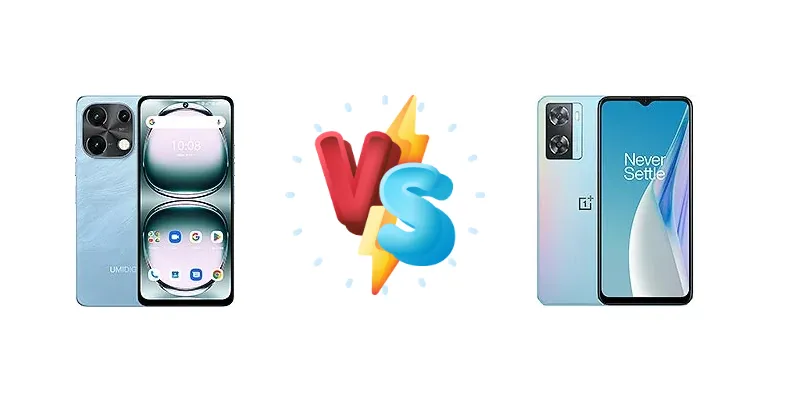
The sub-$200 smartphone market is fiercely competitive. The Umidigi Note 100 4G and OnePlus Nord N20 SE both aim to deliver essential smartphone functionality at an accessible price point. However, they take different approaches to achieving this, particularly in chipset choice and charging technology. This comparison dissects these differences to determine which device offers the best value.
🏆 Quick Verdict
For the average user prioritizing quick top-ups and a more established brand, the OnePlus Nord N20 SE is the better choice, thanks to its significantly faster 33W charging. However, the Umidigi Note 100 4G offers a potentially more efficient CPU architecture for sustained tasks, making it a viable option for those less concerned with charging speed.
| Network |
|---|
| 2G bands | GSM 850 / 900 / 1800 / 1900 | GSM 850 / 900 / 1800 / 1900 |
| 3G bands | HSDPA 850 / 900 / 1700(AWS) / 1900 / 2100 | HSDPA 850 / 900 / 2100 - Global |
| 4G bands | 1, 2, 3, 4, 5, 7, 8, 17, 18, 19, 20, 26, 28, 38, 40, 41, 66 | 1, 3, 5, 7, 8, 20, 28, 38, 40, 41 - Global |
| Speed | HSPA, LTE | HSPA, LTE |
| Technology | GSM / HSPA / LTE | GSM / HSPA / LTE |
| | - | 1, 2, 3, 4, 5, 7, 8, 12, 13, 17, 18, 19, 26, 28, 38, 41, 66 - LATAM |
| Launch |
|---|
| Announced | 2025, October | 2022, August 05 |
| Status | Available. Released 2025, October | Available. Released 2022, August 08 |
| Body |
|---|
| Build | Glass front, plastic back, plastic frame | Glass front, plastic frame, plastic back |
| Dimensions | 167.8 x 77.4 x 7.7 mm (6.61 x 3.05 x 0.30 in) | 163.8 x 75 x 8 mm (6.45 x 2.95 x 0.31 in) |
| SIM | Nano-SIM + Nano-SIM | Nano-SIM + Nano-SIM |
| Weight | 190 g (6.70 oz) | 187 g (6.60 oz) |
| Display |
|---|
| Resolution | 720 x 1600 pixels, 20:9 ratio (~258 ppi density) | 720 x 1612 pixels, 20:9 ratio (~269 ppi density) |
| Size | 6.8 inches, 111.6 cm2 (~86.0% screen-to-body ratio) | 6.56 inches, 103.4 cm2 (~84.2% screen-to-body ratio) |
| Type | IPS LCD, 120Hz | IPS LCD, 480 nits (typ), 600 nits (HBM) |
| Platform |
|---|
| CPU | Octa-core (2x1.8 GHz Cortex-A75 & 6x1.6 GHz Cortex-A55) | Octa-core (4x2.3 GHz Cortex-A53 & 4x1.8 GHz Cortex-A53) |
| Chipset | Unisoc T615 (12 nm) | Mediatek MT6765G Helio G35 (12 nm) |
| GPU | Mali-G57 MP1 | PowerVR GE8320 |
| OS | Android 14 | Android 12, OxygenOS 12.1 |
| Memory |
|---|
| Card slot | microSDXC (uses shared SIM slot) | microSDXC |
| Internal | 128GB 6GB RAM, 256GB 8GB RAM | 64GB 4GB RAM, 128GB 4GB RAM |
| | - | eMMC 5.1 |
| Main Camera |
|---|
| Dual | - | 50 MP, f/1.8, (wide), 1/2.76", 0.64µm, PDAF
Auxiliary lens |
| Features | LED flash | LED flash, HDR, panorama |
| Single | - | 8 MP, f/2.0, 26mm (wide), 1/4", 1.12µm |
| Triple | 50 MP, (wide), AF
2 MP (macro)
Auxiliary lens | - |
| Video | 1080p@30fps | 1080p@30fps |
| Selfie camera |
|---|
| Single | 16 MP, (wide) | 8 MP, f/2.0, 26mm (wide), 1/4.0", 1.12µm |
| Video | Yes | 1080p@30fps |
| Sound |
|---|
| 3.5mm jack | - | Yes |
| 35mm jack | Yes | Yes |
| Loudspeaker | Yes | Yes, with dual speakers |
| Comms |
|---|
| Bluetooth | 5.2, A2DP, LE | 5.3, A2DP, LE, aptX HD |
| NFC | Yes | No |
| Positioning | GPS, GLONASS, GALILEO, BDS | GPS, GLONASS, BDS, GALILEO, QZSS |
| Radio | FM radio | No |
| USB | USB Type-C, OTG | USB Type-C 2.0, OTG |
| WLAN | Wi-Fi 802.11 a/b/g/n/ac, dual-band | Wi-Fi 802.11 a/b/g/n/ac, dual-band, Wi-Fi Direct |
| Features |
|---|
| Sensors | Fingerprint (side-mounted), accelerometer, proximity, compass | Fingerprint (side-mounted), accelerometer, proximity, compass |
| Battery |
|---|
| Charging | 20W wired | 33W wired, 50% in 34 min, 100% in 69 min |
| Type | 5000 mAh | Li-Po 5000 mAh |
| Misc |
|---|
| Colors | Rock Black, Interstellar Blue, Starry White | Blue Oasis, Celestial Black |
| Models | - | CPH2469 |
| Price | - | About 190 EUR |
Umidigi Note 100 4G
- Potentially more efficient CPU architecture (Unisoc T615)
- May offer better sustained performance
- Lower price point (likely)
- Slower 20W charging
- Less established brand reputation
- Likely lower software update support
OnePlus Nord N20 SE
- Significantly faster 33W charging
- Established OnePlus brand and software experience
- Likely better software update support
- Less efficient CPU architecture (Helio G35)
- Potential for more throttling under sustained load
- May be slightly more expensive
Display Comparison
Neither device boasts a standout display. Both utilize 12nm chipsets, suggesting a focus on cost optimization over premium display features. While specific display specs (resolution, panel type) are missing, the focus here is on performance, not visual fidelity. Expect typical budget-level LCD panels with adequate, but not exceptional, color accuracy and brightness.
Camera Comparison
Without detailed camera specifications, a direct comparison is difficult. Both phones likely feature a multi-camera setup geared towards social media sharing rather than professional photography. The absence of information regarding sensor size and aperture suggests both will struggle in low-light conditions. It's safe to assume both will include a standard wide lens and potentially a depth sensor, but detailed analysis is impossible without further data.
Performance
The core difference lies in the chipsets. The Umidigi Note 100 4G features the Unisoc T615, employing a Cortex-A75 based octa-core configuration (2x1.8 GHz Cortex-A75 & 6x1.6 GHz Cortex-A55). This architecture, while still 12nm, offers a performance advantage in sustained workloads compared to the OnePlus Nord N20 SE’s MediaTek Helio G35 (4x2.3 GHz Cortex-A53 & 4x1.8 GHz Cortex-A53). The Helio G35 prioritizes clock speed with its four A53 cores, but the A53 architecture is older and less efficient than the A75. This means the Umidigi may handle multitasking and longer gaming sessions with less throttling. However, the G35’s higher clock speed will likely provide a snappier experience for basic tasks.
Battery Life
The OnePlus Nord N20 SE clearly wins in charging speed with its 33W wired charging, capable of reaching 50% in 34 minutes and 100% in 69 minutes. The Umidigi Note 100 4G is limited to 20W charging, meaning significantly longer charge times. While battery capacity isn't specified, the faster charging of the Nord N20 SE is a major convenience factor, especially for users who frequently need to top up their devices. The Unisoc T615’s potentially better efficiency might offset the slower charging for some users, but the convenience of the OnePlus is undeniable.
Buying Guide
Buy the Umidigi Note 100 4G if you prioritize CPU efficiency for longer, less-intensive tasks like document editing or extended reading, and are comfortable with slower charging. Buy the OnePlus Nord N20 SE if you value rapid charging – getting from 0 to 50% in just 34 minutes – and prefer the backing of a well-known brand with a generally smoother software experience.
Frequently Asked Questions
❓ Will the Helio G35 in the OnePlus Nord N20 SE struggle with demanding games like PUBG?
The Helio G35 is an entry-level gaming chipset. While it can run PUBG, you'll likely need to lower graphics settings to achieve a smooth frame rate. Expect some stuttering during intense firefights. The Unisoc T615 in the Umidigi might offer slightly more consistent performance in longer gaming sessions due to its more efficient architecture, but neither phone is a dedicated gaming device.
❓ How much faster is the 33W charging on the OnePlus Nord N20 SE compared to the 20W charging on the Umidigi Note 100 4G in real-world use?
The difference is substantial. The OnePlus Nord N20 SE can gain a 50% charge in approximately 34 minutes, while the Umidigi Note 100 4G will take considerably longer – likely over an hour and a half – to achieve the same level. This makes the OnePlus significantly more convenient for users who need a quick power boost.
❓ Is the Unisoc T615 chipset known for overheating?
The Unisoc T615 is generally considered to be a relatively cool-running chipset, thanks to its 12nm process and efficient Cortex-A75 cores. It's unlikely to experience significant overheating during typical usage, but prolonged gaming or demanding tasks could lead to some thermal throttling.