
Umidigi Note 100 4G vs Motorola Moto G Power (2022): A Deep Dive into Budget Performance
| Phones Images | |||||
|---|---|---|---|---|---|
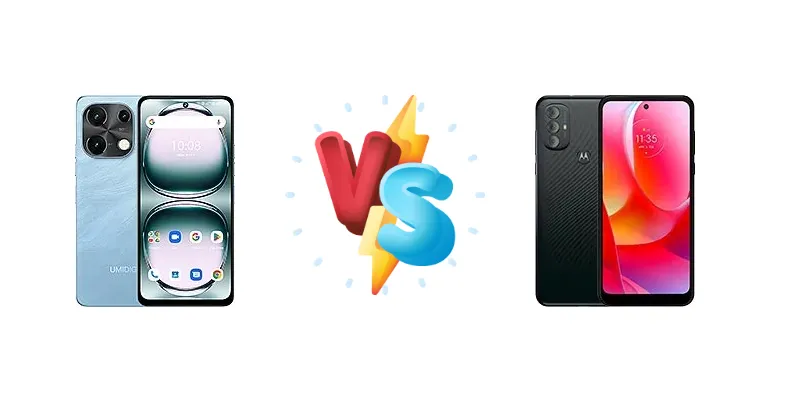
|
🏆 Quick Verdict
For the average user prioritizing sustained performance and faster charging, the Umidigi Note 100 4G emerges as the better choice. Its Unisoc T615 chipset, while not a powerhouse, offers a more balanced CPU architecture than the Moto G Power’s Helio G37, and the 20W charging significantly reduces downtime compared to Motorola’s slower 10W implementation.
| PHONES | ||
|---|---|---|
| Phone Names | Umidigi Note 100 4G | Motorola Moto G Power (2022) |
| Network | ||
|---|---|---|
| 2G bands | GSM 850 / 900 / 1800 / 1900 | GSM 850 / 900 / 1800 / 1900 |
| 3G bands | HSDPA 850 / 900 / 1700(AWS) / 1900 / 2100 | HSDPA 850 / 900 / 1700(AWS) / 1900 / 2100 |
| 4G bands | 1, 2, 3, 4, 5, 7, 8, 17, 18, 19, 20, 26, 28, 38, 40, 41, 66 | 1, 2, 3, 4, 5, 7, 8, 12, 13, 14, 17, 25, 26, 29, 30, 38, 41, 66, 71 - USA |
| Speed | HSPA, LTE | HSPA, LTE |
| Technology | GSM / HSPA / LTE | GSM / HSPA / LTE |
| Launch | ||
|---|---|---|
| Announced | 2025, October | 2021, November 17 |
| Status | Available. Released 2025, October | Available. Released 2022, February 22 |
| Body | ||
|---|---|---|
| Build | Glass front, plastic back, plastic frame | Glass front, plastic back, plastic frame |
| Dimensions | 167.8 x 77.4 x 7.7 mm (6.61 x 3.05 x 0.30 in) | 167.2 x 76.5 x 9.4 mm (6.58 x 3.01 x 0.37 in) |
| SIM | Nano-SIM + Nano-SIM | Nano-SIM |
| Weight | 190 g (6.70 oz) | 203 g (7.16 oz) |
| - | Water-repellent coating | |
| Display | ||
|---|---|---|
| Resolution | 720 x 1600 pixels, 20:9 ratio (~258 ppi density) | 720 x 1600 pixels, 20:9 ratio (~270 ppi density) |
| Size | 6.8 inches, 111.6 cm2 (~86.0% screen-to-body ratio) | 6.5 inches, 102.0 cm2 (~79.7% screen-to-body ratio) |
| Type | IPS LCD, 120Hz | IPS LCD, 90Hz |
| Platform | ||
|---|---|---|
| CPU | Octa-core (2x1.8 GHz Cortex-A75 & 6x1.6 GHz Cortex-A55) | - |
| Chipset | Unisoc T615 (12 nm) | Mediatek MT6765 Helio G37 (12 nm) |
| GPU | Mali-G57 MP1 | - |
| OS | Android 14 | Android 11 |
| Memory | ||
|---|---|---|
| Card slot | microSDXC (uses shared SIM slot) | microSDXC (dedicated slot) |
| Internal | 128GB 6GB RAM, 256GB 8GB RAM | 64GB 4GB RAM, 128GB 4GB RAM |
| - | eMMC 5.1 | |
| Main Camera | ||
|---|---|---|
| Features | LED flash | LED flash, HDR |
| Triple | 50 MP, (wide), AF 2 MP (macro) Auxiliary lens | 50 MP, f/1.8, (wide), 0.65µm, PDAF 2 MP (macro) Auxiliary lens |
| Video | 1080p@30fps | 1080p@30fps, gyro-EIS |
| Selfie camera | ||
|---|---|---|
| Single | 16 MP, (wide) | 8 MP, f/2.0, 1.12µm |
| Video | Yes | 1080p@30fps |
| Sound | ||
|---|---|---|
| 3.5mm jack | - | Yes |
| 35mm jack | Yes | Yes |
| Loudspeaker | Yes | Yes |
| Comms | ||
|---|---|---|
| Bluetooth | 5.2, A2DP, LE | 5.0, A2DP, LE |
| NFC | Yes | No |
| Positioning | GPS, GLONASS, GALILEO, BDS | GPS, GLONASS, GALILEO |
| Radio | FM radio | Unspecified |
| USB | USB Type-C, OTG | USB Type-C 2.0 |
| WLAN | Wi-Fi 802.11 a/b/g/n/ac, dual-band | Wi-Fi 802.11 a/b/g/n/ac, dual-band, Wi-Fi Direct |
| Features | ||
|---|---|---|
| Sensors | Fingerprint (side-mounted), accelerometer, proximity, compass | Fingerprint (side-mounted), accelerometer, gyro, proximity, compass, barometer |
| Battery | ||
|---|---|---|
| Charging | 20W wired | 10W wired |
| Type | 5000 mAh | Li-Po 5000 mAh |
| Misc | ||
|---|---|---|
| Colors | Rock Black, Interstellar Blue, Starry White | Black |
| Price | - | About 70 EUR |
Umidigi Note 100 4G
- Faster 20W charging for quicker top-ups.
- More powerful CPU architecture (Cortex-A75 cores) for smoother performance.
- Potentially better image processing due to the Unisoc T615 ISP.
- Battery capacity is unknown, potentially smaller than the Moto G Power.
- Brand recognition is lower than Motorola.
Motorola Moto G Power (2022)
- Likely larger battery capacity for extended battery life.
- Established brand reputation and software support from Motorola.
- Generally more readily available in retail stores.
- Significantly slower 10W charging.
- Less powerful CPU architecture (all Cortex-A53 cores) for reduced performance.
- May exhibit more lag during multitasking.
Display Comparison
Neither device boasts a standout display. Both likely utilize IPS LCD panels, common in this price bracket. The absence of detailed display specs necessitates focusing on performance. However, the chipset's ability to efficiently drive the display is crucial; the Unisoc T615's Cortex-A75 cores should provide a smoother experience during scrolling and video playback compared to the Helio G37's exclusively Cortex-A53 based CPU.
Camera Comparison
Without detailed camera specs beyond the presence of sensors, a direct comparison is difficult. It’s safe to assume both phones feature basic camera setups geared towards casual photography. The focus should be on image processing capabilities, which are heavily tied to the chipset. The Unisoc T615’s ISP (Image Signal Processor) may offer slightly better noise reduction and dynamic range compared to the Helio G37, but real-world results will depend heavily on software optimization. The inclusion of a 2MP macro lens on either device is largely a marketing tactic and unlikely to deliver significant photographic value.
Performance
The core difference lies in the chipsets. The Umidigi Note 100 4G’s Unisoc T615 features a heterogeneous core configuration – two Cortex-A75 cores for performance and six Cortex-A55 cores for efficiency. This contrasts with the Motorola Moto G Power (2022)’s MediaTek Helio G37, which relies solely on six Cortex-A53 cores. The A75 cores in the Umidigi offer a significant architectural advantage, translating to faster app launch times and a more responsive user experience, particularly when handling demanding tasks. While both are 12nm chips, the architectural difference is more impactful than the node size alone. The Helio G37 prioritizes power efficiency, potentially leading to longer battery life during light use, but at the cost of overall speed.
Battery Life
The Motorola Moto G Power (2022) is known for its large battery capacity (typically 5000mAh, though not specified in the provided data), aiming for multi-day battery life. However, the Umidigi Note 100 4G compensates with significantly faster 20W wired charging. The Moto G Power’s 10W charging is comparatively slow, requiring several hours for a full charge. This difference in charging speed is a critical factor for users who value convenience and minimal downtime. While the Moto G Power may last longer on a single charge, the Umidigi’s faster charging allows for quicker top-ups, potentially negating the battery life advantage for many users.
Buying Guide
Buy the Umidigi Note 100 4G if you need a phone that can handle moderate multitasking and benefits from quicker charging cycles, making it ideal for users who are frequently on the go. Buy the Motorola Moto G Power (2022) if your primary concern is maximizing battery life above all else, and you're willing to accept slower charging and potentially less responsive performance for extended usage between charges.