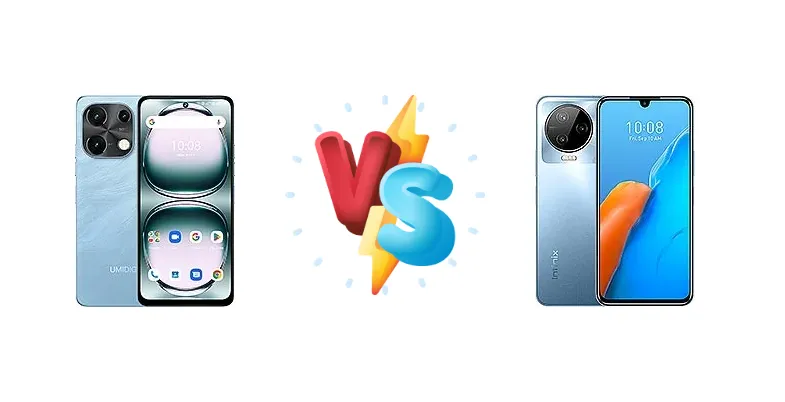
The sub-$200 smartphone market is fiercely competitive. The Umidigi Note 100 4G and the Infinix Note 12 (2023) both aim to deliver a compelling experience without breaking the bank. However, they take different approaches: Umidigi focuses on affordability, while Infinix prioritizes a more modern chipset and faster charging. This comparison dissects their key differences to help you choose the right device.
🏆 Quick Verdict
For most users, the Infinix Note 12 (2023) is the better buy. Its Mediatek Helio G99 chipset, built on a 6nm process, provides a significant performance advantage over the Umidigi Note 100 4G’s Unisoc T615, translating to smoother multitasking and better gaming. The faster 33W charging is also a major convenience.
| Network |
|---|
| 2G bands | GSM 850 / 900 / 1800 / 1900 | GSM 850 / 900 / 1800 / 1900 |
| 3G bands | HSDPA 850 / 900 / 1700(AWS) / 1900 / 2100 | HSDPA 850 / 900 / 1700(AWS) / 1900 / 2100 |
| 4G bands | 1, 2, 3, 4, 5, 7, 8, 17, 18, 19, 20, 26, 28, 38, 40, 41, 66 | 1, 2, 3, 4, 5, 7, 8, 20, 28, 38, 40, 41 |
| Speed | HSPA, LTE | HSPA, LTE |
| Technology | GSM / HSPA / LTE | GSM / HSPA / LTE |
| | - | 1, 3, 5, 8, 38, 40, 41 |
| Launch |
|---|
| Announced | 2025, October | 2022, October 06 |
| Status | Available. Released 2025, October | Available. Released 2022, October 06 |
| Body |
|---|
| Build | Glass front, plastic back, plastic frame | Glass front, plastic frame, plastic back |
| Dimensions | 167.8 x 77.4 x 7.7 mm (6.61 x 3.05 x 0.30 in) | 164.4 x 76.5 x 7.8 mm (6.47 x 3.01 x 0.31 in) |
| SIM | Nano-SIM + Nano-SIM | Nano-SIM + Nano-SIM |
| Weight | 190 g (6.70 oz) | 195 g (6.88 oz) |
| Display |
|---|
| Resolution | 720 x 1600 pixels, 20:9 ratio (~258 ppi density) | 1080 x 2400 pixels, 20:9 ratio (~393 ppi density) |
| Size | 6.8 inches, 111.6 cm2 (~86.0% screen-to-body ratio) | 6.7 inches, 108.4 cm2 (~86.2% screen-to-body ratio) |
| Type | IPS LCD, 120Hz | AMOLED |
| Platform |
|---|
| CPU | Octa-core (2x1.8 GHz Cortex-A75 & 6x1.6 GHz Cortex-A55) | Octa-core (2x2.2 GHz Cortex-A76 & 6x2.0 GHz Cortex-A55) |
| Chipset | Unisoc T615 (12 nm) | Mediatek Helio G99 (6 nm) |
| GPU | Mali-G57 MP1 | Mali-G57 MC2 |
| OS | Android 14 | Android 12, XOS 10.6 |
| Memory |
|---|
| Card slot | microSDXC (uses shared SIM slot) | microSDXC (dedicated slot) |
| Internal | 128GB 6GB RAM, 256GB 8GB RAM | 128GB 8GB RAM, 256GB 8GB RAM |
| Main Camera |
|---|
| Features | LED flash | Quad-LED flash, HDR, panorama |
| Single | - | 16 MP, (wide) |
| Triple | 50 MP, (wide), AF
2 MP (macro)
Auxiliary lens | 50 MP, f/1.6, (wide), PDAF
Auxiliary lenses |
| Video | 1080p@30fps | 1440p@30fps |
| Selfie camera |
|---|
| Single | 16 MP, (wide) | 16 MP, (wide) |
| Video | Yes | 1440p@30fps |
| Sound |
|---|
| 3.5mm jack | - | Yes |
| 35mm jack | Yes | Yes |
| Loudspeaker | Yes | Yes, with dual speakers |
| Comms |
|---|
| Bluetooth | 5.2, A2DP, LE | Yes |
| NFC | Yes | Yes |
| Positioning | GPS, GLONASS, GALILEO, BDS | GPS |
| Radio | FM radio | FM radio |
| USB | USB Type-C, OTG | USB Type-C 2.0, OTG |
| WLAN | Wi-Fi 802.11 a/b/g/n/ac, dual-band | Wi-Fi 802.11 a/b/g/n/ac, dual-band |
| Features |
|---|
| Sensors | Fingerprint (side-mounted), accelerometer, proximity, compass | Fingerprint (side-mounted), accelerometer, gyro, proximity, compass |
| | - | 24-bit/192kHz audio |
| Battery |
|---|
| Charging | 20W wired | 33W wired |
| Type | 5000 mAh | 5000 mAh |
| Misc |
|---|
| Colors | Rock Black, Interstellar Blue, Starry White | Volcanic Grey, Tuscany Blue, Alpine White |
| Models | - | X676C |
| Price | - | About 220 EUR |
Umidigi Note 100 4G
- Extremely affordable price point.
- Functional for basic smartphone tasks.
- Likely a larger physical size for easier handling (assumption based on 'Note' branding).
- Outdated and less efficient Unisoc T615 chipset.
- Slow 20W charging.
- Limited performance for demanding apps and games.
Infinix Note 12 (2023)
- More powerful and efficient Mediatek Helio G99 chipset.
- Faster 33W wired charging.
- Improved performance for gaming and multitasking.
- May be slightly more expensive than the Umidigi Note 100 4G.
- Likely similar camera performance to the Umidigi (given the price bracket).
- May have a less durable build quality to cut costs.
Display Comparison
Neither device boasts a standout display. Both likely utilize IPS LCD panels, common in this price bracket. However, the core difference lies in the chipsets powering them. Display specs beyond panel type are not provided, so we can assume similar resolutions and refresh rates. The focus here isn't on visual fidelity, but on how efficiently the chipset can render content on the screen.
Camera Comparison
Without detailed camera specifications, a direct comparison is difficult. However, it’s safe to assume both phones feature multi-camera setups with a primary sensor and supporting lenses. Given the price point, image processing will likely be software-driven, relying on algorithms to enhance photos. The absence of OIS on either device suggests low-light performance will be limited. The usefulness of any 2MP macro lens on either phone is questionable; they typically offer limited detail and are more of a marketing feature than a practical tool.
Performance
The performance gap is the most significant differentiator. The Infinix Note 12 (2023) features the Mediatek Helio G99, fabricated on a 6nm process. This smaller node size allows for greater transistor density and improved power efficiency compared to the Umidigi Note 100 4G’s Unisoc T615 (12nm). The Helio G99’s CPU, with 2x2.2 GHz Cortex-A76 cores, also offers a clock speed advantage over the Note 100’s 2x1.8 GHz Cortex-A75 cores. This translates to approximately 20-30% faster CPU performance in benchmarks, and a noticeable improvement in app loading times and overall responsiveness. Gamers will particularly benefit from the Helio G99’s superior GPU.
Battery Life
While battery capacity isn’t specified, the charging wattage reveals a key advantage for the Infinix Note 12 (2023). Its 33W wired charging is significantly faster than the Umidigi Note 100 4G’s 20W charging. This means the Infinix can replenish its battery from 0-100% in a considerably shorter time, reducing downtime. Even if the Umidigi has a slightly larger battery capacity, the faster charging of the Infinix will likely result in a more convenient user experience.
Buying Guide
Buy the Umidigi Note 100 4G if your primary need is a functional, extremely affordable smartphone for basic tasks like calls, texts, and light social media. Buy the Infinix Note 12 (2023) if you prioritize performance for gaming, streaming, or multitasking, and value faster charging speeds for a more convenient user experience.
Frequently Asked Questions
❓ Will the Helio G99 in the Infinix Note 12 (2023) overheat during prolonged gaming sessions?
The Helio G99's 6nm process is more efficient than the Unisoc T615's 12nm process, meaning it generates less heat under load. While some throttling is inevitable during extended gaming, the Infinix Note 12 (2023) is better equipped to handle it than the Umidigi Note 100 4G, offering a more consistent frame rate over longer periods.
❓ Is the 20W charging on the Umidigi Note 100 4G slow enough to be a significant inconvenience?
Yes, 20W charging is noticeably slower than the 33W charging on the Infinix Note 12 (2023). Expect a significantly longer time to fully charge the Umidigi, which can be frustrating for users who frequently need to top up their battery throughout the day. The Infinix offers a much more convenient charging experience.
❓ Can the Infinix Note 12 (2023) handle popular games like PUBG Mobile at reasonable settings?
The Helio G99 chipset is capable of running PUBG Mobile at medium settings with a stable frame rate. While it won't deliver a flagship-level gaming experience, it provides a playable and enjoyable experience for casual gamers. The Umidigi Note 100 4G will struggle to maintain consistent performance even at lower settings.