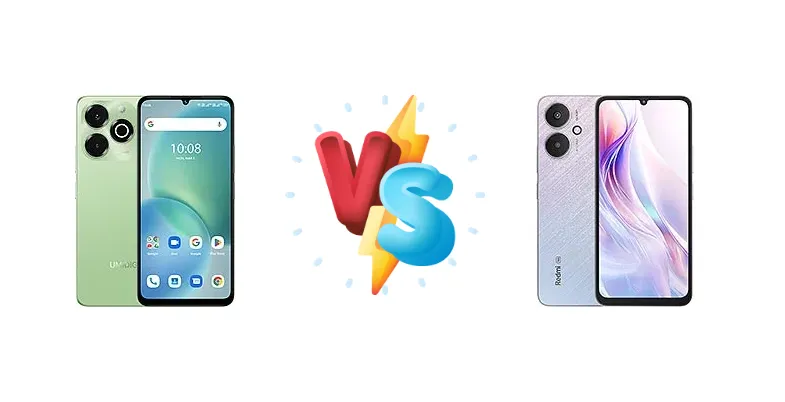
The sub-$200 smartphone market is fiercely competitive, and the Umidigi G9x and Xiaomi Redmi 13C 5G represent compelling options for users seeking 5G connectivity on a tight budget. However, they approach this goal with vastly different chipsets and feature sets. This comparison dissects the key differences to help you determine which device delivers the best value.
🏆 Quick Verdict
For most users, the Xiaomi Redmi 13C 5G is the superior choice. Its Mediatek Dimensity 6100+ chipset provides a significant performance uplift over the Umidigi G9x’s Unisoc SC9863A1, translating to smoother multitasking and a more responsive user experience. While the G9x offers a lower entry price, the Redmi 13C 5G’s faster charging and more capable processor justify the extra investment.
| Network |
|---|
| 2G bands | GSM 850 / 900 / 1800 / 1900 | GSM 850 / 900 / 1800 / 1900 |
| 3G bands | HSDPA 850 / 900 / 1700(AWS) / 1900 / 2100 | HSDPA 800 / 850 / 900 / 1700(AWS) / 1900 / 2100 - International |
| 4G bands | LTE | 1, 2, 3, 4, 5, 7, 8, 12, 13, 17, 18, 19, 20, 26, 28, 32, 38, 40, 41, 66 - International |
| 5G bands | - | 1, 3, 5, 7, 8, 20, 28, 38, 40, 41, 66, 77, 78 SA/NSA - International |
| Speed | HSPA, LTE | HSPA, LTE, 5G |
| Technology | GSM / HSPA / LTE | GSM / HSPA / LTE / 5G |
| Launch |
|---|
| Announced | 2025, June | 2023, December 06 |
| Status | Available. Released 2025, June | Available. Released 2023, December 16 |
| Body |
|---|
| Build | Glass front, plastic frame, plastic back | Glass front (Gorilla Glass 3), plastic frame, plastic back |
| Dimensions | 168.3 x 78 x 8.1 mm (6.63 x 3.07 x 0.32 in) | 168.1 x 77.9 x 8.2 mm (6.62 x 3.07 x 0.32 in) |
| SIM | Nano-SIM + Nano-SIM | Nano-SIM + Nano-SIM |
| Weight | 190 g (6.70 oz) | 192 g or 195 g (6.77 oz) |
| Display |
|---|
| Protection | - | Corning Gorilla Glass 3 |
| Resolution | 720 x 1600 pixels, 20:9 ratio (~260 ppi density) | 720 x 1600 pixels, 20:9 ratio (~260 ppi density) |
| Size | 6.75 inches, 110.0 cm2 (~83.8% screen-to-body ratio) | 6.74 inches, 109.7 cm2 (~83.8% screen-to-body ratio) |
| Type | IPS LCD, 90Hz | IPS LCD, 90Hz, 450 nits (typ), 600 nits (HBM) |
| Platform |
|---|
| CPU | Octa-core (4x1.6 GHz Cortex-A55 & 4x1.2 GHz Cortex-A55) | Octa-core (2x2.2 GHz Cortex-A76 & 6x2.0 GHz Cortex-A55) |
| Chipset | Unisoc SC9863A1 (22 nm) | Mediatek Dimensity 6100+ (6 nm) |
| GPU | IMG8322 | Mali-G57 MC2 |
| OS | Android 14 (Go edition) | Android 13, MIUI 14 |
| Memory |
|---|
| Card slot | microSDXC (uses shared SIM slot) | microSDXC (dedicated slot) |
| Internal | 64GB 4GB RAM, 128GB 4GB RAM | 64GB 4GB RAM, 128GB 4GB RAM, 128GB 6GB RAM, 256GB 8GB RAM |
| Main Camera |
|---|
| Dual | 13 MP, (wide)
0.3 MP | - |
| Features | LED flash | LED flash, HDR |
| Single | - | 50 MP, f/1.8, 28mm (wide), 1/2.76", 1.12µm, PDAF
Auxiliary lens |
| Video | Yes | 1080p@30fps |
| Selfie camera |
|---|
| Features | - | HDR |
| Single | 5 MP, (wide) | 5 MP, f/2.2, (wide) |
| Video | Yes | 1080p@30fps |
| Sound |
|---|
| 35mm jack | Unspecified | Yes |
| Loudspeaker | Yes | Yes |
| Comms |
|---|
| Bluetooth | 4.2, A2DP | 5.3, A2DP, LE |
| NFC | No | Yes (market/region dependent) |
| Positioning | GPS, GLONASS, GALILEO, BDS | GPS, GLONASS, GALILEO, BDS |
| Radio | FM radio | FM radio |
| USB | USB Type-C, OTG | USB Type-C 2.0, OTG |
| WLAN | Wi-Fi 802.11 b/g/n | Wi-Fi 802.11 a/b/g/n/ac, dual-band |
| Features |
|---|
| Sensors | Fingerprint (side-mounted), accelerometer, proximity | Fingerprint (side-mounted), accelerometer, compass |
| Battery |
|---|
| Charging | 10W wired | 18W wired, PD |
| Type | 5000 mAh | 5000 mAh |
| Misc |
|---|
| Colors | Sand Black, Sand Silver, Sand Green | Starry Black, Twilight Blue, Starry Silver, Starlight Black, Startrail Green, Startrail Silver |
| Models | - | 23124RN87G, 23124RN87I, 23124RN87C |
| Price | $ 79.99 / £ 79.99 | $ 198.99 / £ 119.00 / € 116.99 / ₹ 10,895 |
| SAR | - | 1.09 W/kg (head) 1.09 W/kg (body) |
| SAR EU | - | 0.98 W/kg (head) 0.98 W/kg (body) |
Umidigi G9x
- Lowest possible price point
- Functional for basic tasks
- Likely lightweight design
- Significantly weaker performance
- Slow 10W charging
- Potentially poor camera quality
Xiaomi Redmi 13C 5G
- Much faster processor (Dimensity 6100+)
- Faster 18W charging with PD
- Better overall user experience
- Higher price than Umidigi G9x
- Display likely lacks advanced features
- May include bloatware
Display Comparison
Neither device boasts a standout display. Both likely utilize LCD panels, a common cost-saving measure in this segment. The Redmi 13C 5G’s display specifications are not provided, but given its market positioning, it’s unlikely to offer features like high refresh rates or HDR support. The Umidigi G9x similarly lacks detailed display information. The real difference will likely be in color accuracy and peak brightness, areas where the Redmi 13C 5G may have a slight edge due to Xiaomi’s generally better display calibration.
Camera Comparison
Without detailed camera specifications, a direct comparison is difficult. However, both phones likely feature a primary camera paired with basic auxiliary lenses. The Redmi 13C 5G, benefiting from Xiaomi’s image processing expertise, is likely to produce more consistently pleasing images, even with a similar sensor size. The Umidigi G9x may struggle with dynamic range and low-light performance. The presence of a 2MP macro camera on either device is largely a marketing gimmick and shouldn’t heavily influence purchasing decisions.
Performance
This is where the Redmi 13C 5G truly shines. The Mediatek Dimensity 6100+ (6nm) is built on a far more advanced process node than the Unisoc SC9863A1 (22nm). The Dimensity 6100+’s CPU configuration – 2x2.2 GHz Cortex-A76 & 6x2.0 GHz Cortex-A55 – is significantly more powerful than the G9x’s 4x1.6 GHz Cortex-A55 & 4x1.2 GHz Cortex-A55. The Cortex-A76 cores in the Redmi 13C 5G provide a substantial boost in single-core performance, crucial for app launch speeds and general responsiveness. The 6nm process also translates to better power efficiency and reduced thermal throttling during sustained workloads. Gamers and power users will overwhelmingly benefit from the Redmi 13C 5G’s superior processing power.
Battery Life
Battery capacity isn’t specified for either device, but both likely fall in the 5000mAh range, typical for this price point. The Redmi 13C 5G’s 18W wired charging with PD support is a clear advantage over the Umidigi G9x’s slow 10W charging. This means the Redmi 13C 5G can replenish its battery significantly faster, reducing downtime. While a larger battery capacity on the G9x could partially offset the slower charging, the efficiency gains of the Dimensity 6100+ likely mean the Redmi 13C 5G will offer comparable, if not better, real-world battery life.
Buying Guide
Buy the Umidigi G9x if you prioritize absolute lowest cost and basic smartphone functionality, and are willing to accept compromises in performance and charging speed. Buy the Xiaomi Redmi 13C 5G if you value a smoother, more responsive experience, faster 5G connectivity, and quicker charging times, even if it means spending a bit more upfront.
Frequently Asked Questions
❓ Will the Dimensity 6100+ in the Redmi 13C 5G handle demanding games like PUBG Mobile?
The Dimensity 6100+ is capable of running PUBG Mobile, but you’ll likely need to lower the graphics settings to achieve a consistently smooth frame rate. The Unisoc SC9863A1 in the Umidigi G9x will struggle with PUBG Mobile, even on the lowest settings.
❓ How much faster is the 18W charging on the Redmi 13C 5G compared to the 10W charging on the Umidigi G9x?
The 18W charging on the Redmi 13C 5G will significantly reduce charging times. Expect a 0-100% charge in approximately 2-2.5 hours, compared to 3+ hours on the Umidigi G9x. The Power Delivery (PD) support also allows for faster charging with compatible chargers.
❓ Is the 5G connectivity on both phones equally reliable?
While both support 5G, the Dimensity 6100+ chipset in the Redmi 13C 5G generally offers better 5G modem performance and wider band support, potentially resulting in more stable and faster 5G connections depending on your carrier and location.
❓ Does the Redmi 13C 5G come with a lot of pre-installed bloatware?
Xiaomi phones are known to include some pre-installed apps (bloatware). However, many of these can be uninstalled, and the overall software experience is generally well-optimized. The Umidigi G9x may have less bloatware, but its software support and updates are likely to be less frequent.