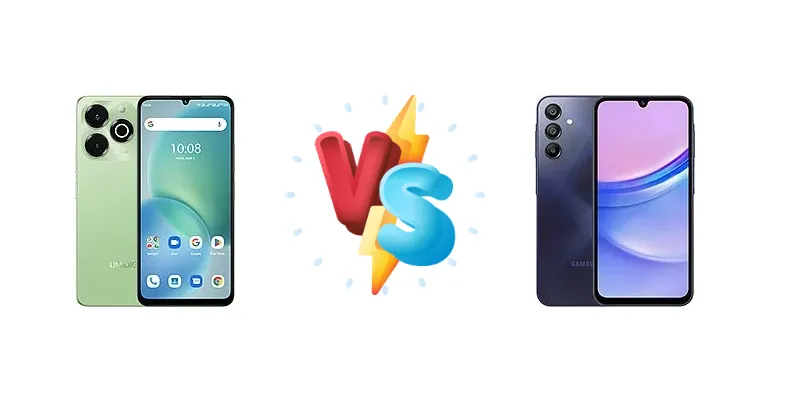
The sub-$200 smartphone market is fiercely competitive. The Umidigi G9x and Samsung Galaxy A15 represent two distinct approaches to delivering value. The G9x aims for affordability above all else, while the A15 leverages Samsung’s brand recognition and a more modern chipset. This comparison dissects their key differences to determine which phone offers the best experience for your money.
🏆 Quick Verdict
For most users, the Samsung Galaxy A15 is the superior choice. Its significantly more powerful Mediatek Helio G99 chipset, coupled with a brighter display and faster charging, provides a smoother and more enjoyable user experience, justifying the slight price premium. The Umidigi G9x remains a viable option for those on the absolute tightest of budgets.
| Network |
|---|
| 2G bands | GSM 850 / 900 / 1800 / 1900 | GSM 850 / 900 / 1800 / 1900 |
| 3G bands | HSDPA 850 / 900 / 1700(AWS) / 1900 / 2100 | HSDPA 850 / 900 / 2100 |
| 4G bands | LTE | 1, 3, 5, 7, 8, 20, 28, 38, 40, 41 |
| Speed | HSPA, LTE | HSPA, LTE |
| Technology | GSM / HSPA / LTE | GSM / HSPA / LTE |
| Launch |
|---|
| Announced | 2025, June | 2023, December 11 |
| Status | Available. Released 2025, June | Available. Released 2023, December 16 |
| Body |
|---|
| Build | Glass front, plastic frame, plastic back | Glass front, plastic back, plastic frame |
| Dimensions | 168.3 x 78 x 8.1 mm (6.63 x 3.07 x 0.32 in) | 160.1 x 76.8 x 8.4 mm (6.30 x 3.02 x 0.33 in) |
| SIM | Nano-SIM + Nano-SIM | · Nano-SIM· Nano-SIM + Nano-SIM |
| Weight | 190 g (6.70 oz) | 200 g (7.05 oz) |
| Display |
|---|
| Resolution | 720 x 1600 pixels, 20:9 ratio (~260 ppi density) | 1080 x 2340 pixels, 19.5:9 ratio (~396 ppi density) |
| Size | 6.75 inches, 110.0 cm2 (~83.8% screen-to-body ratio) | 6.5 inches, 103.7 cm2 (~84.3% screen-to-body ratio) |
| Type | IPS LCD, 90Hz | Super AMOLED, 90Hz, 800 nits (HBM) |
| Platform |
|---|
| CPU | Octa-core (4x1.6 GHz Cortex-A55 & 4x1.2 GHz Cortex-A55) | Octa-core (2x2.2 GHz Cortex-A76 & 6x2.0 GHz Cortex-A55) |
| Chipset | Unisoc SC9863A1 (22 nm) | Mediatek Helio G99 (6 nm) |
| GPU | IMG8322 | Mali-G57 MC2 |
| OS | Android 14 (Go edition) | Android 14, up to 4 major Android upgrades, One UI 7 |
| Memory |
|---|
| Card slot | microSDXC (uses shared SIM slot) | microSDXC (uses shared SIM slot) |
| Internal | 64GB 4GB RAM, 128GB 4GB RAM | 128GB 4GB RAM, 128GB 6GB RAM, 128GB 8GB RAM, 256GB 6GB RAM, 256GB 8GB RAM |
| Main Camera |
|---|
| Dual | 13 MP, (wide)
0.3 MP | - |
| Features | LED flash | LED flash, panorama, HDR |
| Triple | - | 50 MP, f/1.8, 26mm (wide), 1/2.8", 0.64µm, PDAF
5 MP, f/2.2, 17mm (ultrawide), 1/5.0", 1.12µm
2 MP (macro) |
| Video | Yes | 1080p@30fps |
| Selfie camera |
|---|
| Single | 5 MP, (wide) | 13 MP, f/2.0, 26mm (wide), 1/3.06", 1.12µm |
| Video | Yes | 1080p@30fps |
| Sound |
|---|
| 35mm jack | Unspecified | Yes |
| Loudspeaker | Yes | Yes |
| Comms |
|---|
| Bluetooth | 4.2, A2DP | 5.3, A2DP, LE |
| NFC | No | Yes (market/region dependent) |
| Positioning | GPS, GLONASS, GALILEO, BDS | GPS, GALILEO, GLONASS, BDS, QZSS |
| Radio | FM radio | FM radio (market/region dependent) |
| USB | USB Type-C, OTG | USB Type-C 2.0 |
| WLAN | Wi-Fi 802.11 b/g/n | Wi-Fi 802.11 a/b/g/n/ac, dual-band, Wi-Fi Direct |
| Features |
|---|
| Sensors | Fingerprint (side-mounted), accelerometer, proximity | Fingerprint (side-mounted), accelerometer, compass |
| Battery |
|---|
| Charging | 10W wired | 25W wired |
| Type | 5000 mAh | 5000 mAh |
| Misc |
|---|
| Colors | Sand Black, Sand Silver, Sand Green | Brave Black, Optimistic Blue, Magical Blue, Personality Yellow |
| Models | - | SM-A155F, SM-A155F/DSN, SM-A155M, SM-A155M/DS, SM-A155P, SM-A155R |
| Price | $ 79.99 / £ 79.99 | € 168.99 / $ 125.00 / £ 113.00 |
| SAR EU | - | 0.42 W/kg (head) 1.29 W/kg (body) |
Umidigi G9x
- Extremely affordable price point
- Functional for basic smartphone tasks
- Lightweight and potentially compact design (assumed)
- Outdated and inefficient Unisoc chipset
- Slow 10W charging
- Likely lower display brightness and quality
Samsung Galaxy A15
- Powerful Mediatek Helio G99 chipset
- Bright and vibrant display (808 nits)
- Fast 25W wired charging
- Long battery life (15:28h active use)
- Slightly higher price than the Umidigi G9x
- May include bloatware (typical for Samsung)
- Build quality may not be premium
Display Comparison
The Samsung Galaxy A15 boasts a significantly brighter display, reaching a measured 808 nits. This is crucial for outdoor visibility, a clear advantage over the Umidigi G9x, whose brightness is not specified but is likely considerably lower given its focus on cost reduction. While both likely utilize LCD panels, the A15’s higher peak brightness translates to a more vibrant and usable experience in direct sunlight. The A15’s larger screen size (assumed, based on typical A-series sizing) also contributes to a more immersive viewing experience.
Camera Comparison
Without detailed camera specifications for the Umidigi G9x, a direct comparison is limited. However, Samsung typically invests more in image processing and sensor quality, even in its budget A-series. The A15 likely benefits from Samsung’s software optimizations, resulting in more consistent and pleasing images. While both phones likely feature a primary camera and potentially a depth or macro sensor, the A15’s image processing pipeline will likely deliver superior results, especially in challenging lighting conditions. The G9x’s camera is likely adequate for basic snapshots, but won’t compete with the A15’s capabilities.
Performance
The performance gap between these two devices is substantial. The Samsung Galaxy A15’s Mediatek Helio G99, fabricated on a 6nm process, is a far more efficient and powerful chipset than the Umidigi G9x’s Unisoc SC9863A1 (22nm). The Helio G99’s octa-core configuration, featuring two Cortex-A76 cores clocked at 2.2 GHz, provides a noticeable boost in CPU performance for tasks like app loading and multitasking compared to the G9x’s four Cortex-A55 cores at 1.6 GHz. The 6nm process also means better thermal management, reducing the likelihood of performance throttling during sustained use. This difference is particularly noticeable in gaming and demanding applications.
Battery Life
The Samsung Galaxy A15 shines in battery life, achieving an impressive 15:28 hours of active use. While the Umidigi G9x’s battery capacity is unknown, its less efficient Unisoc chipset and slower 10W charging will likely result in shorter runtimes and longer charging times. The A15’s 25W wired charging is a significant advantage, allowing for quicker top-ups and reducing downtime. The combination of a more efficient chipset and faster charging makes the A15 the clear winner in the battery department.
Buying Guide
Buy the Umidigi G9x if you prioritize extreme affordability and basic smartphone functionality is sufficient. It’s a good choice for first-time smartphone users or as a secondary device. Buy the Samsung Galaxy A15 if you value performance for everyday tasks, enjoy media consumption with a brighter screen, and appreciate faster charging speeds. It’s ideal for users who want a reliable and capable smartphone without breaking the bank.
Frequently Asked Questions
❓ Is the Mediatek Helio G99 in the Galaxy A15 capable of handling demanding games like PUBG Mobile?
Yes, the Helio G99 is a capable gaming chipset for its price range. While it won’t deliver flagship-level performance, it can comfortably run PUBG Mobile at medium settings with stable frame rates. The 6nm process also helps to mitigate thermal throttling during extended gaming sessions.
❓ How long does it realistically take to fully charge the Samsung Galaxy A15 from 0% to 100% with the 25W charger?
With the included 25W charger, the Samsung Galaxy A15 typically takes around 1 hour and 30 minutes to fully charge from 0% to 100%. This is significantly faster than the Umidigi G9x’s 10W charging, which could take upwards of 3 hours.
❓ Does the Umidigi G9x support software updates and security patches?
Umidigi’s software update track record is less consistent than Samsung’s. While the G9x will likely receive some updates, they may be infrequent and delayed compared to the Galaxy A15, which benefits from Samsung’s regular security patches and Android version updates.
❓ What type of storage does the Samsung Galaxy A15 use, and is it expandable?
The Samsung Galaxy A15 utilizes UFS 2.2 storage, which is faster and more responsive than the eMMC storage often found in phones at this price point. It also supports microSD card expansion, allowing you to increase storage capacity as needed.