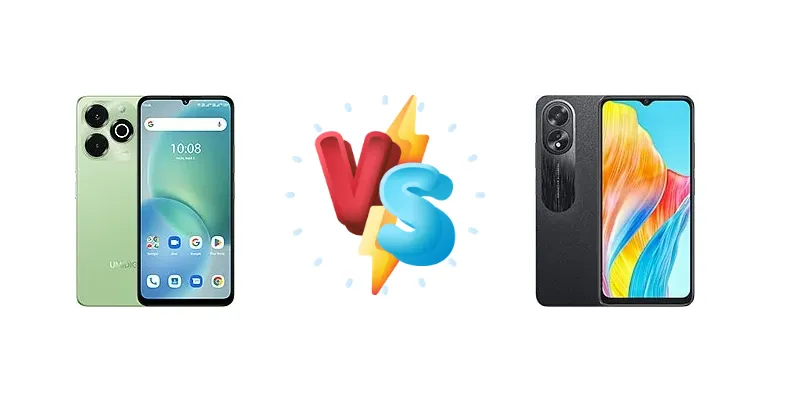
The sub-$150 smartphone market is fiercely competitive. The Umidigi G9x and Oppo A18 represent two compelling options, but cater to slightly different priorities. The G9x focuses on delivering a functional experience at an extremely low price point, while the A18 leverages a more modern chipset for improved performance, albeit at a potentially higher cost. This comparison dissects the key differences to determine which device offers the best value.
🏆 Quick Verdict
For the average user prioritizing responsiveness and occasional gaming, the Oppo A18 is the better choice. Its Helio G85 chipset, built on a 12nm process, provides a significant performance advantage over the Umidigi G9x’s older Unisoc SC9863A1. While the G9x offers a viable basic smartphone experience, the A18 delivers a smoother, more capable user experience.
| Network |
|---|
| 2G bands | GSM 850 / 900 / 1800 / 1900 | GSM 850 / 900 / 1800 / 1900 |
| 3G bands | HSDPA 850 / 900 / 1700(AWS) / 1900 / 2100 | HSDPA 850 / 900 / 2100 |
| 4G bands | LTE | 1, 3, 5, 7, 8, 20, 28, 38, 40, 41 |
| Speed | HSPA, LTE | HSPA, LTE |
| Technology | GSM / HSPA / LTE | GSM / HSPA / LTE |
| Launch |
|---|
| Announced | 2025, June | 2023, September 27 |
| Status | Available. Released 2025, June | Available. Released 2023, October 05 |
| Body |
|---|
| Build | Glass front, plastic frame, plastic back | - |
| Dimensions | 168.3 x 78 x 8.1 mm (6.63 x 3.07 x 0.32 in) | 163.7 x 75 x 8.2 mm (6.44 x 2.95 x 0.32 in) |
| SIM | Nano-SIM + Nano-SIM | Nano-SIM + Nano-SIM |
| Weight | 190 g (6.70 oz) | 188 g (6.63 oz) |
| Display |
|---|
| Resolution | 720 x 1600 pixels, 20:9 ratio (~260 ppi density) | 720 x 1612 pixels, 20:9 ratio (~269 ppi density) |
| Size | 6.75 inches, 110.0 cm2 (~83.8% screen-to-body ratio) | 6.56 inches, 103.4 cm2 (~84.2% screen-to-body ratio) |
| Type | IPS LCD, 90Hz | IPS LCD, 90Hz, 720 nits (peak) |
| Platform |
|---|
| CPU | Octa-core (4x1.6 GHz Cortex-A55 & 4x1.2 GHz Cortex-A55) | Octa-core (2x2.0 GHz Cortex-A75 & 6x1.8 GHz Cortex-A55) |
| Chipset | Unisoc SC9863A1 (22 nm) | Mediatek MT6769 Helio G85 (12 nm) |
| GPU | IMG8322 | Mali-G52 MC2 |
| OS | Android 14 (Go edition) | Android 13, upgradable to Android 15, ColorOS 15 |
| Memory |
|---|
| Card slot | microSDXC (uses shared SIM slot) | microSDXC |
| Internal | 64GB 4GB RAM, 128GB 4GB RAM | 64GB 4GB RAM, 128GB 4GB RAM |
| Main Camera |
|---|
| Dual | 13 MP, (wide)
0.3 MP | 8 MP, f/2.0, (wide), AF
Auxiliary lens |
| Features | LED flash | LED flash, panorama |
| Video | Yes | 1080p@30fps |
| Selfie camera |
|---|
| Features | - | Panorama |
| Single | 5 MP, (wide) | 5 MP, f/2.2, (wide) |
| Video | Yes | 1080p@30fps |
| Sound |
|---|
| 35mm jack | Unspecified | Yes |
| Loudspeaker | Yes | Yes |
| Comms |
|---|
| Bluetooth | 4.2, A2DP | 5.3, A2DP, LE, aptX HD |
| NFC | No | No |
| Positioning | GPS, GLONASS, GALILEO, BDS | GPS, GALILEO, GLONASS, BDS, QZSS |
| Radio | FM radio | No |
| USB | USB Type-C, OTG | USB Type-C 2.0, OTG |
| WLAN | Wi-Fi 802.11 b/g/n | Wi-Fi 802.11 a/b/g/n/ac, dual-band |
| Features |
|---|
| Sensors | Fingerprint (side-mounted), accelerometer, proximity | Fingerprint (side-mounted), accelerometer, proximity, compass |
| Battery |
|---|
| Charging | 10W wired | - |
| Type | 5000 mAh | Li-Po 5000 mAh |
| Misc |
|---|
| Colors | Sand Black, Sand Silver, Sand Green | Glowing Black, Glowing Blue |
| Models | - | CPH2591 |
| Price | $ 79.99 / £ 79.99 | ₹ 10,290 |
Umidigi G9x
- Extremely affordable price point
- Functional for basic smartphone tasks
- May offer longer software support due to simpler hardware
- Significantly weaker performance compared to the Oppo A18
- Less efficient chipset leading to potentially shorter battery life
- Likely to struggle with demanding apps and games
Oppo A18
- More powerful Helio G85 chipset for smoother performance
- Better power efficiency for longer battery life
- Improved image processing capabilities
- Potentially slightly higher price than the Umidigi G9x
- May receive fewer software updates compared to simpler devices
- Still limited by budget constraints in terms of features
Display Comparison
Neither device boasts a standout display. Details on panel type and resolution are missing, but the focus here is on performance. The absence of high refresh rates is expected at this price point. The real difference lies under the hood, impacting the smoothness of UI animations. The more powerful GPU in the Oppo A18 will translate to a more fluid visual experience, even on a similar resolution display.
Camera Comparison
Without detailed camera specifications beyond the presence of sensors, a direct comparison is difficult. However, the chipset plays a crucial role in image processing. The Helio G85’s ISP (Image Signal Processor) in the Oppo A18 is more advanced, enabling better noise reduction, dynamic range, and overall image quality. While both phones likely feature basic camera setups, the A18 will likely produce more usable photos, especially in challenging lighting conditions. The 2MP macro cameras often found in this segment are generally of limited utility on both devices.
Performance
The core differentiator is the chipset. The Oppo A18’s MediaTek Helio G85 (12nm) is a substantial upgrade over the Umidigi G9x’s Unisoc SC9863A1 (22nm). The G85 features a combination of 2x2.0 GHz Cortex-A75 and 6x1.8 GHz Cortex-A55 cores, offering significantly better single-core and multi-core performance than the G9x’s 4x1.6 GHz Cortex-A55 and 4x1.2 GHz Cortex-A55 configuration. The 12nm process also contributes to better power efficiency. This translates to faster app loading times, smoother multitasking, and a more enjoyable gaming experience on the A18. The G9x will struggle with demanding applications and may exhibit noticeable lag.
Battery Life
Battery capacity details are missing for both devices. However, the Helio G85’s 12nm process offers better power efficiency than the Unisoc SC9863A1’s 22nm process. This means the Oppo A18 will likely achieve comparable or better battery life despite potentially having a similar capacity battery. Furthermore, the A18’s 10W charging is standard for this price range, and the more efficient chipset will likely result in faster overall charge times to full capacity.
Buying Guide
Buy the Umidigi G9x if you need a functional smartphone for basic tasks like calls, texts, and light social media, and your budget is extremely limited. It’s a good option for a first smartphone or a backup device. Buy the Oppo A18 if you prefer a more responsive experience, enjoy occasional mobile gaming, or value a more modern chipset for future software updates and app compatibility. The A18 offers a better long-term investment for most users.
Frequently Asked Questions
❓ Will the Helio G85 in the Oppo A18 overheat during prolonged gaming sessions?
While the Helio G85 is a capable chipset, it's not a flagship processor. Moderate gaming is expected to be fine, but extended, graphically intensive sessions may lead to some thermal throttling. The phone's thermal design will play a role, but it's unlikely to reach dangerously high temperatures.
❓ Is the Unisoc SC9863A1 in the Umidigi G9x sufficient for running popular social media apps like Facebook and Instagram?
Yes, the Unisoc SC9863A1 is capable of running basic social media apps. However, expect slower loading times and occasional lag, especially when multitasking or using the apps with resource-intensive features like video playback or filters. The experience won't be as smooth as on the Oppo A18.
❓ Can either of these phones handle popular mobile games like PUBG Mobile or Call of Duty Mobile?
The Oppo A18 will offer a significantly better gaming experience. You'll likely be able to play PUBG Mobile or Call of Duty Mobile at medium settings with acceptable frame rates. The Umidigi G9x will struggle to run these games smoothly, even at the lowest settings, and may experience significant lag and frame drops.
❓ What kind of software updates can I expect from Umidigi and Oppo for these devices?
Software update support is often limited on budget smartphones. Umidigi typically provides fewer updates than Oppo. The Oppo A18, being from a larger manufacturer, is more likely to receive at least one major Android version update and security patches for a longer period, though expectations should remain modest.