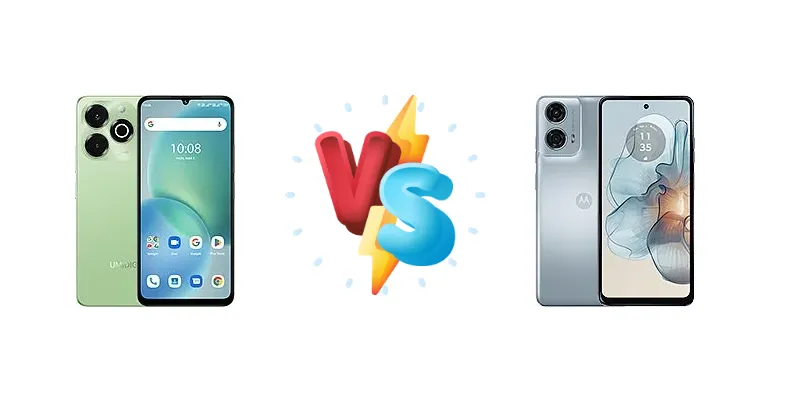
The sub-$150 smartphone market is fiercely competitive. The Umidigi G9x and Motorola Moto G24 Power both aim to deliver essential features at an accessible price point, but they take different approaches. The G9x prioritizes a lower entry cost, while the G24 Power focuses on faster charging and a more capable chipset. This comparison dissects their key differences to determine which phone offers the best value.
🏆 Quick Verdict
For most users, the Motorola Moto G24 Power is the better choice. Its Mediatek Helio G85 chipset, built on a more efficient 12nm process, provides a noticeable performance advantage over the Umidigi G9x’s Unisoc SC9863A1. Crucially, the 30W charging support of the G24 Power significantly reduces downtime compared to the G9x’s slow 10W charging.
| Network |
|---|
| 2G bands | GSM 850 / 900 / 1800 / 1900 | GSM 850 / 900 / 1800 / 1900 |
| 3G bands | HSDPA 850 / 900 / 1700(AWS) / 1900 / 2100 | HSDPA 850 / 900 / 1900 / 2100 |
| 4G bands | LTE | 1, 2, 3, 5, 7, 8, 20, 28, 38, 40, 41 |
| Speed | HSPA, LTE | HSPA, LTE |
| Technology | GSM / HSPA / LTE | GSM / HSPA / LTE |
| Launch |
|---|
| Announced | 2025, June | 2024, January 30 |
| Status | Available. Released 2025, June | Available. Released 2024, February 07 |
| Body |
|---|
| Build | Glass front, plastic frame, plastic back | Glass front, plastic back, plastic frame |
| Dimensions | 168.3 x 78 x 8.1 mm (6.63 x 3.07 x 0.32 in) | 163.5 x 74.5 x 9 mm (6.44 x 2.93 x 0.35 in) |
| SIM | Nano-SIM + Nano-SIM | Nano-SIM + Nano-SIM |
| Weight | 190 g (6.70 oz) | 197 g (6.95 oz) |
| Display |
|---|
| Resolution | 720 x 1600 pixels, 20:9 ratio (~260 ppi density) | 720 x 1612 pixels, 20:9 ratio (~269 ppi density) |
| Size | 6.75 inches, 110.0 cm2 (~83.8% screen-to-body ratio) | 6.56 inches, 103.4 cm2 (~84.9% screen-to-body ratio) |
| Type | IPS LCD, 90Hz | IPS LCD, 90Hz, 537 nits (peak) |
| Platform |
|---|
| CPU | Octa-core (4x1.6 GHz Cortex-A55 & 4x1.2 GHz Cortex-A55) | Octa-core (2x2.0 GHz Cortex-A75 & 6x1.7 GHz Cortex-A55) |
| Chipset | Unisoc SC9863A1 (22 nm) | Mediatek MT6769Z Helio G85 (12 nm) |
| GPU | IMG8322 | Mali-G52 MC2 |
| OS | Android 14 (Go edition) | Android 14 |
| Memory |
|---|
| Card slot | microSDXC (uses shared SIM slot) | microSDXC (dedicated slot) |
| Internal | 64GB 4GB RAM, 128GB 4GB RAM | 128GB 4GB RAM, 128GB 8GB RAM, 256GB 4GB RAM, 256GB 8GB RAM |
| Main Camera |
|---|
| Dual | 13 MP, (wide)
0.3 MP | 50 MP, f/1.8 (wide), 0.64µm, PDAF
2 MP (macro) |
| Features | LED flash | LED flash, HDR, panorama |
| Video | Yes | 1080p@30fps |
| Selfie camera |
|---|
| Single | 5 MP, (wide) | 8 MP, f/2.0, (wide), 1.12µm - International version
16 MP, f/2.5, (wide), 1.0µm - India version |
| Video | Yes | 1080p@30fps |
| Sound |
|---|
| 35mm jack | Unspecified | Yes |
| Loudspeaker | Yes | Yes, with stereo speakers |
| Comms |
|---|
| Bluetooth | 4.2, A2DP | 5.0, A2DP, LE |
| NFC | No | Yes (market/region dependent) |
| Positioning | GPS, GLONASS, GALILEO, BDS | GPS, GALILEO, GLONASS |
| Radio | FM radio | FM radio (market/region dependent) |
| USB | USB Type-C, OTG | USB Type-C 2.0 |
| WLAN | Wi-Fi 802.11 b/g/n | Wi-Fi 802.11 a/b/g/n/ac, dual-band |
| Features |
|---|
| Sensors | Fingerprint (side-mounted), accelerometer, proximity | Fingerprint (side-mounted), accelerometer, gyro, proximity, compass |
| Battery |
|---|
| Charging | 10W wired | 30W wired |
| Type | 5000 mAh | 6000 mAh |
| Misc |
|---|
| Colors | Sand Black, Sand Silver, Sand Green | Glacier Blue, Ink Blue |
| Price | $ 79.99 / £ 79.99 | € 132.29 |
Umidigi G9x
- Lowest possible price point
- Acceptable for basic tasks
- Potentially longer standby time (due to less powerful chipset)
- Very slow charging (10W)
- Weak performance for gaming or multitasking
- Outdated chipset fabrication process (22nm)
Motorola Moto G24 Power
- Faster and more responsive performance
- Significantly faster charging (30W)
- More efficient chipset (12nm)
- Slightly higher price
- May not be ideal for extremely prolonged gaming sessions (thermal throttling potential)
- Camera performance still limited by budget sensors
Display Comparison
Neither device boasts a standout display. Both likely utilize IPS LCD panels, common in this price bracket. However, detailed specs like resolution and peak brightness are missing. The focus here is on internal differences. The G24 Power’s chipset has a more powerful GPU, which *could* translate to better video playback smoothness, though this is dependent on software optimization. Bezels are likely comparable, and color accuracy will be typical for budget phones – acceptable, but not color-critical.
Camera Comparison
Without detailed camera sensor information, a direct comparison is difficult. However, it’s safe to assume both phones feature basic camera setups geared towards casual photography. The G24 Power’s more powerful ISP (Image Signal Processor) within the Helio G85 chipset *could* result in slightly better image processing, particularly in low-light conditions. The presence of a more capable chipset suggests a higher likelihood of features like HDR support. The G9x will likely struggle with complex scenes and dynamic range. We can expect both phones to include a 2MP macro camera, which is generally of limited practical use.
Performance
The core difference lies in the chipsets. The Motorola Moto G24 Power’s Mediatek Helio G85 (12nm) is a significant step up from the Umidigi G9x’s Unisoc SC9863A1 (22nm). The Helio G85 features two Cortex-A75 cores clocked at 2.0 GHz, providing a substantial boost in single-core performance compared to the G9x’s four Cortex-A55 cores at 1.6 GHz. This translates to snappier app launches and smoother multitasking. The 12nm fabrication process of the Helio G85 also contributes to better power efficiency, potentially leading to longer battery life under load. While both phones likely have similar RAM configurations, the G85’s superior processing power will be the limiting factor for demanding applications.
Battery Life
The Motorola Moto G24 Power’s 30W wired charging is a game-changer in this price segment. This allows for a significantly faster 0-100% charge time compared to the Umidigi G9x’s sluggish 10W charging. While battery capacity isn’t specified, the G24 Power’s more efficient chipset will likely offset any capacity difference. The faster charging is a major convenience factor, reducing downtime and making the phone more usable throughout the day. The G9x will require overnight charging to ensure a full battery.
Buying Guide
Buy the Umidigi G9x if your absolute priority is minimizing upfront cost and you primarily use your phone for basic tasks like calls, messaging, and light social media. You’ll need to be patient with charging times. Buy the Motorola Moto G24 Power if you value a smoother user experience, occasional gaming, and the convenience of significantly faster charging. The G24 Power is the better all-rounder for users who demand more from their smartphone.
Frequently Asked Questions
❓ Will the Motorola Moto G24 Power overheat during extended gaming sessions?
While the Helio G85 is a capable chipset, it's still a budget processor. Prolonged gaming at high settings *could* lead to some thermal throttling, reducing performance slightly. However, the 12nm process is more efficient than the G9x’s 22nm, mitigating this risk compared to the Umidigi G9x.
❓ Is the 10W charging on the Umidigi G9x really that slow?
Yes, 10W charging is significantly slower than the 30W charging on the Moto G24 Power. Expect a full charge to take several hours, potentially requiring overnight charging. This is a major inconvenience for users who need to quickly top up their battery.
❓ Can the Motorola Moto G24 Power handle popular games like PUBG Mobile?
The Helio G85 can run PUBG Mobile, but you’ll likely need to use medium or low graphics settings for a smooth experience. The G9x will struggle to maintain a playable framerate even on the lowest settings.
❓ Does the Umidigi G9x support software updates?
Umidigi’s software update track record is inconsistent. While they do provide updates, they are often less frequent and slower to arrive compared to Motorola, which generally offers more reliable software support for its G series.