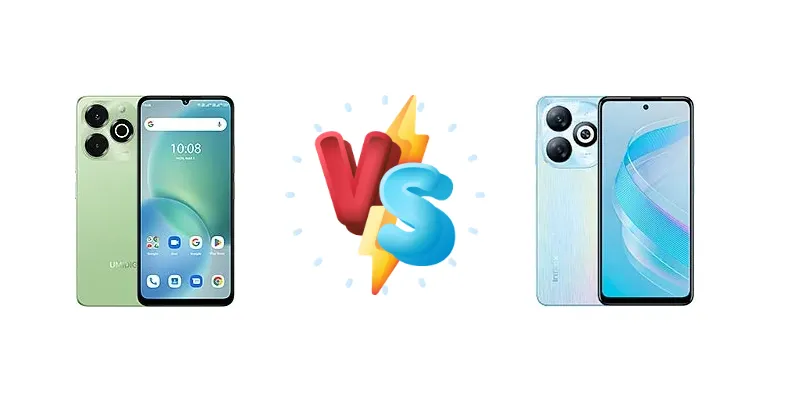
The sub-$150 smartphone market is fiercely competitive. Both the Umidigi G9x and the Infinix Smart 8 Pro aim to deliver essential smartphone functionality at an incredibly accessible price point. However, they take different approaches to achieving this, primarily through their chipset choices. This comparison dissects those differences and determines which device offers the best value for your money.
🏆 Quick Verdict
For the average user prioritizing responsiveness and slightly better performance in everyday tasks, the Infinix Smart 8 Pro emerges as the winner. Its Mediatek Helio G36, built on a more efficient 12nm process, provides a noticeable edge over the Umidigi G9x’s Unisoc SC9863A1, despite both phones sharing the same 10W charging.
| Network |
|---|
| 2G bands | GSM 850 / 900 / 1800 / 1900 | GSM 850 / 900 / 1800 / 1900 |
| 3G bands | HSDPA 850 / 900 / 1700(AWS) / 1900 / 2100 | HSDPA 850 / 900 / 1700(AWS) / 1900 / 2100 |
| 4G bands | LTE | 1, 2, 3, 4, 5, 7, 8, 20, 28, 38, 41, 40 |
| Speed | HSPA, LTE | HSPA, LTE |
| Technology | GSM / HSPA / LTE | GSM / HSPA / LTE |
| Launch |
|---|
| Announced | 2025, June | 2024, January 29 |
| Status | Available. Released 2025, June | Available. Released 2024, February |
| Body |
|---|
| Build | Glass front, plastic frame, plastic back | Glass front, plastic back, plastic frame |
| Dimensions | 168.3 x 78 x 8.1 mm (6.63 x 3.07 x 0.32 in) | 163.6 x 75.6 x 8.5 mm (6.44 x 2.98 x 0.33 in) |
| SIM | Nano-SIM + Nano-SIM | Nano-SIM + Nano-SIM |
| Weight | 190 g (6.70 oz) | 189 g (6.67 oz) |
| Display |
|---|
| Resolution | 720 x 1600 pixels, 20:9 ratio (~260 ppi density) | 720 x 1612 pixels, 20:9 ratio (~267 ppi density) |
| Size | 6.75 inches, 110.0 cm2 (~83.8% screen-to-body ratio) | 6.6 inches, 104.6 cm2 (~84.6% screen-to-body ratio) |
| Type | IPS LCD, 90Hz | IPS LCD, 90Hz, 500 nits (peak) |
| Platform |
|---|
| CPU | Octa-core (4x1.6 GHz Cortex-A55 & 4x1.2 GHz Cortex-A55) | Octa-core (4x2.2 GHz Cortex-A53 & 4x1.6 GHz Cortex-A53) |
| Chipset | Unisoc SC9863A1 (22 nm) | Mediatek Helio G36 (12 nm) |
| GPU | IMG8322 | PowerVR GE8320 |
| OS | Android 14 (Go edition) | Android 13 (Go edition), XOS 13 |
| Memory |
|---|
| Card slot | microSDXC (uses shared SIM slot) | microSDXC (dedicated slot) |
| Internal | 64GB 4GB RAM, 128GB 4GB RAM | 64GB 4GB RAM, 128GB 8GB RAM, 256GB 4GB RAM |
| Main Camera |
|---|
| Dual | 13 MP, (wide)
0.3 MP | - |
| Features | LED flash | Ring-LED flash, HDR, panorama |
| Single | - | 50 MP, f/1.9, (wide), AF
Auxiliary lens |
| Video | Yes | 1080p@30fps |
| Selfie camera |
|---|
| Single | 5 MP, (wide) | 8 MP, f/2.0, (wide) |
| Video | Yes | Yes |
| Sound |
|---|
| 35mm jack | Unspecified | Yes |
| Loudspeaker | Yes | Yes |
| Comms |
|---|
| Bluetooth | 4.2, A2DP | 5.0, A2DP, LE |
| NFC | No | No |
| Positioning | GPS, GLONASS, GALILEO, BDS | GPS |
| Radio | FM radio | FM radio |
| USB | USB Type-C, OTG | USB Type-C 2.0, OTG |
| WLAN | Wi-Fi 802.11 b/g/n | Wi-Fi 802.11 a/b/g/n/ac, dual-band |
| Features |
|---|
| Sensors | Fingerprint (side-mounted), accelerometer, proximity | Fingerprint (side-mounted), accelerometer, gyro, proximity, compass |
| Battery |
|---|
| Charging | 10W wired | 10W wired
Reverse wired |
| Type | 5000 mAh | 5000 mAh |
| Misc |
|---|
| Colors | Sand Black, Sand Silver, Sand Green | Rainbow Blue, Galaxy White, Shiny Gold, Timber Black |
| Models | - | X6525B |
| Price | $ 79.99 / £ 79.99 | About 100 EUR |
Umidigi G9x
- Potentially lower price point
- Simple and straightforward user experience
- Functional for basic tasks
- Less powerful chipset
- Lower performance in multitasking
- Less efficient processor
Infinix Smart 8 Pro
- More powerful and efficient chipset
- Reverse wired charging capability
- Smoother multitasking experience
- May be slightly more expensive
- 10W charging is still slow
- Camera performance is still limited
Display Comparison
Neither device boasts a standout display. Both likely utilize LCD panels, common in this price bracket. Without specific display specs, it's difficult to assess color accuracy or brightness. However, the focus here is on processing power, not visual fidelity. Bezels are expected to be substantial on both, maximizing screen real estate within a budget.
Camera Comparison
Both phones are expected to feature basic camera setups. Without detailed sensor information, it’s safe to assume both will rely on primary sensors for acceptable daylight photography. The presence of a 2MP macro lens on either device is largely marketing fluff; image quality will be limited. The image processing capabilities of the Helio G36 might offer a slight advantage in dynamic range and noise reduction, but don't expect flagship-level results from either.
Performance
The core difference lies in the chipsets. The Infinix Smart 8 Pro’s Mediatek Helio G36 (12nm) is a clear architectural advantage over the Umidigi G9x’s Unisoc SC9863A1 (22nm). The smaller fabrication process of the Helio G36 translates to improved power efficiency and potentially better sustained performance. While both are octa-core, the Helio G36 utilizes Cortex-A53 cores clocked at 2.2 GHz, a step up from the G9x’s 1.6 GHz and 1.2 GHz Cortex-A55 cores. This means faster app loading times and smoother multitasking on the Infinix. The G9x will likely struggle with more demanding applications.
Battery Life
Both devices are limited to 10W wired charging, meaning relatively slow charging speeds. The actual battery capacity isn't specified, but typical for this segment is around 5000mAh. The Helio G36’s improved efficiency in the Smart 8 Pro could translate to slightly longer battery life, offsetting any potential capacity differences. The Smart 8 Pro also includes reverse wired charging, a feature absent on the G9x, allowing it to charge other devices – a useful feature for travelers or emergencies.
Buying Guide
Buy the Umidigi G9x if you prioritize a potentially lower initial cost and are primarily focused on very basic smartphone functions like calls, texts, and light social media browsing. Buy the Infinix Smart 8 Pro if you prefer a more responsive user experience, slightly better multitasking capabilities, and the added convenience of reverse wired charging, making it a useful power bank in a pinch.
Frequently Asked Questions
❓ Will the Infinix Smart 8 Pro handle popular games like PUBG Mobile?
While the Helio G36 can run PUBG Mobile, expect to play at low to medium settings with reduced frame rates. It's not a gaming powerhouse, but it's capable of providing a playable experience, unlike the Umidigi G9x which will likely struggle significantly.
❓ Does the Umidigi G9x support fast charging, or any charging optimizations?
The Umidigi G9x is limited to 10W wired charging. There are no reported charging optimizations or support for faster charging protocols. Expect a full charge to take several hours.
❓ Is the reverse charging feature on the Infinix Smart 8 Pro useful?
Yes, the reverse wired charging feature is surprisingly useful. It allows you to use the Smart 8 Pro as a power bank to charge accessories like wireless earbuds or even another phone in an emergency, a feature the Umidigi G9x lacks.
❓ How does the Unisoc SC9863A1 compare to other chipsets in this price range?
The Unisoc SC9863A1 is generally considered an entry-level chipset, falling behind competitors like the Mediatek Helio G36 in terms of performance and efficiency. It's suitable for very basic tasks but will struggle with demanding applications.