
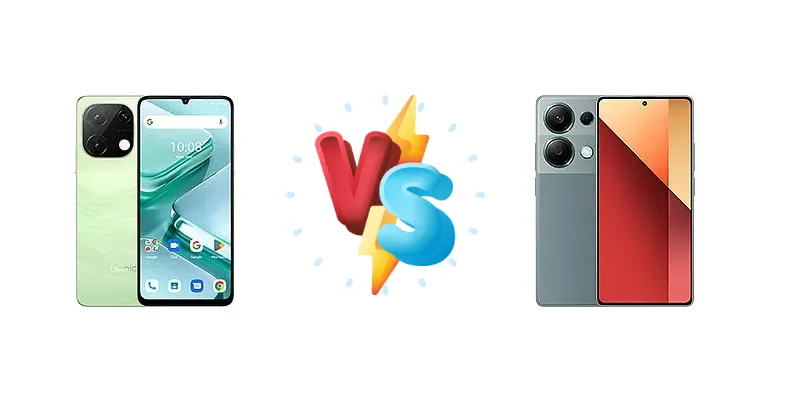
Umidigi G9T vs Xiaomi Redmi Note 13 Pro 4G: A Detailed Comparison
| Phones Images | |||||
|---|---|---|---|---|---|
|
🏆 Quick Verdict
For most users, the Xiaomi Redmi Note 13 Pro 4G is the superior choice. Its significantly faster 67W charging, coupled with a brighter 1047 nit display and a more powerful Mediatek Helio G99 Ultra chipset, justifies the slight price premium. However, the Umidigi G9T remains a viable option for those on an extremely tight budget.
| PHONES | ||
|---|---|---|
| Phone Names | Umidigi G9T | Xiaomi Redmi Note 13 Pro 4G |
| Network | ||
|---|---|---|
| 2G bands | GSM 850 / 900 / 1800 / 1900 | GSM 850 / 900 / 1800 / 1900 |
| 3G bands | HSDPA 850 / 900 / 1700(AWS) / 1900 / 2100 | HSDPA 850 / 900 / 1700(AWS) / 1900 / 2100 |
| 4G bands | 1, 2, 3, 4, 5, 7, 8, 17, 18, 19, 20, 26, 28, 38, 40, 41, 66 | 1, 2, 3, 4, 5, 7, 8, 12, 13, 17, 18, 19, 20, 26, 28, 38, 40, 41, 66 |
| Speed | HSPA, LTE | HSPA, LTE |
| Technology | GSM / HSPA / LTE | GSM / HSPA / LTE |
| Launch | ||
|---|---|---|
| Announced | 2024, September | 2024, January 15 |
| Status | Available. Released 2024, September | Available. Released 2024, January 15 |
| Body | ||
|---|---|---|
| Build | - | Glass front (Gorilla Glass 5), plastic frame, plastic back |
| Dimensions | 167.2 x 77 x 7.9 mm (6.58 x 3.03 x 0.31 in) | 161.1 x 75 x 8 mm (6.34 x 2.95 x 0.31 in) |
| SIM | Nano-SIM + Nano-SIM | Nano-SIM + Nano-SIM |
| Weight | 189 g (6.67 oz) | 188 g (6.63 oz) |
| Display | ||
|---|---|---|
| Protection | - | Corning Gorilla Glass 5 |
| Resolution | 720 x 1600 pixels, 20:9 ratio (~260 ppi density) | 1080 x 2400 pixels, 20:9 ratio (~395 ppi density) |
| Size | 6.75 inches, 110.0 cm2 (~85.4% screen-to-body ratio) | 6.67 inches, 107.4 cm2 (~88.9% screen-to-body ratio) |
| Type | IPS LCD, 90Hz | AMOLED, 1B colors, 120Hz, 500 nits (typ), 1000 nits (HBM), 1300 nits (peak) |
| Platform | ||
|---|---|---|
| CPU | Octa-core (2x1.6 GHz Cortex-A75 & 6x1.6 GHz Cortex-A55) | Octa-core (2x2.2 GHz Cortex-A76 & 6x2.0 GHz Cortex-A55) |
| Chipset | Unisoc T606 (12 nm) | Mediatek Helio G99 Ultra |
| GPU | Mali-G57 MP1 | Mali-G57 MC2 |
| OS | Android 14 | Android 13, up to 3 major Android upgrades, HyperOS |
| Memory | ||
|---|---|---|
| Card slot | microSDXC (uses shared SIM slot) | microSDXC (uses shared SIM slot) |
| Internal | 128GB 4GB RAM, 256GB 4GB RAM | 128GB 8GB RAM, 256GB 8GB RAM, 256GB 12GB RAM, 512GB 8GB RAM, 512GB 12GB RAM |
| Main Camera | ||
|---|---|---|
| Dual | 13 MP, (wide) Auxiliary lens | - |
| Features | LED flash | LED flash, HDR, panorama |
| Triple | - | 200 MP, f/1.7, 23mm (wide), 1/1.4", 0.56µm, multi-directional PDAF, OIS 8 MP, f/2.2, 15mm, 120˚ (ultrawide), 1/4.4", 1.0µm 2 MP (macro) |
| Video | 1080p@30fps | 1080p@30/60fps |
| Selfie camera | ||
|---|---|---|
| Single | 8 MP, (wide) | 16 MP, f/2.4, (wide), 1/3.0", 1.0µm |
| Video | Yes | 1080p@30/60fps |
| Sound | ||
|---|---|---|
| 35mm jack | Yes | Yes |
| Loudspeaker | Yes | Yes, with dual speakers |
| Comms | ||
|---|---|---|
| Bluetooth | 5.0, A2DP, LE | 5.2, A2DP, LE |
| Infrared port | - | Yes |
| NFC | No | Yes (market/region dependent) |
| Positioning | GPS, GLONASS, GALILEO, BDS | GPS, GLONASS, GALILEO, BDS |
| Radio | FM radio | FM radio |
| USB | USB Type-C, OTG | USB Type-C 2.0, OTG |
| WLAN | Wi-Fi 802.11 a/b/g/n/ac, dual-band | Wi-Fi 802.11 a/b/g/n/ac, dual-band |
| Features | ||
|---|---|---|
| Sensors | Fingerprint (side-mounted), accelerometer, compass | Fingerprint (under display, optical), accelerometer, gyro, compass |
| Battery | ||
|---|---|---|
| Charging | 18W wired | 67W wired, 50% in 16 min, 100% in 46 min |
| Type | 5000 mAh | 5000 mAh |
| Misc | ||
|---|---|---|
| Colors | Rock Black, Grass Green | Midnight Black, Lavender Purple, Forest Green |
| Models | - | 23117RA68G, 2312FPCA6G |
| Price | - | € 92.00 / $ 269.99 / £ 299.99 |
| SAR | - | 1.09 W/kg (head) 1.09 W/kg (body) |
| SAR EU | - | 0.99 W/kg (head) 0.99 W/kg (body) |
Umidigi G9T
- Lower price point makes it accessible.
- Functional for basic smartphone tasks.
- Acceptable performance for light usage.
- Significantly slower charging speed.
- Less powerful processor.
- Likely dimmer display.
Xiaomi Redmi Note 13 Pro 4G
- 67W fast charging for quick top-ups.
- Brighter 1047 nit display for better visibility.
- More powerful Mediatek Helio G99 Ultra chipset.
- Slightly higher price.
- May still lack features found in higher-end phones.
- 4G connectivity only.
Display Comparison
The Xiaomi Redmi Note 13 Pro 4G boasts a significantly brighter display, reaching a measured 1047 nits. This is crucial for outdoor visibility, a clear advantage over the Umidigi G9T, which lacks published brightness data and likely offers a considerably dimmer experience. While both likely utilize LCD panels given their price points, the Redmi Note 13 Pro 4G’s higher peak brightness translates to a more enjoyable viewing experience in various lighting conditions. Bezels are expected to be similar on both devices, typical for this price bracket, but the Redmi’s superior brightness is a key differentiator.
Camera Comparison
While both phones feature camera systems, the Redmi Note 13 Pro 4G is expected to offer a more refined experience. Although specific sensor details are missing for the Umidigi G9T, the Redmi Note 13 Pro 4G likely benefits from a larger main sensor and more sophisticated image processing algorithms. The Redmi’s camera is capable of both photo and video recording, while the G9T’s capabilities are less defined. It’s reasonable to assume the Redmi Note 13 Pro 4G will deliver better image quality, particularly in low-light conditions, and more versatile video recording options. The presence of OIS (Optical Image Stabilization) on the Redmi Note 13 Pro 4G, if present, would further enhance its camera performance.
Performance
The Redmi Note 13 Pro 4G’s Mediatek Helio G99 Ultra chipset represents a substantial performance upgrade over the Umidigi G9T’s Unisoc T606. The Helio G99 Ultra features a more modern CPU architecture – Cortex-A76 cores clocked at 2.2 GHz versus the G9T’s Cortex-A75 cores at 1.6 GHz – resulting in faster application loading times and smoother multitasking. The G99 Ultra’s GPU also provides a noticeable boost in gaming performance. While both phones likely feature similar RAM configurations, the chipset difference is the dominant factor. The Unisoc T606 is adequate for basic tasks, but the Helio G99 Ultra offers a more responsive and future-proof experience.
Battery Life
The Redmi Note 13 Pro 4G excels in charging speed with its 67W wired charging, achieving 50% charge in just 16 minutes and a full charge in 46 minutes. This is a massive advantage over the Umidigi G9T’s slower 18W charging. While the G9T’s battery capacity isn’t specified, the Redmi Note 13 Pro 4G’s active use score of 11:36h demonstrates solid battery life. The faster charging of the Redmi Note 13 Pro 4G mitigates any potential concerns about battery life, allowing users to quickly top up their device when needed.
Buying Guide
Buy the Umidigi G9T if you need a functional smartphone for basic tasks like calls, messaging, and light social media use, and your budget is the absolute primary concern. Buy the Xiaomi Redmi Note 13 Pro 4G if you prioritize a smoother user experience, faster charging, a more vibrant display for media consumption, and a more capable camera system, even if it means spending a bit more.