
Umidigi G9T vs Motorola Moto G84: A Deep Dive into Affordable 5G
| Phones Images | |||||
|---|---|---|---|---|---|
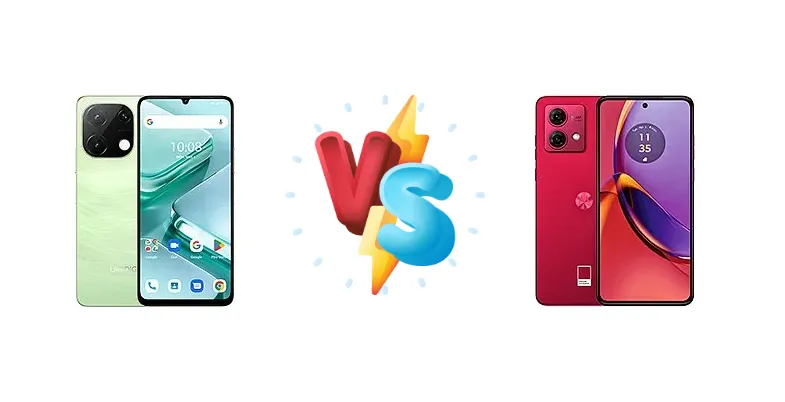
|
🏆 Quick Verdict
For the average user prioritizing a smoother overall experience and longer battery life, the Motorola Moto G84 is the clear winner. Its Snapdragon 695 chipset and 12:31h active use battery score significantly outperform the Umidigi G9T's Unisoc T606 and 18W charging.
| PHONES | ||
|---|---|---|
| Phone Names | Umidigi G9T | Motorola Moto G84 |
| Network | ||
|---|---|---|
| 2G bands | GSM 850 / 900 / 1800 / 1900 | GSM 850 / 900 / 1800 / 1900 |
| 3G bands | HSDPA 850 / 900 / 1700(AWS) / 1900 / 2100 | HSDPA 850 / 900 / 1700(AWS) / 1900 / 2100 - LATAM |
| 4G bands | 1, 2, 3, 4, 5, 7, 8, 17, 18, 19, 20, 26, 28, 38, 40, 41, 66 | 1, 2, 3, 4, 5, 7, 8, 12, 13, 17, 25, 26, 28, 38, 40, 41, 42, 66 - LATAM |
| 5G bands | - | 1, 2, 3, 5, 7, 26, 28, 40, 66, 78 SA/NSA/Sub6 - LATAM |
| Speed | HSPA, LTE | HSPA, LTE, 5G |
| Technology | GSM / HSPA / LTE | GSM / HSPA / LTE / 5G |
| Launch | ||
|---|---|---|
| Announced | 2024, September | 2023, August 24 |
| Status | Available. Released 2024, September | Available. Released 2023, September 08 |
| Body | ||
|---|---|---|
| Build | - | Glass front, plastic frame, plastic back or eco leather back |
| Dimensions | 167.2 x 77 x 7.9 mm (6.58 x 3.03 x 0.31 in) | 160 x 74.4 x 7.6 mm (6.30 x 2.93 x 0.30 in) |
| SIM | Nano-SIM + Nano-SIM | Nano-SIM + Nano-SIM |
| Weight | 189 g (6.67 oz) | 166.8 g (5.86 oz) |
| Display | ||
|---|---|---|
| Resolution | 720 x 1600 pixels, 20:9 ratio (~260 ppi density) | 1080 x 2400 pixels, 20:9 ratio (~405 ppi density) |
| Size | 6.75 inches, 110.0 cm2 (~85.4% screen-to-body ratio) | 6.5 inches, 102.0 cm2 (~85.7% screen-to-body ratio) |
| Type | IPS LCD, 90Hz | P-OLED, 1B colors, 120Hz, 1300 nits (peak) |
| Platform | ||
|---|---|---|
| CPU | Octa-core (2x1.6 GHz Cortex-A75 & 6x1.6 GHz Cortex-A55) | Octa-core (2x2.2 GHz Kryo 660 Gold & 6x1.7 GHz Kryo 660 Silver) |
| Chipset | Unisoc T606 (12 nm) | Qualcomm SM6375 Snapdragon 695 5G (6 nm) |
| GPU | Mali-G57 MP1 | Adreno 619 |
| OS | Android 14 | Android 13, upgradable to Android 15 |
| Memory | ||
|---|---|---|
| Card slot | microSDXC (uses shared SIM slot) | microSDXC (uses shared SIM slot) |
| Internal | 128GB 4GB RAM, 256GB 4GB RAM | 256GB 8GB RAM, 256GB 12GB RAM |
| Main Camera | ||
|---|---|---|
| Dual | 13 MP, (wide) Auxiliary lens | 50 MP, f/1.9 (wide), 1/1.5", 1.0µm, PDAF, OIS 8 MP, f/2.2, 120˚ (ultrawide), 1/4.0", 1.12µm, AF |
| Features | LED flash | LED flash, HDR, panorama |
| Video | 1080p@30fps | 1080p@30/60fps |
| Selfie camera | ||
|---|---|---|
| Single | 8 MP, (wide) | 16 MP, f/2.5, (wide), 1.0µm |
| Video | Yes | 1080p@30fps |
| Sound | ||
|---|---|---|
| 35mm jack | Yes | Yes |
| Loudspeaker | Yes | Yes, with stereo speakers |
| Comms | ||
|---|---|---|
| Bluetooth | 5.0, A2DP, LE | 5.1, A2DP, LE |
| NFC | No | Yes (market/region dependent) |
| Positioning | GPS, GLONASS, GALILEO, BDS | GPS, GLONASS, GALILEO |
| Radio | FM radio | FM radio (market/region dependent) |
| USB | USB Type-C, OTG | USB Type-C 2.0 |
| WLAN | Wi-Fi 802.11 a/b/g/n/ac, dual-band | Wi-Fi 802.11 a/b/g/n/ac, dual-band, Wi-Fi Direct |
| Features | ||
|---|---|---|
| Sensors | Fingerprint (side-mounted), accelerometer, compass | Fingerprint (under display, optical), accelerometer, gyro, proximity, compass |
| Battery | ||
|---|---|---|
| Charging | 18W wired | 30W wired |
| Type | 5000 mAh | Li-Po 5000 mAh |
| Misc | ||
|---|---|---|
| Colors | Rock Black, Grass Green | Marshmallow Blue, Midnight Blue, Viva Magenta |
| Models | - | XT2347, XT2347-1, XT2347-2 |
| Price | - | $ 399.00 / £ 189.99 / € 169.00 |
Umidigi G9T
- Extremely affordable price point
- 5G connectivity
- Functional for basic tasks
- Unisoc T606 chipset offers limited performance
- Slow 18W charging
- Likely lower display quality
Motorola Moto G84
- More powerful Snapdragon 695 chipset
- Excellent battery life (12:31h active use)
- Faster 30W charging
- Brighter display (996 nits)
- Higher price than the Umidigi G9T
- May still lack features found in higher-end phones
- Camera details are limited
Display Comparison
The Motorola Moto G84 boasts a significantly brighter display, reaching a measured 996 nits. This is a substantial advantage over what we'd expect from the G9T, making the Moto G84 far more usable outdoors. While the G9T's display specs are not provided, it's likely to be considerably dimmer. The Moto G84's brightness also suggests a more modern panel technology, potentially improving color accuracy and viewing angles. The lack of refresh rate information for both devices is a notable omission, but the brightness difference is a key differentiator.
Camera Comparison
Both phones are described as having 'Photo / Video' capabilities, but without specific sensor details, a detailed comparison is difficult. However, the Moto G84's brand reputation suggests a more refined image processing pipeline. The G9T, targeting a lower price point, likely utilizes a simpler camera system. The absence of information regarding OIS (Optical Image Stabilization) on either device suggests both rely on software stabilization, but the Snapdragon 695's ISP (Image Signal Processor) is likely more capable, resulting in better low-light performance and video stabilization on the Moto G84.
Performance
The core difference lies in the chipsets. The Motorola Moto G84's Qualcomm Snapdragon 695 (6nm) is a clear step up from the Umidigi G9T's Unisoc T606 (12nm). The 6nm process node of the Snapdragon 695 translates to better power efficiency and thermal management, reducing the likelihood of performance throttling during sustained tasks. The Snapdragon 695's CPU configuration – 2x2.2 GHz Kryo 660 Gold & 6x1.7 GHz Kryo 660 Silver – also offers a performance advantage over the G9T’s 2x1.6 GHz Cortex-A75 & 6x1.6 GHz Cortex-A55. This means faster app loading times, smoother multitasking, and a more responsive user interface on the Moto G84.
Battery Life
The Motorola Moto G84 shines in battery performance, achieving an impressive 12:31h active use score and an endurance rating of 117 hours. This is a significant advantage over the Umidigi G9T, which lacks published battery life data but is hampered by its slower 18W charging. The Moto G84’s 30W charging will deliver a much faster 0-100% charge time, minimizing downtime. While the G9T may have a larger battery capacity, the Snapdragon 695’s superior power efficiency in the Moto G84 likely offsets any capacity difference.
Buying Guide
Buy the Umidigi G9T if you need a functional 5G smartphone on an absolute shoestring budget and are willing to compromise on performance and charging speed. Buy the Motorola Moto G84 if you prioritize a more responsive user experience, significantly better battery life, and faster charging, even if it means spending a bit more.