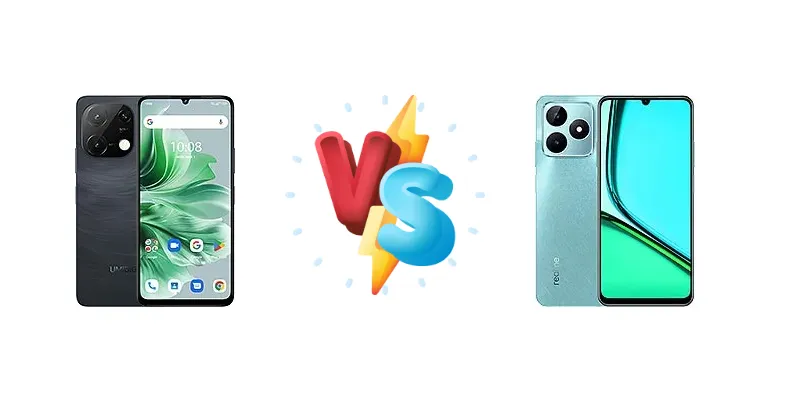
The sub-$150 smartphone market is fiercely competitive. Both the Umidigi G9C and Realme C51s aim to deliver essential features at an accessible price point. However, they take different approaches to achieving this, primarily diverging in their chipset choices and charging capabilities. This comparison dissects these differences to determine which device offers the best value.
🏆 Quick Verdict
For the average user prioritizing quick top-ups and slightly more responsive performance, the Realme C51s is the better choice. Its 33W charging significantly reduces downtime, and the Unisoc Tiger T612 offers a modest performance edge over the Helio G36. However, the Umidigi G9C remains a viable option for those on a tighter budget.
| Network |
|---|
| 2G bands | GSM 850 / 900 / 1800 / 1900 | GSM 850 / 900 / 1800 / 1900 |
| 3G bands | HSDPA 850 / 900 / 1700(AWS) / 1900 / 2100 | HSDPA 900 / 2100 |
| 4G bands | 1, 2, 3, 4, 5, 7, 8, 17, 18, 19, 20, 26, 28, 38, 40, 41, 66 | 1, 3, 5, 8, 38, 40 |
| Speed | HSPA, LTE | HSPA, LTE |
| Technology | GSM / HSPA / LTE | GSM / HSPA / LTE |
| Launch |
|---|
| Announced | 2024, September | 2024, March 15 |
| Status | Available. Released 2024, September | Available. Released 2024, March 15 |
| Body |
|---|
| Build | - | Glass front, plastic frame, plastic back |
| Dimensions | 167.2 x 77 x 7.9 mm (6.58 x 3.03 x 0.31 in) | 167.2 x 76.7 x 7.5 mm (6.58 x 3.02 x 0.30 in) |
| SIM | Nano-SIM + Nano-SIM | Nano-SIM + Nano-SIM |
| Weight | 189 g (6.67 oz) | 182 g (6.42 oz) |
| Display |
|---|
| Resolution | 720 x 1600 pixels, 20:9 ratio (~260 ppi density) | 720 x 1600 pixels, 20:9 ratio (~260 ppi density) |
| Size | 6.75 inches, 110.0 cm2 (~85.4% screen-to-body ratio) | 6.74 inches, 109.7 cm2 (~85.5% screen-to-body ratio) |
| Type | IPS LCD, 90Hz | IPS LCD, 90Hz, 560 nits (peak) |
| Platform |
|---|
| CPU | Octa-core (4x2.2 GHz Cortex-A53 & 4x1.6 GHz Cortex-A53) | Octa-core (2x1.8 GHz Cortex-A75 & 6x1.8 GHz Cortex-A55) |
| Chipset | Mediatek Helio G36 (12 nm) | Unisoc Tiger T612 (12 nm) |
| GPU | PowerVR GE8320 | Mali-G57 |
| OS | Android 14 | Android 13, Realme UI |
| Memory |
|---|
| Card slot | microSDXC (uses shared SIM slot) | microSDXC (dedicated slot) |
| Internal | 128GB 6GB RAM | 128GB 6GB RAM |
| Main Camera |
|---|
| Dual | 50 MP, (wide)
Auxiliary lens | - |
| Features | LED flash | LED flash, HDR, panorama |
| Single | - | 50 MP, f/1.8, 27mm (wide), 1/2.76", 0.64µm, PDAF
Auxiliary lens |
| Video | 1080p@30fps | 1080p@30fps |
| Selfie camera |
|---|
| Features | - | HDR |
| Single | 8 MP, (wide) | 5 MP, f/2.2, 28mm (wide), 1/5.0", 1.12µm |
| Video | Yes | 720p@30fps |
| Sound |
|---|
| 35mm jack | Yes | Yes |
| Loudspeaker | Yes | Yes |
| Comms |
|---|
| Bluetooth | 5.4, A2DP, LE | 5.0, A2DP, LE |
| NFC | Yes | Yes, 360˚ (market/region dependent) |
| Positioning | GPS, GLONASS, GALILEO, BDS | GPS, GLONASS, GALILEO |
| Radio | FM radio | Unspecified |
| USB | USB Type-C, OTG | USB Type-C |
| WLAN | Wi-Fi 802.11 a/b/g/n/ac, dual-band | Wi-Fi 802.11 a/b/g/n/ac, dual-band |
| Features |
|---|
| Sensors | Fingerprint (side-mounted), accelerometer, compass | Fingerprint (side-mounted), accelerometer, gyro, proximity, compass |
| Battery |
|---|
| Charging | 18W wired | 33W wired, 0-50% in 28 min |
| Type | 5000 mAh | 5000 mAh |
| Misc |
|---|
| Colors | Rock Black, Grass Green | Shiny Green, Mighty Black |
| Models | - | RMX3765 |
| Price | - | About 100 EUR |
Umidigi G9C
- Potentially lower price point
- Decent battery life for basic usage
- Reliable for essential smartphone functions
- Slower charging speed (18W)
- Less powerful chipset (Helio G36)
- Likely less responsive user experience
Realme C51s
- Faster 33W charging (0-50% in 28 min)
- More powerful chipset (Unisoc Tiger T612)
- Slightly smoother multitasking and app loading
- May be slightly more expensive
- Camera performance likely similar to G9C
- Still limited for demanding gaming
Display Comparison
Neither device boasts a standout display. Both utilize panels with similar resolutions and likely IPS LCD technology, given their price bracket. Detailed specs like peak brightness and color gamut coverage are unavailable, but we can assume both offer adequate, but not exceptional, viewing experiences. Bezels are likely comparable, prioritizing cost-effectiveness over premium aesthetics. The absence of high refresh rates is standard for this segment.
Camera Comparison
Camera performance is likely to be similar, with both phones relying on budget sensors. Without specific sensor size or aperture information, it’s difficult to make definitive claims. However, the Realme C51s may benefit from slightly better image processing algorithms, a common strength of Realme’s software. The inclusion of a 2MP macro camera on both devices is largely a marketing tactic, offering limited practical benefit due to the low resolution and lack of optical image stabilization (OIS). Expect acceptable results in well-lit conditions, but struggles in low light.
Performance
The core difference lies in the chipsets. The Realme C51s’ Unisoc Tiger T612 features two Cortex-A75 cores clocked at 1.8 GHz, paired with six Cortex-A55 cores, also at 1.8 GHz. This configuration provides a noticeable advantage in single-core performance compared to the Umidigi G9C’s MediaTek Helio G36. The G36 utilizes four Cortex-A53 cores at 2.2 GHz and another four at 1.6 GHz. While the G36 has more cores, the A75 cores in the T612 are architecturally superior, resulting in faster processing for tasks like app loading and web browsing. The T612’s GPU will also offer a slightly better gaming experience, though neither phone is designed for demanding titles. RAM configurations are likely similar, impacting multitasking capabilities equally.
Battery Life
Both phones likely feature battery capacities around 5000mAh, typical for this price range. However, the Realme C51s’ 33W wired charging is a significant advantage. Realme claims a 0-50% charge in just 28 minutes, drastically reducing downtime compared to the Umidigi G9C’s 18W charging. While the G9C will still provide all-day battery life for moderate users, the C51s offers the convenience of quickly topping up when needed. The faster charging speed effectively mitigates any potential difference in overall battery endurance.
Buying Guide
Buy the Umidigi G9C if you prioritize maximizing value and are comfortable with slower charging speeds. It's ideal for users who primarily use their phone for basic tasks like calls, messaging, and light social media. Buy the Realme C51s if you value faster charging and a slightly smoother user experience, especially when multitasking or playing less demanding games. It's a better fit for users who need their phone to keep up with a moderately active lifestyle.
Frequently Asked Questions
❓ Is the Unisoc Tiger T612 in the Realme C51s capable of running popular games like PUBG Mobile?
The Unisoc Tiger T612 can run PUBG Mobile, but likely at lower graphics settings (Medium or Low) and frame rates to maintain a stable experience. It's not a gaming-focused chipset, so don't expect flagship-level performance. The Helio G36 in the Umidigi G9C will struggle more with demanding titles.
❓ How much faster is the 33W charging on the Realme C51s compared to the 18W charging on the Umidigi G9C in real-world use?
The 33W charging on the Realme C51s will significantly reduce charging time. While the Umidigi G9C might take over 2 hours for a full charge, the C51s can reach 50% in approximately 28 minutes and a full charge in around 1 hour 30 minutes. This difference is crucial for users who need to quickly top up their phone throughout the day.
❓ Does either phone support NFC for contactless payments?
Based on typical specifications for phones in this price range, NFC support is not guaranteed on either device. You should verify with the retailer or manufacturer before purchasing if NFC is a critical feature for you.