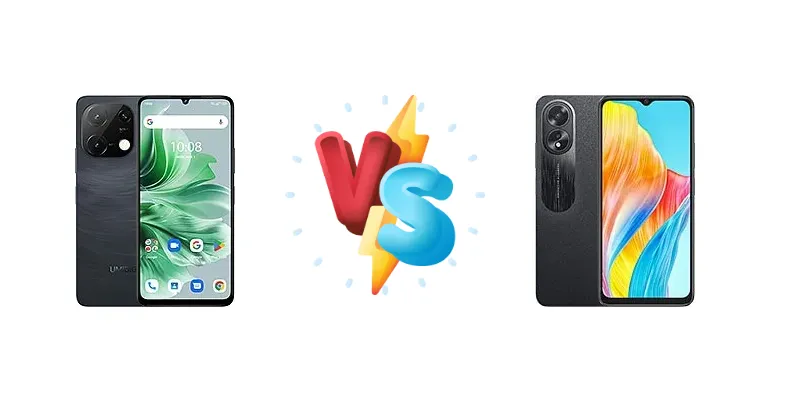
The Umidigi G9C and Oppo A18 represent compelling options in the ultra-budget smartphone segment. Both aim to deliver essential smartphone functionality at a price point that won't break the bank, but they achieve this with different approaches to chipset selection and core specifications. This comparison dives deep into the nuances of each device to determine which offers the best value for your money.
🏆 Quick Verdict
For most users, the Oppo A18 emerges as the stronger choice. Its Helio G85 chipset, featuring more powerful Cortex-A75 cores, provides a noticeable performance uplift over the Umidigi G9C’s Helio G36, translating to smoother multitasking and a better gaming experience. While both offer similar battery charging speeds, the A18’s more efficient processor contributes to longer real-world usage.
| Network |
|---|
| 2G bands | GSM 850 / 900 / 1800 / 1900 | GSM 850 / 900 / 1800 / 1900 |
| 3G bands | HSDPA 850 / 900 / 1700(AWS) / 1900 / 2100 | HSDPA 850 / 900 / 2100 |
| 4G bands | 1, 2, 3, 4, 5, 7, 8, 17, 18, 19, 20, 26, 28, 38, 40, 41, 66 | 1, 3, 5, 7, 8, 20, 28, 38, 40, 41 |
| Speed | HSPA, LTE | HSPA, LTE |
| Technology | GSM / HSPA / LTE | GSM / HSPA / LTE |
| Launch |
|---|
| Announced | 2024, September | 2023, September 27 |
| Status | Available. Released 2024, September | Available. Released 2023, October 05 |
| Body |
|---|
| Dimensions | 167.2 x 77 x 7.9 mm (6.58 x 3.03 x 0.31 in) | 163.7 x 75 x 8.2 mm (6.44 x 2.95 x 0.32 in) |
| SIM | Nano-SIM + Nano-SIM | Nano-SIM + Nano-SIM |
| Weight | 189 g (6.67 oz) | 188 g (6.63 oz) |
| Display |
|---|
| Resolution | 720 x 1600 pixels, 20:9 ratio (~260 ppi density) | 720 x 1612 pixels, 20:9 ratio (~269 ppi density) |
| Size | 6.75 inches, 110.0 cm2 (~85.4% screen-to-body ratio) | 6.56 inches, 103.4 cm2 (~84.2% screen-to-body ratio) |
| Type | IPS LCD, 90Hz | IPS LCD, 90Hz, 720 nits (peak) |
| Platform |
|---|
| CPU | Octa-core (4x2.2 GHz Cortex-A53 & 4x1.6 GHz Cortex-A53) | Octa-core (2x2.0 GHz Cortex-A75 & 6x1.8 GHz Cortex-A55) |
| Chipset | Mediatek Helio G36 (12 nm) | Mediatek MT6769 Helio G85 (12 nm) |
| GPU | PowerVR GE8320 | Mali-G52 MC2 |
| OS | Android 14 | Android 13, upgradable to Android 15, ColorOS 15 |
| Memory |
|---|
| Card slot | microSDXC (uses shared SIM slot) | microSDXC |
| Internal | 128GB 6GB RAM | 64GB 4GB RAM, 128GB 4GB RAM |
| Main Camera |
|---|
| Dual | 50 MP, (wide)
Auxiliary lens | 8 MP, f/2.0, (wide), AF
Auxiliary lens |
| Features | LED flash | LED flash, panorama |
| Video | 1080p@30fps | 1080p@30fps |
| Selfie camera |
|---|
| Features | - | Panorama |
| Single | 8 MP, (wide) | 5 MP, f/2.2, (wide) |
| Video | Yes | 1080p@30fps |
| Sound |
|---|
| 35mm jack | Yes | Yes |
| Loudspeaker | Yes | Yes |
| Comms |
|---|
| Bluetooth | 5.4, A2DP, LE | 5.3, A2DP, LE, aptX HD |
| NFC | Yes | No |
| Positioning | GPS, GLONASS, GALILEO, BDS | GPS, GALILEO, GLONASS, BDS, QZSS |
| Radio | FM radio | No |
| USB | USB Type-C, OTG | USB Type-C 2.0, OTG |
| WLAN | Wi-Fi 802.11 a/b/g/n/ac, dual-band | Wi-Fi 802.11 a/b/g/n/ac, dual-band |
| Features |
|---|
| Sensors | Fingerprint (side-mounted), accelerometer, compass | Fingerprint (side-mounted), accelerometer, proximity, compass |
| Battery |
|---|
| Charging | 18W wired | - |
| Type | 5000 mAh | Li-Po 5000 mAh |
| Misc |
|---|
| Colors | Rock Black, Grass Green | Glowing Black, Glowing Blue |
| Models | - | CPH2591 |
| Price | - | ₹ 10,290 |
Umidigi G9C
- Potentially lower price point
- Functional for basic smartphone tasks
- Reliable for calls and messaging
- Significantly weaker performance
- Less responsive user experience
- Limited gaming capabilities
Oppo A18
- Superior processing power with Helio G85
- Smoother multitasking and app launches
- Better gaming performance
- More efficient power consumption
- May be slightly more expensive
- Camera performance likely similar to G9C
Display Comparison
Neither Umidigi nor Oppo provide display specifications beyond the basic resolution. However, given the price bracket, both likely utilize IPS LCD panels. The key difference lies under the hood: the Oppo A18’s Helio G85 is more capable of driving higher refresh rate displays, though neither phone is confirmed to have one. The G9C’s Helio G36 is a more basic chipset, suggesting a standard 60Hz panel. Color accuracy and peak brightness are likely similar, leaning towards the budget-friendly side.
Camera Comparison
Detailed camera specifications are unavailable, but both phones likely feature a primary camera and a depth sensor. Given the market segment, image quality will be heavily reliant on software processing. The Oppo A18’s more powerful chipset could potentially enable more sophisticated image processing algorithms, leading to slightly better results in challenging lighting conditions. The presence of a more capable ISP within the Helio G85 could also improve dynamic range and noise reduction. It’s unlikely either phone will excel in low-light photography, and the often-included 2MP macro lenses are generally of limited practical use.
Performance
The core distinction between these phones is the chipset. The Oppo A18’s MediaTek Helio G85 (12nm) boasts a CPU configuration of 2x2.0 GHz Cortex-A75 and 6x1.8 GHz Cortex-A55 cores. This is a significant upgrade over the Umidigi G9C’s Helio G36 (12nm) with its 4x2.2 GHz Cortex-A53 and 4x1.6 GHz Cortex-A53 configuration. The Cortex-A75 cores in the G85 offer substantially better single-core performance, crucial for app launch speeds and general responsiveness. While both use the same 12nm process, the architectural improvements in the G85 translate to a smoother experience, particularly when multitasking or running demanding applications. The G9C’s reliance on older Cortex-A53 cores will result in noticeable slowdowns under heavier loads.
Battery Life
Both devices feature 18W wired charging, suggesting similar charging speeds – approximately 2-3 hours for a full charge. Battery capacity is not specified, but given the similar form factors and target price points, they are likely in the 5000mAh range. However, the Oppo A18’s more efficient Helio G85 chipset will consume less power during typical usage, resulting in longer battery life between charges. Users who frequently engage in gaming or video streaming will likely see a more significant benefit from the A18’s power efficiency.
Buying Guide
Buy the Umidigi G9C if you prioritize absolute affordability and need a functional smartphone for basic tasks like calls, messaging, and light social media. It’s a good option for first-time smartphone users or as a reliable backup device. Buy the Oppo A18 if you value a more responsive user experience, enjoy occasional mobile gaming, and want a device that will feel more future-proof thanks to its superior processing power.
Frequently Asked Questions
❓ Will the Oppo A18 struggle with popular apps like Facebook or WhatsApp?
No, the Helio G85 chipset in the Oppo A18 is more than capable of handling everyday apps like Facebook, WhatsApp, and most social media platforms without significant lag. The Cortex-A75 cores provide a noticeable performance boost over the Umidigi G9C, ensuring a smoother and more responsive experience.
❓ Is the gaming experience on the Umidigi G9C acceptable for casual games?
The Umidigi G9C can handle very basic, less demanding games. However, for anything beyond simple puzzle games or turn-based strategy, you'll likely experience significant frame rate drops and lag. The Helio G36 chipset is simply not powerful enough for modern mobile gaming.
❓ How long will it take to fully charge both phones from 0%?
Both the Umidigi G9C and Oppo A18 support 18W wired charging. Expect a full charge to take approximately 2 to 3 hours, assuming you use a compatible charger. While charging speed is similar, the Oppo A18’s more efficient processor means you’ll likely get more usage time from a full charge.
❓ Are either of these phones suitable for video editing or content creation?
Neither the Umidigi G9C nor the Oppo A18 are well-suited for video editing or content creation. Their chipsets lack the processing power and RAM necessary for smooth video editing, and their cameras are unlikely to produce high-quality footage suitable for professional use.