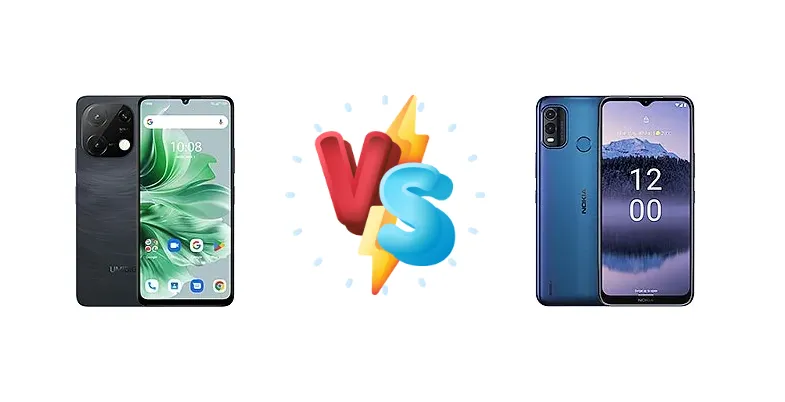
The sub-$150 smartphone market is fiercely competitive. Both the Umidigi G9C and Nokia G11 Plus aim to deliver essential smartphone functionality at an accessible price. However, they take different approaches to achieving this, primarily through their chipset choices. This comparison dissects the key differences between the MediaTek Helio G36-powered Umidigi G9C and the Unisoc T606-equipped Nokia G11 Plus, helping you determine which device best fits your needs.
🏆 Quick Verdict
For users prioritizing raw performance and faster charging, the Umidigi G9C is the better choice. Its Helio G36 chipset, while not a powerhouse, offers a noticeable edge over the Unisoc T606 in the Nokia G11 Plus. However, the Nokia G11 Plus appeals to those valuing brand reliability and a slightly more efficient CPU architecture.
| Network |
|---|
| 2G bands | GSM 850 / 900 / 1800 / 1900 | GSM 850 / 900 / 1800 / 1900 |
| 3G bands | HSDPA 850 / 900 / 1700(AWS) / 1900 / 2100 | HSDPA 850 / 900 / 2100 - International |
| 4G bands | 1, 2, 3, 4, 5, 7, 8, 17, 18, 19, 20, 26, 28, 38, 40, 41, 66 | 1, 3, 5, 7, 8, 20, 28, 38, 40, 41 - International |
| Speed | HSPA, LTE | HSPA 42.2/5.76 Mbps, LTE Cat4 150/50 Mbps |
| Technology | GSM / HSPA / LTE | GSM / HSPA / LTE |
| | - | 1, 3, 5, 8, 40, 41 - India |
| Launch |
|---|
| Announced | 2024, September | 2022, June 29 |
| Status | Available. Released 2024, September | Available. Released 2022, July 20 |
| Body |
|---|
| Build | - | Glass front, plastic frame, plastic back |
| Dimensions | 167.2 x 77 x 7.9 mm (6.58 x 3.03 x 0.31 in) | 164.8 x 75.9 x 8.6 mm (6.49 x 2.99 x 0.34 in) |
| SIM | Nano-SIM + Nano-SIM | · Nano-SIM· Nano-SIM + Nano-SIM |
| Weight | 189 g (6.67 oz) | 192 g (6.77 oz) |
| | - | Splash protection |
| Display |
|---|
| Resolution | 720 x 1600 pixels, 20:9 ratio (~260 ppi density) | 720 x 1600 pixels, 20:9 ratio (~269 ppi density) |
| Size | 6.75 inches, 110.0 cm2 (~85.4% screen-to-body ratio) | 6.52 inches, 102.6 cm2 (~82.1% screen-to-body ratio) |
| Type | IPS LCD, 90Hz | IPS LCD, 90Hz, 400 nits (typ) |
| Platform |
|---|
| CPU | Octa-core (4x2.2 GHz Cortex-A53 & 4x1.6 GHz Cortex-A53) | Octa-core (2x1.6 GHz Cortex-A75 & 6x1.6 GHz Cortex-A55) |
| Chipset | Mediatek Helio G36 (12 nm) | Unisoc T606 (12 nm) |
| GPU | PowerVR GE8320 | Mali-G57 MP1 |
| OS | Android 14 | Android 12, upgradable to Android 13 |
| Memory |
|---|
| Card slot | microSDXC (uses shared SIM slot) | microSDXC (dedicated slot) |
| Internal | 128GB 6GB RAM | 32GB 3GB RAM, 64GB 3GB RAM, 64GB 4GB RAM, 128GB 3GB RAM |
| | - | eMMC 5.1 |
| Main Camera |
|---|
| Dual | 50 MP, (wide)
Auxiliary lens | 50 MP, f/1.8, (wide), 1/2.67", PDAF
Auxiliary lens |
| Features | LED flash | LED flash |
| Single | - | 8 MP, f/2.0, (wide), 1/4.0" |
| Video | 1080p@30fps | 1080p@30fps |
| Selfie camera |
|---|
| Single | 8 MP, (wide) | 8 MP, f/2.0, (wide), 1/4.0" |
| Video | Yes | 1080p@30fps |
| Sound |
|---|
| 3.5mm jack | - | Yes |
| 35mm jack | Yes | Yes |
| Loudspeaker | Yes | Yes |
| Comms |
|---|
| Bluetooth | 5.4, A2DP, LE | 5.0, A2DP, LE |
| NFC | Yes | No |
| Positioning | GPS, GLONASS, GALILEO, BDS | GPS |
| Radio | FM radio | FM radio |
| USB | USB Type-C, OTG | USB Type-C 2.0, OTG |
| WLAN | Wi-Fi 802.11 a/b/g/n/ac, dual-band | Wi-Fi 802.11 a/b/g/n/ac, dual-band, Wi-Fi Direct |
| Features |
|---|
| Sensors | Fingerprint (side-mounted), accelerometer, compass | Fingerprint (rear-mounted), accelerometer, proximity |
| Battery |
|---|
| Charging | 18W wired | 10W wired |
| Type | 5000 mAh | Li-Ion 5000 mAh |
| Misc |
|---|
| Colors | Rock Black, Grass Green | Lake Blue, Charcoal Grey |
| Price | - | About 130 EUR |
Umidigi G9C
- Faster 18W charging for quicker top-ups.
- Helio G36 offers better overall performance for multitasking and gaming.
- Potentially smoother app launching and responsiveness.
- MediaTek chipsets sometimes have less consistent software updates.
- May experience slightly faster battery drain during intensive use.
Nokia G11 Plus
- Nokia’s reputation for software support and build quality.
- Unisoc T606’s architecture is more power-efficient for lighter tasks.
- Potentially longer battery life during basic usage.
- Slower 10W charging is a significant drawback.
- Unisoc T606 offers less raw performance than the Helio G36.
Display Comparison
Neither device boasts a standout display. Both are likely utilizing LCD panels, common in this price bracket. Without specific display specs, it's difficult to definitively compare brightness or color accuracy. However, the focus should be on usability rather than visual fidelity. Bezels are expected to be relatively thick on both, maximizing screen real estate within a budget.
Camera Comparison
Without detailed camera specifications, a direct comparison is challenging. Both phones likely feature a primary camera and potentially a depth or macro sensor. However, given the price point, image quality will be heavily reliant on software processing. The absence of Optical Image Stabilization (OIS) on either device suggests low-light performance will be limited. Focusing on the primary sensor’s megapixel count (if available) would be the most meaningful comparison, but without that data, it’s safe to assume both offer adequate, but not exceptional, photography capabilities.
Performance
The core difference lies in the chipsets. The Umidigi G9C’s MediaTek Helio G36 features a combination of Cortex-A53 cores clocked at 2.2 GHz and 1.6 GHz. This configuration prioritizes burst performance, potentially beneficial for launching apps and short gaming sessions. Conversely, the Nokia G11 Plus utilizes the Unisoc T606, employing two Cortex-A75 cores at 1.6 GHz alongside six Cortex-A55 cores, also at 1.6 GHz. The A75 cores offer better single-core performance than the A53, but the G36’s higher clock speeds and octa-core configuration likely translate to superior multi-core performance. This means the G9C will likely handle more demanding multitasking scenarios more effectively. The Unisoc T606’s architecture is more power-efficient, potentially leading to slightly better battery life during less intensive tasks.
Battery Life
The Nokia G11 Plus’s 10W charging is a significant disadvantage compared to the Umidigi G9C’s 18W charging. This translates to a considerably longer time to fully charge the device. While battery capacity isn’t specified, the Unisoc T606’s efficiency might partially offset the slower charging, offering comparable overall battery life. However, users who frequently need to top up their phones will find the G9C’s faster charging a substantial benefit.
Buying Guide
Buy the Umidigi G9C if you need a phone for light gaming, smoother multitasking, and faster charging. Its Helio G36 chipset provides a performance boost for everyday tasks and casual gaming. Buy the Nokia G11 Plus if you prioritize a potentially longer-lasting battery due to the more efficient Cortex-A55 cores and prefer the Nokia brand's reputation for software support and build quality, even if it means sacrificing some processing power.
Frequently Asked Questions
❓ Will the Umidigi G9C struggle with graphically demanding games like PUBG Mobile?
While the Helio G36 isn't a gaming powerhouse, it should be capable of running PUBG Mobile at lower settings. Expect frame rate drops during intense action, and you may need to lower graphics settings to achieve a playable experience. The Nokia G11 Plus will likely perform even less well in demanding games.
❓ How long will it take to fully charge the Nokia G11 Plus with its 10W charging?
Given the 10W charging rate, expect a full charge to take approximately 3-4 hours, potentially longer depending on the battery capacity. This is significantly slower than the Umidigi G9C’s 18W charging, which should complete a full charge in around 2-2.5 hours.
❓ Is the Unisoc T606 chipset known for overheating issues?
The Unisoc T606 generally doesn't suffer from significant overheating issues. Its power-efficient architecture helps to keep temperatures under control, even during prolonged use. However, sustained heavy gaming on either device may lead to some thermal throttling.
❓ Which phone is likely to receive more software updates?
Nokia generally provides more consistent and longer-term software support for its devices, even in the budget segment. Umidigi's update track record is less predictable. If software updates and security patches are a priority, the Nokia G11 Plus is the safer bet.