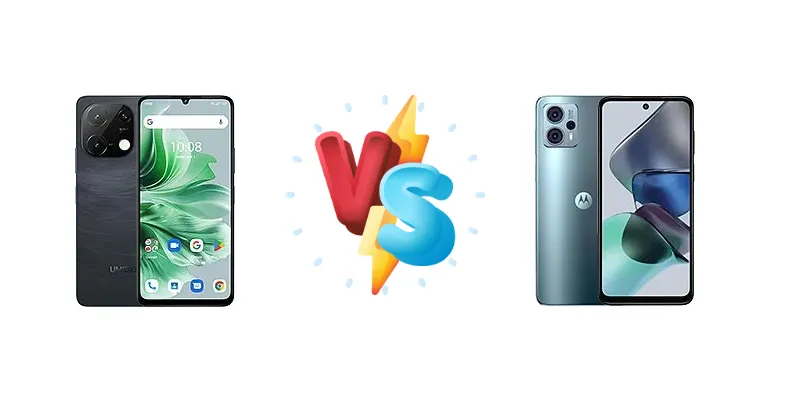
The sub-$150 smartphone market is fiercely competitive. Both the Umidigi G9C and Motorola Moto G23 aim to deliver essential smartphone functionality at an accessible price. However, they take different approaches to achieving this, primarily through their chipset choices and charging capabilities. This comparison dissects those differences to determine which device offers the best value.
🏆 Quick Verdict
For most users, the Motorola Moto G23 is the better choice. While the Umidigi G9C offers a functional experience, the Moto G23’s Helio G85 chipset provides a noticeable performance uplift, and its 30W charging significantly reduces downtime. The G23’s more modern CPU architecture translates to a smoother user experience.
| Network |
|---|
| 2G bands | GSM 850 / 900 / 1800 / 1900 | GSM 850 / 900 / 1800 / 1900 |
| 3G bands | HSDPA 850 / 900 / 1700(AWS) / 1900 / 2100 | HSDPA 850 / 900 / 1900 / 2100 - Europe, AP/MEA |
| 4G bands | 1, 2, 3, 4, 5, 7, 8, 17, 18, 19, 20, 26, 28, 38, 40, 41, 66 | 1, 2, 3, 5, 7, 8, 20, 28, 38, 40, 41 - Europe |
| Speed | HSPA, LTE | HSPA, LTE |
| Technology | GSM / HSPA / LTE | GSM / HSPA / LTE |
| | - | 1, 2, 3, 5, 7, 8, 18, 19, 20, 26, 28, 38, 40, 41 - AP/MEA |
| Launch |
|---|
| Announced | 2024, September | 2023, January 24 |
| Status | Available. Released 2024, September | Available. Released 2023, January 24 |
| Body |
|---|
| Build | - | Glass front, plastic frame, plastic back |
| Dimensions | 167.2 x 77 x 7.9 mm (6.58 x 3.03 x 0.31 in) | 162.7 x 74.7 x 8.2 mm (6.41 x 2.94 x 0.32 in) |
| SIM | Nano-SIM + Nano-SIM | · Nano-SIM· Nano-SIM + Nano-SIM |
| Weight | 189 g (6.67 oz) | 184.3 g (6.49 oz) |
| | - | Water-resistant design |
| Display |
|---|
| Protection | - | Panda glass |
| Resolution | 720 x 1600 pixels, 20:9 ratio (~260 ppi density) | 720 x 1600 pixels, 20:9 ratio (~270 ppi density) |
| Size | 6.75 inches, 110.0 cm2 (~85.4% screen-to-body ratio) | 6.5 inches, 102.0 cm2 (~83.9% screen-to-body ratio) |
| Type | IPS LCD, 90Hz | IPS LCD, 90Hz, 400 nits (peak) |
| Platform |
|---|
| CPU | Octa-core (4x2.2 GHz Cortex-A53 & 4x1.6 GHz Cortex-A53) | Octa-core (2x2.0 GHz Cortex-A75 & 6x1.8 GHz Cortex-A55) |
| Chipset | Mediatek Helio G36 (12 nm) | Mediatek MT6769Z Helio G85 (12 nm) |
| GPU | PowerVR GE8320 | Mali-G52 MC2 |
| OS | Android 14 | Android 13, planned upgrade to Android 14 |
| Memory |
|---|
| Card slot | microSDXC (uses shared SIM slot) | microSDXC (dedicated slot) |
| Internal | 128GB 6GB RAM | 64GB 4GB RAM, 128GB 4GB RAM, 128GB 8GB RAM |
| Main Camera |
|---|
| Dual | 50 MP, (wide)
Auxiliary lens | - |
| Features | LED flash | LED flash, HDR, panorama |
| Triple | - | 50 MP, f/1.8, (wide), 0.64µm, PDAF
5 MP, f/2.2, 118˚ (ultrawide)
2 MP (macro) |
| Video | 1080p@30fps | 1080p@30fps |
| Selfie camera |
|---|
| Features | - | HDR |
| Single | 8 MP, (wide) | 16 MP, f/2.5, (wide), 1.0µm |
| Video | Yes | 1080p@30fps |
| Sound |
|---|
| 3.5mm jack | - | Yes |
| 35mm jack | Yes | Yes |
| Loudspeaker | Yes | Yes, with stereo speakers |
| Comms |
|---|
| Bluetooth | 5.4, A2DP, LE | 5.1, A2DP, LE |
| NFC | Yes | Yes (market/region dependent) |
| Positioning | GPS, GLONASS, GALILEO, BDS | GPS, GLONASS, GALILEO |
| Radio | FM radio | FM radio |
| USB | USB Type-C, OTG | USB Type-C 2.0 |
| WLAN | Wi-Fi 802.11 a/b/g/n/ac, dual-band | Wi-Fi 802.11 a/b/g/n/ac, dual-band |
| Features |
|---|
| Sensors | Fingerprint (side-mounted), accelerometer, compass | Fingerprint (side-mounted), accelerometer, gyro, proximity |
| Battery |
|---|
| Charging | 18W wired | 30W wired |
| Type | 5000 mAh | 5000 mAh |
| Misc |
|---|
| Colors | Rock Black, Grass Green | Matte Charcoal, Pearl White, Steel Blue |
| Models | - | XT2333-1 |
| Price | - | About 80 EUR |
Umidigi G9C
- Most affordable option
- Functional for basic tasks
- Decent battery life (assuming optimized software)
- Slower processor
- Slower charging speed
- Less responsive user experience
Motorola Moto G23
- Faster and more efficient processor
- Significantly faster charging
- Smoother multitasking and gaming
- Slightly higher price point
- May not have the absolute longest battery life
- Camera performance likely similar to G9C
Display Comparison
Neither device boasts a standout display. Both utilize 12nm chipsets, suggesting a focus on cost optimization over premium display features. While specific display specs (resolution, panel type) are missing, the focus here is on performance. The absence of high refresh rates or advanced panel technologies like LTPO is expected at this price point. Bezels are likely comparable, prioritizing maximizing screen real estate within the budget constraints.
Camera Comparison
Without detailed camera specifications, a direct comparison is limited. However, it’s safe to assume both phones will feature a primary camera alongside supporting lenses (likely a depth or macro sensor). The image processing capabilities will likely be tuned for vibrant, social media-friendly results. The absence of Optical Image Stabilization (OIS) is expected in this price bracket. The larger sensor size, if present on the Moto G23, would be a key advantage, capturing more light and resulting in better low-light performance. The 2MP macro cameras often found on these devices offer limited practical benefit.
Performance
The core difference lies in the chipsets. The Umidigi G9C’s MediaTek Helio G36 features an octa-core configuration with four Cortex-A53 cores clocked at 2.2 GHz and another four at 1.6 GHz. This older architecture prioritizes power efficiency over raw performance. Conversely, the Motorola Moto G23 utilizes the Helio G85, employing a more modern octa-core setup with two Cortex-A75 cores at 2.0 GHz and six Cortex-A55 cores at 1.8 GHz. The A75 cores represent a significant architectural improvement, offering substantially better single-core performance, crucial for app launch times and general responsiveness. This translates to a smoother experience for everyday tasks and a more capable gaming experience on the Moto G23.
Battery Life
While battery capacity isn’t specified, the charging wattage is a clear differentiator. The Umidigi G9C supports 18W wired charging, while the Motorola Moto G23 boasts 30W wired charging. This means the Moto G23 will significantly reduce charging times, getting you back up and running much faster. Even with a similar battery capacity, the 30W charging will be a noticeable convenience for users who rely heavily on their phones throughout the day. The faster charging offsets any potential battery capacity differences.
Buying Guide
Buy the Umidigi G9C if you prioritize absolute affordability and are willing to accept compromises in performance and charging speed. It’s a suitable option for basic tasks like calls, texts, and light social media. Buy the Motorola Moto G23 if you value a more responsive user experience, faster charging, and a chipset capable of handling moderate gaming and multitasking without significant slowdowns. It’s the better choice for users who want a phone that can keep up with a slightly more demanding lifestyle.
Frequently Asked Questions
❓ Will the Helio G85 in the Moto G23 handle popular games like PUBG Mobile or Call of Duty Mobile?
The Helio G85 is capable of running PUBG Mobile and Call of Duty Mobile at medium settings with reasonable frame rates. While it won't deliver a flagship gaming experience, it provides a playable experience for casual gamers. Expect some frame drops during intense action sequences.
❓ How long will it take to fully charge the Motorola Moto G23 with the 30W charger?
With the included 30W charger, the Motorola Moto G23 should charge from 0% to 100% in approximately 60-75 minutes, depending on usage during charging. This is a significant improvement over the Umidigi G9C’s 18W charging, which will likely take over 2 hours.
❓ Is the Umidigi G9C a good choice for someone who primarily uses their phone for calls, texts, and WhatsApp?
Yes, the Umidigi G9C is a perfectly adequate choice for basic communication tasks. Its Helio G36 chipset is sufficient for handling calls, texts, and messaging apps without significant lag. However, if you anticipate using more demanding apps, the Moto G23 would provide a smoother experience.
❓ Does either phone have a dedicated microSD card slot for expandable storage?
While not explicitly stated in the provided specifications, Motorola phones in this price range often include a dedicated microSD card slot. The Umidigi G9C's inclusion of a microSD slot is less certain and would require checking the official product page. Expandable storage is a valuable feature for users who store a lot of photos, videos, or music.