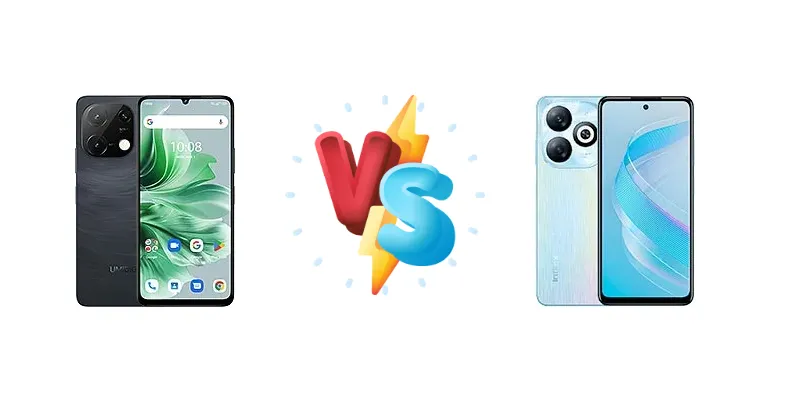
The Umidigi G9C and Infinix Smart 8 Pro represent the fiercely competitive sub-$150 smartphone market. Both devices leverage the MediaTek Helio G36 chipset, suggesting similar performance on paper. However, key differences in charging capabilities and potential software optimizations create a nuanced buying decision for budget-conscious consumers.
🏆 Quick Verdict
For most users, the Infinix Smart 8 Pro edges out the Umidigi G9C. While performance is identical, the inclusion of reverse wired charging adds a layer of utility absent in the G9C, making it a more versatile option despite the slower charging speed.
| Network |
|---|
| 2G bands | GSM 850 / 900 / 1800 / 1900 | GSM 850 / 900 / 1800 / 1900 |
| 3G bands | HSDPA 850 / 900 / 1700(AWS) / 1900 / 2100 | HSDPA 850 / 900 / 1700(AWS) / 1900 / 2100 |
| 4G bands | 1, 2, 3, 4, 5, 7, 8, 17, 18, 19, 20, 26, 28, 38, 40, 41, 66 | 1, 2, 3, 4, 5, 7, 8, 20, 28, 38, 41, 40 |
| Speed | HSPA, LTE | HSPA, LTE |
| Technology | GSM / HSPA / LTE | GSM / HSPA / LTE |
| Launch |
|---|
| Announced | 2024, September | 2024, January 29 |
| Status | Available. Released 2024, September | Available. Released 2024, February |
| Body |
|---|
| Build | - | Glass front, plastic back, plastic frame |
| Dimensions | 167.2 x 77 x 7.9 mm (6.58 x 3.03 x 0.31 in) | 163.6 x 75.6 x 8.5 mm (6.44 x 2.98 x 0.33 in) |
| SIM | Nano-SIM + Nano-SIM | Nano-SIM + Nano-SIM |
| Weight | 189 g (6.67 oz) | 189 g (6.67 oz) |
| Display |
|---|
| Resolution | 720 x 1600 pixels, 20:9 ratio (~260 ppi density) | 720 x 1612 pixels, 20:9 ratio (~267 ppi density) |
| Size | 6.75 inches, 110.0 cm2 (~85.4% screen-to-body ratio) | 6.6 inches, 104.6 cm2 (~84.6% screen-to-body ratio) |
| Type | IPS LCD, 90Hz | IPS LCD, 90Hz, 500 nits (peak) |
| Platform |
|---|
| CPU | Octa-core (4x2.2 GHz Cortex-A53 & 4x1.6 GHz Cortex-A53) | Octa-core (4x2.2 GHz Cortex-A53 & 4x1.6 GHz Cortex-A53) |
| Chipset | Mediatek Helio G36 (12 nm) | Mediatek Helio G36 (12 nm) |
| GPU | PowerVR GE8320 | PowerVR GE8320 |
| OS | Android 14 | Android 13 (Go edition), XOS 13 |
| Memory |
|---|
| Card slot | microSDXC (uses shared SIM slot) | microSDXC (dedicated slot) |
| Internal | 128GB 6GB RAM | 64GB 4GB RAM, 128GB 8GB RAM, 256GB 4GB RAM |
| Main Camera |
|---|
| Dual | 50 MP, (wide)
Auxiliary lens | - |
| Features | LED flash | Ring-LED flash, HDR, panorama |
| Single | - | 50 MP, f/1.9, (wide), AF
Auxiliary lens |
| Video | 1080p@30fps | 1080p@30fps |
| Selfie camera |
|---|
| Single | 8 MP, (wide) | 8 MP, f/2.0, (wide) |
| Video | Yes | Yes |
| Sound |
|---|
| 35mm jack | Yes | Yes |
| Loudspeaker | Yes | Yes |
| Comms |
|---|
| Bluetooth | 5.4, A2DP, LE | 5.0, A2DP, LE |
| NFC | Yes | No |
| Positioning | GPS, GLONASS, GALILEO, BDS | GPS |
| Radio | FM radio | FM radio |
| USB | USB Type-C, OTG | USB Type-C 2.0, OTG |
| WLAN | Wi-Fi 802.11 a/b/g/n/ac, dual-band | Wi-Fi 802.11 a/b/g/n/ac, dual-band |
| Features |
|---|
| Sensors | Fingerprint (side-mounted), accelerometer, compass | Fingerprint (side-mounted), accelerometer, gyro, proximity, compass |
| Battery |
|---|
| Charging | 18W wired | 10W wired
Reverse wired |
| Type | 5000 mAh | 5000 mAh |
| Misc |
|---|
| Colors | Rock Black, Grass Green | Rainbow Blue, Galaxy White, Shiny Gold, Timber Black |
| Models | - | X6525B |
| Price | - | About 100 EUR |
Umidigi G9C
- Faster 18W wired charging.
- Potentially slightly better sustained performance due to less focus on reverse charging features.
- Simple, straightforward user experience.
- Lacks reverse charging functionality.
- May have less optimized software compared to Infinix.
- No details on display quality.
Infinix Smart 8 Pro
- Includes reverse wired charging for added versatility.
- Infinix's software often includes useful features and optimizations.
- Potentially better software support.
- Slower 10W wired charging.
- May experience slightly more heat during charging due to reverse charging circuitry.
- No details on display quality.
Display Comparison
Both the Umidigi G9C and Infinix Smart 8 Pro likely utilize LCD panels, typical for this price point. Specific details like resolution and peak brightness are not provided, but we can assume they are similar, aiming for a 720p+ resolution to balance clarity and battery life. Bezels are expected to be noticeable on both devices, as manufacturers prioritize cost savings over ultra-thin designs in this segment. Color accuracy will likely be standard for budget LCDs, meaning it won't be suitable for color-critical work.
Camera Comparison
Camera specifications are not detailed beyond the presence of cameras. Given the price point, image quality will be heavily reliant on software processing. Expect the primary sensors to be around 8-13MP. The absence of Optical Image Stabilization (OIS) is almost certain. Any 'macro' cameras included are likely to be low-resolution (2MP) and offer limited practical benefit. Image processing will focus on enhancing brightness and contrast, but detail and dynamic range will be limited, especially in low-light conditions.
Performance
The core of both phones is the MediaTek Helio G36 (12 nm). This chipset features an octa-core configuration with 4x2.2 GHz Cortex-A53 cores and 4x1.6 GHz Cortex-A53 cores. This means identical CPU performance is expected. The GPU within the Helio G36 is capable of handling basic gaming and everyday tasks, but don't expect to run demanding titles at high settings. RAM configurations are not specified, but both will likely offer options around 3-4GB, which is sufficient for basic multitasking. Thermal management will be passive, relying on the phone's chassis to dissipate heat, potentially leading to some throttling during extended gaming sessions.
Battery Life
Battery capacity is not specified for either device. However, given the Helio G36's efficiency and the target price point, we can estimate capacities around 5000mAh. The key difference lies in charging: the Umidigi G9C supports 18W wired charging, while the Infinix Smart 8 Pro offers 10W wired charging *and* reverse wired charging. While 18W is faster for charging the G9C itself, the Infinix's reverse charging capability allows it to function as a portable power bank for other devices, a unique advantage in this price bracket. A full 0-100% charge on the G9C will likely take around 2-3 hours, while the Smart 8 Pro will take closer to 3-4 hours.
Buying Guide
Buy the Umidigi G9C if your priority is maximizing charging speed within this budget segment; the 18W charging will get you back up and running faster. Buy the Infinix Smart 8 Pro if you value versatility and the convenience of being able to top up other devices using your phone as a power bank, even if it means a slightly slower charging experience for the phone itself.
Frequently Asked Questions
❓ Does the Infinix Smart 8 Pro's reverse charging work with all devices?
The Infinix Smart 8 Pro's reverse charging utilizes the standard USB-C connector. Therefore, it will work with any device that charges via USB-C. However, the charging speed will be limited to 5W, so it's best suited for topping up smaller devices like earbuds or smartwatches.
❓ Will I experience significant lag when multitasking on either the Umidigi G9C or Infinix Smart 8 Pro?
With the MediaTek Helio G36 and likely 3-4GB of RAM, both phones will handle basic multitasking (switching between apps like messaging, web browsing, and music) adequately. However, running multiple demanding apps simultaneously may result in noticeable lag and app reloading. Closing unused apps is recommended to maintain smooth performance.
❓ How does the 18W charging on the Umidigi G9C compare to standard 10W charging in real-world use?
The 18W charging on the Umidigi G9C will noticeably reduce charging times compared to the 10W charging on the Infinix Smart 8 Pro. Expect roughly a 30-60 minute difference for a full charge, making the G9C a better choice if minimizing downtime is a priority.