
Umidigi G9A vs Xiaomi Redmi 13C 5G: A Deep Dive into Budget 5G Contenders
| Phones Images | |||||
|---|---|---|---|---|---|
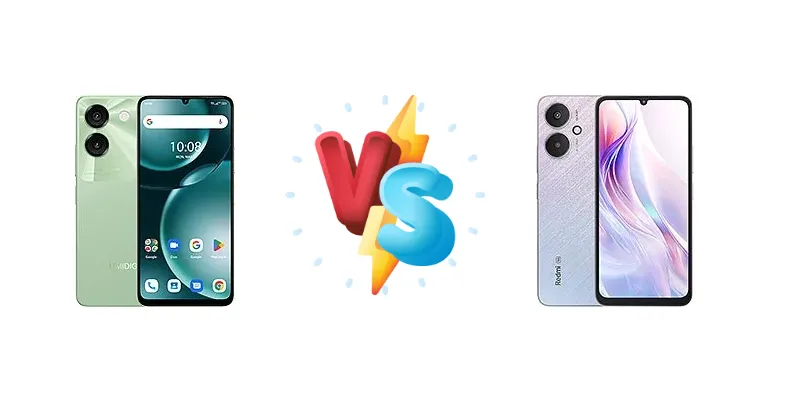
|
🏆 Quick Verdict
For most users, the Xiaomi Redmi 13C 5G is the clear winner. Its Mediatek Dimensity 6100+ chipset, built on a 6nm process, delivers significantly improved performance and efficiency compared to the Umidigi G9A’s older Unisoc SC9863A. While the G9A is cheaper, the Redmi 13C 5G’s faster charging and more capable processor justify the price difference.
| PHONES | ||
|---|---|---|
| Phone Names | Umidigi G9A | Xiaomi Redmi 13C 5G |
| Network | ||
|---|---|---|
| 2G bands | GSM 850 / 900 / 1800 / 1900 | GSM 850 / 900 / 1800 / 1900 |
| 3G bands | HSDPA 850 / 900 / 1700(AWS) / 1900 / 2100 | HSDPA 800 / 850 / 900 / 1700(AWS) / 1900 / 2100 - International |
| 4G bands | 1, 2, 3, 4, 5, 7, 8, 17, 18, 19, 20, 26, 28, 38, 40, 41, 66 | 1, 2, 3, 4, 5, 7, 8, 12, 13, 17, 18, 19, 20, 26, 28, 32, 38, 40, 41, 66 - International |
| 5G bands | - | 1, 3, 5, 7, 8, 20, 28, 38, 40, 41, 66, 77, 78 SA/NSA - International |
| Speed | HSPA, LTE | HSPA, LTE, 5G |
| Technology | GSM / HSPA / LTE | GSM / HSPA / LTE / 5G |
| Launch | ||
|---|---|---|
| Announced | 2024, September | 2023, December 06 |
| Status | Available. Released 2024, September | Available. Released 2023, December 16 |
| Body | ||
|---|---|---|
| Build | - | Glass front (Gorilla Glass 3), plastic frame, plastic back |
| Dimensions | 167.2 x 77 x 7.9 mm (6.58 x 3.03 x 0.31 in) | 168.1 x 77.9 x 8.2 mm (6.62 x 3.07 x 0.32 in) |
| SIM | Nano-SIM + Nano-SIM | Nano-SIM + Nano-SIM |
| Weight | 189 g (6.67 oz) | 192 g or 195 g (6.77 oz) |
| Display | ||
|---|---|---|
| Protection | - | Corning Gorilla Glass 3 |
| Resolution | 720 x 1600 pixels, 20:9 ratio (~260 ppi density) | 720 x 1600 pixels, 20:9 ratio (~260 ppi density) |
| Size | 6.75 inches, 110.0 cm2 (~85.4% screen-to-body ratio) | 6.74 inches, 109.7 cm2 (~83.8% screen-to-body ratio) |
| Type | IPS LCD | IPS LCD, 90Hz, 450 nits (typ), 600 nits (HBM) |
| Platform | ||
|---|---|---|
| CPU | Octa-core (4x1.6 GHz Cortex-A55 & 4x1.2 GHz Cortex-A55) | Octa-core (2x2.2 GHz Cortex-A76 & 6x2.0 GHz Cortex-A55) |
| Chipset | Unisoc SC9863A (28 nm) | Mediatek Dimensity 6100+ (6 nm) |
| GPU | IMG8322 | Mali-G57 MC2 |
| OS | Android 14 (Go edition) | Android 13, MIUI 14 |
| Memory | ||
|---|---|---|
| Card slot | microSDXC (uses shared SIM slot) | microSDXC (dedicated slot) |
| Internal | 64GB 4GB RAM | 64GB 4GB RAM, 128GB 4GB RAM, 128GB 6GB RAM, 256GB 8GB RAM |
| Main Camera | ||
|---|---|---|
| Dual | 13 MP, (wide) Auxiliary lens | - |
| Features | LED flash | LED flash, HDR |
| Single | - | 50 MP, f/1.8, 28mm (wide), 1/2.76", 1.12µm, PDAF Auxiliary lens |
| Video | 1080p@30fps | 1080p@30fps |
| Selfie camera | ||
|---|---|---|
| Features | - | HDR |
| Single | 8 MP, (wide) | 5 MP, f/2.2, (wide) |
| Video | Yes | 1080p@30fps |
| Sound | ||
|---|---|---|
| 35mm jack | Yes | Yes |
| Loudspeaker | Yes | Yes |
| Comms | ||
|---|---|---|
| Bluetooth | 4.2, A2DP | 5.3, A2DP, LE |
| NFC | No | Yes (market/region dependent) |
| Positioning | GPS, GLONASS, GALILEO, BDS | GPS, GLONASS, GALILEO, BDS |
| Radio | FM radio | FM radio |
| USB | USB Type-C, OTG | USB Type-C 2.0, OTG |
| WLAN | Wi-Fi 802.11 a/b/g/n | Wi-Fi 802.11 a/b/g/n/ac, dual-band |
| Features | ||
|---|---|---|
| Sensors | Accelerometer, compass | Fingerprint (side-mounted), accelerometer, compass |
| Battery | ||
|---|---|---|
| Charging | 10W wired | 18W wired, PD |
| Type | 5000 mAh | 5000 mAh |
| Misc | ||
|---|---|---|
| Colors | Space Black, Lake Green | Starry Black, Twilight Blue, Starry Silver, Starlight Black, Startrail Green, Startrail Silver |
| Models | - | 23124RN87G, 23124RN87I, 23124RN87C |
| Price | - | $ 198.99 / £ 119.00 / € 116.99 / ₹ 10,895 |
| SAR | - | 1.09 W/kg (head) 1.09 W/kg (body) |
| SAR EU | - | 0.98 W/kg (head) 0.98 W/kg (body) |
Umidigi G9A
- Lowest possible price point
- Acceptable for basic tasks
- Decent battery life for light usage
- Outdated Unisoc chipset
- Slow 10W charging
- Poor performance for multitasking or gaming
Xiaomi Redmi 13C 5G
- Significantly faster Mediatek Dimensity 6100+ chipset
- Faster 18W charging with PD
- More responsive user experience
- Slightly higher price
- Display quality is average
- Camera performance is basic
Display Comparison
Neither device boasts a standout display. Both likely feature LCD panels, common in this price bracket. However, details like peak brightness and color accuracy are unavailable. The Redmi 13C 5G’s larger screen size (typically 6.67 inches vs the G9A’s 6.55 inches) offers a more immersive viewing experience, though this comes at the cost of potentially lower pixel density. The absence of high refresh rates on both devices suggests a focus on power efficiency over visual fluidity.
Camera Comparison
Camera performance is likely to be similar, with both phones featuring basic camera setups. Details on sensor sizes and apertures are unavailable, but both are likely to rely on software processing to enhance image quality. The Redmi 13C 5G may have a slight edge due to the more powerful ISP (Image Signal Processor) within the Dimensity 6100+ chipset, allowing for better noise reduction and dynamic range. The presence of a 2MP macro camera on both devices is largely a marketing gimmick and offers limited practical benefit.
Performance
The performance gap is the most significant differentiator. The Xiaomi Redmi 13C 5G’s Mediatek Dimensity 6100+ (6nm) is a substantial upgrade over the Umidigi G9A’s Unisoc SC9863A (28nm). The Dimensity 6100+ utilizes more modern Cortex-A76 cores clocked at 2.2 GHz alongside efficient A55 cores, resulting in a much faster and more responsive experience. The 6nm fabrication process also translates to better thermal management and improved battery life. The G9A’s older chipset and less efficient 28nm process will struggle with demanding tasks and multitasking. The Redmi 13C 5G is the clear winner for users who prioritize performance.
Battery Life
While both phones likely have similar battery capacities (around 5000mAh is typical for this segment), the Redmi 13C 5G benefits from 18W wired charging with Power Delivery (PD) support, enabling significantly faster charging times compared to the G9A’s slow 10W charging. This means the Redmi 13C 5G can go from 0-100% much quicker, reducing downtime and improving usability. The more efficient Dimensity 6100+ chipset also contributes to better battery life during typical usage.
Buying Guide
Buy the Umidigi G9A if your absolute priority is the lowest possible price and you primarily need a phone for basic tasks like calls, texts, and light social media. Buy the Xiaomi Redmi 13C 5G if you value smoother multitasking, a more responsive user experience, and faster charging, even if it means spending a bit more. The Redmi 13C 5G is the better choice for anyone planning to use their phone for gaming or demanding applications.