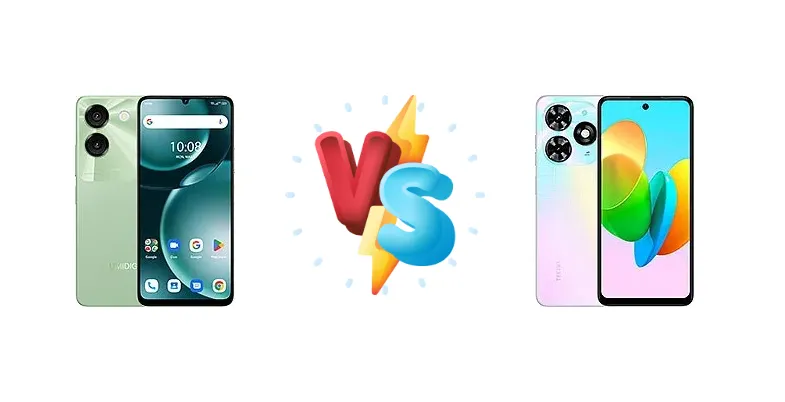
The Umidigi G9A and Tecno Spark 20C represent the fiercely competitive sub-$150 smartphone market. Both aim to deliver essential functionality at an accessible price, but they take different approaches to achieving this. The G9A relies on a Unisoc chipset, while the Spark 20C opts for a Mediatek solution. This comparison will dissect the key differences to determine which device offers the best value.
🏆 Quick Verdict
For the average user prioritizing responsiveness and faster charging, the Tecno Spark 20C is the better choice. Its Mediatek chipset, clocked at 2.2 GHz, provides a noticeable performance edge over the Umidigi G9A’s Unisoc SC9863A, and the 18W charging significantly reduces downtime compared to the G9A’s 10W.
| Network |
|---|
| 2G bands | GSM 850 / 900 / 1800 / 1900 | GSM 850 / 900 / 1800 / 1900 |
| 3G bands | HSDPA 850 / 900 / 1700(AWS) / 1900 / 2100 | HSDPA 900 / 2100 |
| 4G bands | 1, 2, 3, 4, 5, 7, 8, 17, 18, 19, 20, 26, 28, 38, 40, 41, 66 | LTE |
| Speed | HSPA, LTE | HSPA, LTE |
| Technology | GSM / HSPA / LTE | GSM / HSPA / LTE |
| Launch |
|---|
| Announced | 2024, September | 2023, November 27 |
| Status | Available. Released 2024, September | Available. Released 2023, December |
| Body |
|---|
| Build | - | Glass front, plastic back, plastic frame |
| Dimensions | 167.2 x 77 x 7.9 mm (6.58 x 3.03 x 0.31 in) | 163.7 x 75.6 x 8.6 mm (6.44 x 2.98 x 0.34 in) |
| SIM | Nano-SIM + Nano-SIM | Nano-SIM + Nano-SIM |
| Weight | 189 g (6.67 oz) | - |
| Display |
|---|
| Resolution | 720 x 1600 pixels, 20:9 ratio (~260 ppi density) | 720 x 1612 pixels, 20:9 ratio (~267 ppi density) |
| Size | 6.75 inches, 110.0 cm2 (~85.4% screen-to-body ratio) | 6.6 inches, 104.6 cm2 (~84.6% screen-to-body ratio) |
| Type | IPS LCD | IPS LCD, 90Hz |
| Platform |
|---|
| CPU | Octa-core (4x1.6 GHz Cortex-A55 & 4x1.2 GHz Cortex-A55) | Octa-core 2.2 GHz Cortex-A53 |
| Chipset | Unisoc SC9863A (28 nm) | Mediatek |
| GPU | IMG8322 | - |
| OS | Android 14 (Go edition) | Android 13 |
| Memory |
|---|
| Card slot | microSDXC (uses shared SIM slot) | microSDXC |
| Internal | 64GB 4GB RAM | 128GB 4GB RAM, 128GB 8GB RAM, 256GB 4GB RAM |
| Main Camera |
|---|
| Dual | 13 MP, (wide)
Auxiliary lens | - |
| Features | LED flash | Dual-LED flash, HDR |
| Single | - | 50 MP, (wide), 1/2.8", PDAF
Auxiliary lens |
| Video | 1080p@30fps | 1080p@30fps |
| Selfie camera |
|---|
| Features | - | Dual-LED flash |
| Single | 8 MP, (wide) | 8 MP |
| Video | Yes | Yes |
| Sound |
|---|
| 35mm jack | Yes | Yes |
| Loudspeaker | Yes | Yes, with stereo speakers |
| Comms |
|---|
| Bluetooth | 4.2, A2DP | Yes |
| NFC | No | No |
| Positioning | GPS, GLONASS, GALILEO, BDS | GPS |
| Radio | FM radio | FM radio |
| USB | USB Type-C, OTG | USB Type-C, OTG |
| WLAN | Wi-Fi 802.11 a/b/g/n | Yes |
| Features |
|---|
| Sensors | Accelerometer, compass | Fingerprint (side-mounted), accelerometer, compass |
| Battery |
|---|
| Charging | 10W wired | 18W wired |
| Type | 5000 mAh | 5000 mAh |
| Misc |
|---|
| Colors | Space Black, Lake Green | Mystery White, Alpenglow Gold, Magic Skin, Gravity Black |
| Models | - | BG7n, BG7 |
| Price | - | About 140 EUR |
Umidigi G9A
- Potentially better power efficiency due to the Unisoc chipset's core configuration.
- Likely a lower price point, making it accessible to budget-conscious buyers.
- Functional for basic smartphone tasks.
- Significantly slower performance compared to the Tecno Spark 20C.
- Slow 10W charging.
- Limited multitasking capabilities.
Tecno Spark 20C
- Faster performance thanks to the 2.2 GHz Mediatek chipset.
- 18W fast charging for quicker top-ups.
- More responsive user experience.
- May be slightly more expensive than the Umidigi G9A.
- Potentially slightly lower battery life due to the more powerful chipset.
- Likely similar display quality to the Umidigi G9A.
Display Comparison
Neither device boasts a standout display. Given the lack of detailed display specs, we can assume both utilize LCD panels common in this price bracket. The focus here is on functionality over fidelity. Bezels are likely to be substantial on both, and color accuracy will be standard for budget devices. The absence of high refresh rates or advanced features like LTPO is expected.
Camera Comparison
Without detailed camera specifications, a direct comparison is difficult. However, it’s safe to assume both devices feature basic camera setups geared towards casual photography. The presence of a 2MP macro camera on either device is largely a marketing tactic, offering limited practical benefit due to the low resolution and lack of optical image stabilization (OIS). Image processing will likely be heavily reliant on software algorithms to enhance image quality, and results will vary depending on lighting conditions. The main sensor size is the key factor, but without that data, we can only speculate.
Performance
The core difference lies in the chipsets. The Tecno Spark 20C’s Mediatek chipset, with its octa-core configuration clocked at 2.2 GHz using Cortex-A53 cores, offers a significant advantage over the Umidigi G9A’s Unisoc SC9863A. The Unisoc chip utilizes a split core configuration (1.6 GHz Cortex-A55 & 1.2 GHz Cortex-A55), suggesting a focus on power efficiency over raw performance. The higher clock speed of the Mediatek chipset translates to snappier app launches and smoother multitasking. While both are octa-core, the Cortex-A53 architecture in the Tecno is older but generally performs better than the A55 in the Umidigi at the same clock speed. Thermal management is unlikely to be a major concern on either device given the relatively low-power chipsets.
Battery Life
While battery capacity isn't specified, the charging wattage is a clear differentiator. The Tecno Spark 20C’s 18W wired charging is a substantial improvement over the Umidigi G9A’s 10W. This means significantly faster charging times, reducing the time spent tethered to a power outlet. Even with a similar battery capacity, the faster charging speed of the Tecno Spark 20C provides a more convenient user experience. A full 0-100% charge on the Tecno will likely take around 2-3 hours, while the Umidigi could take upwards of 4 hours.
Buying Guide
Buy the Umidigi G9A if you need a basic, functional smartphone for light tasks like calls, messaging, and occasional social media browsing, and are comfortable with slower performance and charging. Buy the Tecno Spark 20C if you prefer a more responsive experience for everyday use, including smoother multitasking and quicker app loading times, and value faster charging to minimize interruptions.
Frequently Asked Questions
❓ Will the Mediatek chipset in the Tecno Spark 20C struggle with demanding games like PUBG Mobile?
While the Mediatek chipset is a step up, don't expect flagship-level gaming performance. PUBG Mobile will likely be playable at lower graphics settings and frame rates. The chipset's Cortex-A53 cores are older, and sustained performance may be limited by thermal throttling. The Umidigi G9A would struggle even more.
❓ Is the 10W charging on the Umidigi G9A realistically usable for someone who uses their phone heavily throughout the day?
10W charging is quite slow by today's standards. For heavy users, it will likely require overnight charging to ensure a full battery. Frequent top-ups throughout the day will take a significant amount of time, making it less convenient than the Tecno Spark 20C's 18W charging.
❓ How much RAM does each phone have, and will that impact multitasking?
The RAM capacity isn't specified. However, in this price range, both phones likely have 2GB or 3GB of RAM. Lower RAM will limit the number of apps you can have open simultaneously without experiencing slowdowns. The Tecno Spark 20C's faster processor will mitigate this somewhat, but more RAM is always preferable.