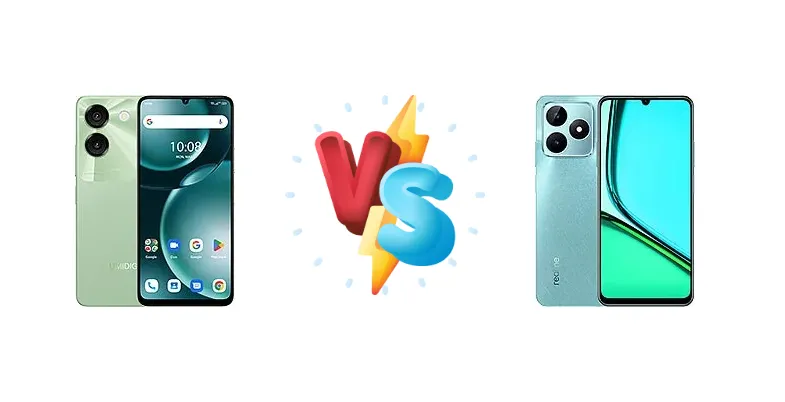
The sub-$150 smartphone market is fiercely competitive. The Umidigi G9A represents a baseline of affordability, while the Realme C51s attempts to elevate the experience with a more modern chipset and significantly faster charging. This comparison dissects the core differences to help you determine which device best suits your needs.
🏆 Quick Verdict
For most users, the Realme C51s is the superior choice. Its Unisoc Tiger T612 chipset delivers noticeably better performance than the Umidigi G9A’s SC9863A, and the 33W charging is a game-changer for convenience. While the G9A is cheaper, the performance trade-offs are substantial.
| Network |
|---|
| 2G bands | GSM 850 / 900 / 1800 / 1900 | GSM 850 / 900 / 1800 / 1900 |
| 3G bands | HSDPA 850 / 900 / 1700(AWS) / 1900 / 2100 | HSDPA 900 / 2100 |
| 4G bands | 1, 2, 3, 4, 5, 7, 8, 17, 18, 19, 20, 26, 28, 38, 40, 41, 66 | 1, 3, 5, 8, 38, 40 |
| Speed | HSPA, LTE | HSPA, LTE |
| Technology | GSM / HSPA / LTE | GSM / HSPA / LTE |
| Launch |
|---|
| Announced | 2024, September | 2024, March 15 |
| Status | Available. Released 2024, September | Available. Released 2024, March 15 |
| Body |
|---|
| Build | - | Glass front, plastic frame, plastic back |
| Dimensions | 167.2 x 77 x 7.9 mm (6.58 x 3.03 x 0.31 in) | 167.2 x 76.7 x 7.5 mm (6.58 x 3.02 x 0.30 in) |
| SIM | Nano-SIM + Nano-SIM | Nano-SIM + Nano-SIM |
| Weight | 189 g (6.67 oz) | 182 g (6.42 oz) |
| Display |
|---|
| Resolution | 720 x 1600 pixels, 20:9 ratio (~260 ppi density) | 720 x 1600 pixels, 20:9 ratio (~260 ppi density) |
| Size | 6.75 inches, 110.0 cm2 (~85.4% screen-to-body ratio) | 6.74 inches, 109.7 cm2 (~85.5% screen-to-body ratio) |
| Type | IPS LCD | IPS LCD, 90Hz, 560 nits (peak) |
| Platform |
|---|
| CPU | Octa-core (4x1.6 GHz Cortex-A55 & 4x1.2 GHz Cortex-A55) | Octa-core (2x1.8 GHz Cortex-A75 & 6x1.8 GHz Cortex-A55) |
| Chipset | Unisoc SC9863A (28 nm) | Unisoc Tiger T612 (12 nm) |
| GPU | IMG8322 | Mali-G57 |
| OS | Android 14 (Go edition) | Android 13, Realme UI |
| Memory |
|---|
| Card slot | microSDXC (uses shared SIM slot) | microSDXC (dedicated slot) |
| Internal | 64GB 4GB RAM | 128GB 6GB RAM |
| Main Camera |
|---|
| Dual | 13 MP, (wide)
Auxiliary lens | - |
| Features | LED flash | LED flash, HDR, panorama |
| Single | - | 50 MP, f/1.8, 27mm (wide), 1/2.76", 0.64µm, PDAF
Auxiliary lens |
| Video | 1080p@30fps | 1080p@30fps |
| Selfie camera |
|---|
| Features | - | HDR |
| Single | 8 MP, (wide) | 5 MP, f/2.2, 28mm (wide), 1/5.0", 1.12µm |
| Video | Yes | 720p@30fps |
| Sound |
|---|
| 35mm jack | Yes | Yes |
| Loudspeaker | Yes | Yes |
| Comms |
|---|
| Bluetooth | 4.2, A2DP | 5.0, A2DP, LE |
| NFC | No | Yes, 360˚ (market/region dependent) |
| Positioning | GPS, GLONASS, GALILEO, BDS | GPS, GLONASS, GALILEO |
| Radio | FM radio | Unspecified |
| USB | USB Type-C, OTG | USB Type-C |
| WLAN | Wi-Fi 802.11 a/b/g/n | Wi-Fi 802.11 a/b/g/n/ac, dual-band |
| Features |
|---|
| Sensors | Accelerometer, compass | Fingerprint (side-mounted), accelerometer, gyro, proximity, compass |
| Battery |
|---|
| Charging | 10W wired | 33W wired, 0-50% in 28 min |
| Type | 5000 mAh | 5000 mAh |
| Misc |
|---|
| Colors | Space Black, Lake Green | Shiny Green, Mighty Black |
| Models | - | RMX3765 |
| Price | - | About 100 EUR |
Umidigi G9A
- Lowest possible price point
- Acceptable for basic smartphone tasks
- Potentially longer battery life due to less powerful chipset (though offset by slower charging)
- Significantly slower performance
- Extremely slow 10W charging
- Outdated chipset architecture
Realme C51s
- Faster and more responsive performance
- 33W fast charging – a major convenience factor
- More efficient chipset
- Higher price than the Umidigi G9A
- Display specs are unknown
- Camera performance likely similar to G9A
Display Comparison
Neither device boasts a standout display. Both likely utilize LCD panels, common in this price bracket. However, specifics like resolution and peak brightness are missing. The Realme C51s benefits from a more modern chipset which *could* translate to better image processing, but without display specs, it's difficult to quantify. Bezels are likely substantial on both, prioritizing cost reduction over premium aesthetics.
Camera Comparison
Camera performance is likely to be similar on both devices, relying heavily on software processing. Both will likely feature a primary camera and a depth sensor, with the Umidigi G9A potentially including a secondary macro lens of limited utility. Without sensor size or aperture information, it’s difficult to assess image quality. The Realme C51s’ more powerful chipset *could* enable slightly better image processing, but the primary differentiator will likely be software algorithms. Expect acceptable results in good lighting conditions, but struggles in low light.
Performance
The Realme C51s’ Unisoc Tiger T612, fabricated on a 12nm process, represents a significant architectural leap over the Umidigi G9A’s 28nm Unisoc SC9863A. The T612’s CPU configuration – 2x1.8 GHz Cortex-A75 and 6x1.8 GHz Cortex-A55 – provides a substantial performance advantage over the G9A’s 4x1.6 GHz Cortex-A55 & 4x1.2 GHz Cortex-A55. The A75 cores in the C51s are considerably more powerful than the A55 cores found in both devices, resulting in faster app launches and smoother multitasking. This difference will be most noticeable when running demanding applications or switching between multiple apps. The 12nm process also contributes to better power efficiency, potentially offsetting the faster clock speeds.
Battery Life
While battery capacity isn’t specified, the Realme C51s’ 33W wired charging is the standout feature. The ability to charge from 0-50% in just 28 minutes is a significant convenience advantage over the Umidigi G9A’s slow 10W charging. Even with a similar battery capacity, the C51s will minimize downtime. The more efficient Unisoc T612 chipset may also contribute to slightly better battery life during typical usage, further enhancing the C51s’ appeal.
Buying Guide
Buy the Umidigi G9A if you absolutely need the lowest possible price and your smartphone usage is limited to basic tasks like calls, texts, and light social media. Buy the Realme C51s if you prioritize a smoother user experience, faster app loading times, and the convenience of rapid charging, even if it means spending a bit more.
Frequently Asked Questions
❓ Will the Realme C51s handle popular games like PUBG Mobile or Call of Duty?
The Unisoc Tiger T612 is capable of running these games, but you’ll likely need to lower graphics settings to achieve a playable frame rate. Don't expect a flagship gaming experience, but it's a significant improvement over the Umidigi G9A's chipset.
❓ How much faster is the 33W charging on the Realme C51s compared to the 10W charging on the Umidigi G9A in real-world use?
The 33W charging on the C51s will dramatically reduce charging times. While a full charge will still take over an hour, reaching 50% in 28 minutes is a substantial advantage over the G9A, which could take over 3 hours to reach the same level.
❓ Is the Realme C51s likely to overheat during extended use, like video recording or gaming?
The Unisoc Tiger T612's 12nm process is more efficient than the G9A's 28nm process, meaning it's less prone to overheating. While some throttling is possible during prolonged intensive tasks, it shouldn't be a major issue.