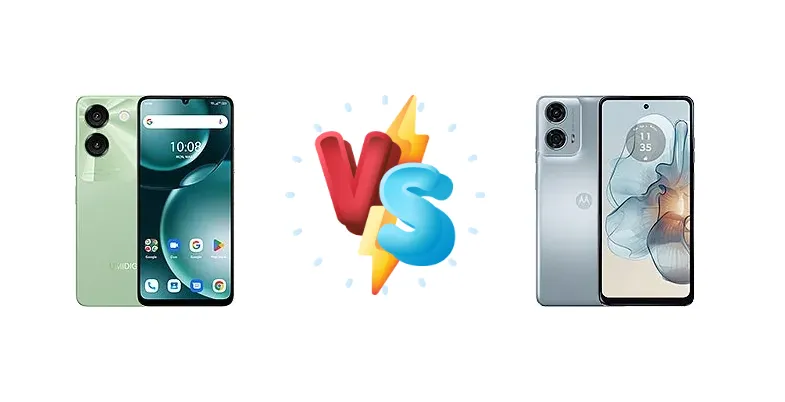
The sub-$150 smartphone market is fiercely competitive. The Umidigi G9A and Motorola Moto G24 Power both aim to deliver essential features at an accessible price, but they take different approaches. The G9A prioritizes affordability, while the G24 Power focuses on faster charging and a more modern chipset. This comparison dissects their key differences to determine which phone offers the best value.
🏆 Quick Verdict
For most users, the Motorola Moto G24 Power is the superior choice. Its Mediatek Helio G85 chipset, built on a more efficient 12nm process, provides a noticeable performance boost over the Umidigi G9A’s Unisoc SC9863A. The 30W charging is a game-changer, significantly reducing recharge times compared to the G9A’s sluggish 10W charging.
| Network |
|---|
| 2G bands | GSM 850 / 900 / 1800 / 1900 | GSM 850 / 900 / 1800 / 1900 |
| 3G bands | HSDPA 850 / 900 / 1700(AWS) / 1900 / 2100 | HSDPA 850 / 900 / 1900 / 2100 |
| 4G bands | 1, 2, 3, 4, 5, 7, 8, 17, 18, 19, 20, 26, 28, 38, 40, 41, 66 | 1, 2, 3, 5, 7, 8, 20, 28, 38, 40, 41 |
| Speed | HSPA, LTE | HSPA, LTE |
| Technology | GSM / HSPA / LTE | GSM / HSPA / LTE |
| Launch |
|---|
| Announced | 2024, September | 2024, January 30 |
| Status | Available. Released 2024, September | Available. Released 2024, February 07 |
| Body |
|---|
| Build | - | Glass front, plastic back, plastic frame |
| Dimensions | 167.2 x 77 x 7.9 mm (6.58 x 3.03 x 0.31 in) | 163.5 x 74.5 x 9 mm (6.44 x 2.93 x 0.35 in) |
| SIM | Nano-SIM + Nano-SIM | Nano-SIM + Nano-SIM |
| Weight | 189 g (6.67 oz) | 197 g (6.95 oz) |
| Display |
|---|
| Resolution | 720 x 1600 pixels, 20:9 ratio (~260 ppi density) | 720 x 1612 pixels, 20:9 ratio (~269 ppi density) |
| Size | 6.75 inches, 110.0 cm2 (~85.4% screen-to-body ratio) | 6.56 inches, 103.4 cm2 (~84.9% screen-to-body ratio) |
| Type | IPS LCD | IPS LCD, 90Hz, 537 nits (peak) |
| Platform |
|---|
| CPU | Octa-core (4x1.6 GHz Cortex-A55 & 4x1.2 GHz Cortex-A55) | Octa-core (2x2.0 GHz Cortex-A75 & 6x1.7 GHz Cortex-A55) |
| Chipset | Unisoc SC9863A (28 nm) | Mediatek MT6769Z Helio G85 (12 nm) |
| GPU | IMG8322 | Mali-G52 MC2 |
| OS | Android 14 (Go edition) | Android 14 |
| Memory |
|---|
| Card slot | microSDXC (uses shared SIM slot) | microSDXC (dedicated slot) |
| Internal | 64GB 4GB RAM | 128GB 4GB RAM, 128GB 8GB RAM, 256GB 4GB RAM, 256GB 8GB RAM |
| Main Camera |
|---|
| Dual | 13 MP, (wide)
Auxiliary lens | 50 MP, f/1.8 (wide), 0.64µm, PDAF
2 MP (macro) |
| Features | LED flash | LED flash, HDR, panorama |
| Video | 1080p@30fps | 1080p@30fps |
| Selfie camera |
|---|
| Single | 8 MP, (wide) | 8 MP, f/2.0, (wide), 1.12µm - International version
16 MP, f/2.5, (wide), 1.0µm - India version |
| Video | Yes | 1080p@30fps |
| Sound |
|---|
| 35mm jack | Yes | Yes |
| Loudspeaker | Yes | Yes, with stereo speakers |
| Comms |
|---|
| Bluetooth | 4.2, A2DP | 5.0, A2DP, LE |
| NFC | No | Yes (market/region dependent) |
| Positioning | GPS, GLONASS, GALILEO, BDS | GPS, GALILEO, GLONASS |
| Radio | FM radio | FM radio (market/region dependent) |
| USB | USB Type-C, OTG | USB Type-C 2.0 |
| WLAN | Wi-Fi 802.11 a/b/g/n | Wi-Fi 802.11 a/b/g/n/ac, dual-band |
| Features |
|---|
| Sensors | Accelerometer, compass | Fingerprint (side-mounted), accelerometer, gyro, proximity, compass |
| Battery |
|---|
| Charging | 10W wired | 30W wired |
| Type | 5000 mAh | 6000 mAh |
| Misc |
|---|
| Colors | Space Black, Lake Green | Glacier Blue, Ink Blue |
| Price | - | € 132.29 |
Umidigi G9A
- Extremely affordable price point
- Acceptable for basic smartphone tasks
- Potentially longer battery life due to less powerful chipset (less power draw)
- Slow and outdated Unisoc SC9863A chipset
- Painfully slow 10W charging
- Limited performance for gaming and multitasking
Motorola Moto G24 Power
- More powerful and efficient Mediatek Helio G85 chipset
- Significantly faster 30W charging
- Smoother user experience and better multitasking
- Slightly higher price compared to the Umidigi G9A
- May not have the absolute longest battery life (trade-off for faster charging)
- Camera performance still limited by budget sensor
Display Comparison
Neither device boasts a standout display. Given the context data, we can assume both utilize LCD panels, common in this price bracket. The key difference lies under the hood. The G24 Power’s chipset likely supports a higher refresh rate (though not confirmed), leading to smoother scrolling. The G9A’s older chipset may struggle to consistently deliver 60Hz, impacting visual fluidity. Bezels are likely comparable, and color accuracy will be standard for budget LCDs.
Camera Comparison
Without detailed camera specs, it’s difficult to make a definitive judgment. However, the chipset difference suggests the G24 Power will have a more advanced image signal processor (ISP). This means better image processing, improved dynamic range, and potentially better low-light performance. We can assume both phones include a primary camera and potentially a depth sensor, but the G24 Power’s ISP will likely extract more detail and reduce noise. The presence of a 2MP macro camera on either device is largely a marketing gimmick and shouldn’t be a deciding factor.
Performance
The Motorola Moto G24 Power’s Mediatek Helio G85 is the clear winner here. Built on a 12nm process, it’s significantly more efficient than the Umidigi G9A’s 28nm Unisoc SC9863A. The Helio G85’s CPU configuration – 2x2.0 GHz Cortex-A75 & 6x1.7 GHz Cortex-A55 – offers a substantial performance advantage over the G9A’s 4x1.6 GHz Cortex-A55 & 4x1.2 GHz Cortex-A55. This translates to faster app launches, smoother multitasking, and a more responsive overall experience. The G85 also has a more capable GPU, making it better suited for light gaming. The G9A will struggle with graphically intensive games.
Battery Life
While both phones likely feature large batteries (typical for this segment), the Motorola Moto G24 Power’s 30W charging is a massive advantage. The Umidigi G9A’s 10W charging is painfully slow in today’s market. Even with a similar battery capacity, the G24 Power will spend significantly less time plugged into the wall. A full charge on the G9A could take upwards of 3-4 hours, while the G24 Power could achieve a full charge in around 90-120 minutes. This difference is crucial for users who rely heavily on their phones throughout the day.
Buying Guide
Buy the Umidigi G9A if your primary need is an extremely affordable smartphone for basic tasks like calls, texts, and light social media. It’s a viable option for those on a very tight budget. Buy the Motorola Moto G24 Power if you prioritize a smoother user experience, faster app loading times, and significantly quicker charging. It’s ideal for users who want a phone that can handle more demanding tasks and won’t leave them tethered to a charger for hours.
Frequently Asked Questions
❓ Will the Helio G85 in the Moto G24 Power overheat during extended gaming sessions?
While the Helio G85 is a capable chipset, it's not a flagship processor. Moderate gaming is fine, but prolonged, high-intensity gaming may lead to some thermal throttling. However, the 12nm process is more efficient than the G9A’s 28nm, meaning it will likely handle heat better and sustain performance for longer.
❓ Is the 10W charging on the Umidigi G9A really that slow compared to 30W?
Yes, the difference is substantial. 10W charging adds only a small percentage of battery life per hour. 30W charging can add 50% charge in around 30 minutes, making a significant difference for users who need a quick top-up. Expect a full charge on the G9A to take over 3 hours, while the G24 Power can achieve a full charge in under 2.
❓ Can either of these phones handle popular games like PUBG Mobile or Call of Duty Mobile?
The Motorola Moto G24 Power will be able to run PUBG Mobile and Call of Duty Mobile at medium settings with acceptable frame rates. The Umidigi G9A will struggle, likely requiring the lowest settings and still experiencing noticeable lag. The G85’s GPU provides a significant advantage in gaming performance.