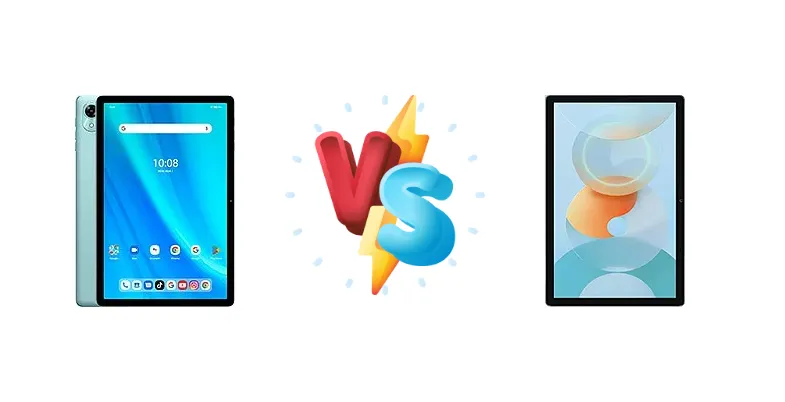
The Umidigi G9 Tab and Blackview Tab 13 represent a growing segment of affordable Android tablets aiming to deliver functionality without breaking the bank. Both devices target users seeking a larger screen for media consumption, light productivity, and casual gaming, but they diverge in their core processing power. This comparison dissects the key differences to determine which tablet offers the best value.
🏆 Quick Verdict
For the average user prioritizing responsiveness and smoother multitasking, the Blackview Tab 13 emerges as the better choice. Its Mediatek Helio G85 chipset, with higher clocked Cortex-A75 cores, provides a noticeable performance edge over the Umidigi G9 Tab’s Unisoc T606, justifying a potential price premium.
| Network |
|---|
| 2G bands | GSM 850 / 900 / 1800 / 1900 | GSM 850 / 900 / 1800 / 1900 |
| 3G bands | HSDPA 850 / 900 / 1700(AWS) / 1900 / 2100 | HSDPA 900 / 2100 |
| 4G bands | 1, 2, 3, 4, 5, 7, 8, 12, 13, 17, 20, 28, 38, 40, 41, 66 | 1, 3, 7, 8, 20, 40 |
| Speed | HSPA, LTE | HSPA, LTE |
| Technology | GSM / HSPA / LTE | GSM / HSPA / LTE |
| Launch |
|---|
| Announced | 2024, September | 2022, August 20 |
| Status | Available. Released 2024, September | Available. Released 2022, August 20 |
| Body |
|---|
| Build | Glass front, plastic back, plastic frame | - |
| Dimensions | 257.3 x 168.8 x 9.1 mm (10.13 x 6.65 x 0.36 in) | 238.8 x 157.6 x 7.7 mm (9.40 x 6.20 x 0.30 in) |
| SIM | Nano-SIM + Nano-SIM | Nano-SIM + Nano-SIM |
| Weight | 522 g (1.15 lb) | 450 g (0.99 lb) |
| Display |
|---|
| Resolution | 800 x 1280 pixels, 16:10 ratio (~137 ppi density) | 1200 x 1920 pixels, 16:10 ratio (~224 ppi density) |
| Size | 11.0 inches, 350.9 cm2 (~80.8% screen-to-body ratio) | 10.1 inches, 295.8 cm2 (~78.6% screen-to-body ratio) |
| Type | IPS LCD | IPS LCD |
| Platform |
|---|
| CPU | Octa-core (2x1.6 GHz Cortex-A75 & 6x1.6 GHz Cortex-A55) | Octa-core (2x2.0 GHz Cortex-A75 & 6x1.8 GHz Cortex-A55) |
| Chipset | Unisoc T606 (12 nm) | Mediatek MT6769Z Helio G85 (12 nm) |
| GPU | Mali-G57 MP1 | Mali-G52 MC2 |
| OS | Android 14 | Android 12, Doke OS_P 3.0 |
| Memory |
|---|
| Card slot | microSDXC (uses shared SIM slot) | microSDXC (uses shared SIM slot) |
| Internal | 256GB 4GB RAM | 128GB 6GB RAM |
| | - | eMMC 5.1 |
| Main Camera |
|---|
| Dual | - | 13 MP
2 MP |
| Features | LED flash | - |
| Single | 13 MP, (wide) | 8 MP |
| Video | 1080p@30fps | 1080p@30fps |
| Selfie camera |
|---|
| Single | 8 MP, (wide) | 8 MP |
| Video | 720p@30fps | Yes |
| Sound |
|---|
| 3.5mm jack | - | No |
| 35mm jack | Yes | No |
| Loudspeaker | Yes, with stereo speakers | Yes, with stereo speakers |
| Comms |
|---|
| Bluetooth | 5.0, A2DP, LE | 5.0, A2DP |
| NFC | No | No |
| Positioning | GPS, GALILEO, GLONASS, BDS | GPS, GLONASS, GALILEO, BDS |
| Radio | FM radio | FM Radio |
| USB | USB Type-C 2.0, OTG | USB Type-C, OTG |
| WLAN | Wi-Fi 802.11 a/b/g/n/ac, dual-band | Wi-Fi 802.11 a/b/g/n/ac, dual-band |
| Features |
|---|
| Sensors | Accelerometer, proximity (accessories only), compass | Accelerometer |
| Battery |
|---|
| Charging | 18W wired | - |
| Type | 7200 mAh | 7280 mAh |
| Misc |
|---|
| Colors | Glacier Blue, Lake Green, Nebula Purple, Space Grey | Twilight Blue, Space Gray, Silver |
Umidigi G9 Tab
- Potentially lower price point
- Sufficient for basic tasks like reading and video playback
- Unisoc T606 is relatively power efficient
- Noticeably slower performance compared to the Blackview Tab 13
- Less capable for multitasking and gaming
- May struggle with demanding apps
Blackview Tab 13
- Faster and more responsive performance with the Helio G85
- Better suited for gaming and multitasking
- More efficient chipset potentially leading to longer battery life
- Likely a slightly higher price tag
- May experience more heat during prolonged gaming sessions
- Camera performance is still limited by budget sensors
Display Comparison
Neither Umidigi nor Blackview provide detailed display specifications beyond the tablet size. However, given the price point, both likely utilize IPS LCD panels. The key differentiator lies in the processing power driving the display. A more powerful chipset, like the Helio G85 in the Blackview Tab 13, can handle higher refresh rates (if supported) and more complex visual processing, resulting in smoother animations. Without specific brightness or color gamut data, it's difficult to assess visual quality beyond the expected limitations of budget panels.
Camera Comparison
Camera performance is unlikely to be a deciding factor for buyers in this segment. Both tablets likely feature basic camera setups focused on video calls and casual snapshots. Without detailed sensor information, it’s safe to assume image quality will be adequate in good lighting conditions but suffer in low light. The absence of Optical Image Stabilization (OIS) on either device further limits their photographic capabilities. Focusing on the chipset’s image signal processor (ISP) capabilities, the Helio G85 in the Blackview Tab 13 likely offers slightly better image processing and noise reduction.
Performance
The core difference between these tablets is the chipset. The Blackview Tab 13’s Mediatek Helio G85 features two Cortex-A75 cores clocked at 2.0 GHz, compared to the Umidigi G9 Tab’s Unisoc T606 with 1.6 GHz Cortex-A75 cores. This 20% clock speed increase, coupled with slightly faster Cortex-A55 cores (1.8 GHz vs 1.6 GHz), translates to a tangible performance advantage for the Blackview Tab 13 in CPU-intensive tasks. While both use a 12nm process, the Helio G85’s architecture is demonstrably more efficient for gaming and multitasking. The G85 also boasts a more capable GPU, further widening the performance gap.
Battery Life
Both tablets feature 18W wired charging, suggesting similar charging speeds. While battery capacity isn't specified, the more efficient Helio G85 chipset in the Blackview Tab 13 could potentially translate to longer battery life despite potentially similar capacity. The power draw of the chipset during typical usage will be lower, allowing the battery to last longer between charges. Expect approximately 3-4 hours of screen-on time for moderate usage on both devices, but the Blackview Tab 13 may edge out the Umidigi G9 Tab in real-world endurance.
Buying Guide
Buy the Umidigi G9 Tab if you primarily need a tablet for static tasks like reading ebooks, watching pre-downloaded videos, or basic web browsing where sustained performance isn't critical. Buy the Blackview Tab 13 if you anticipate more demanding usage, including light gaming, multitasking between several apps, or streaming high-resolution content, as the Helio G85 offers a more fluid experience.
Frequently Asked Questions
❓ Will the Blackview Tab 13 handle popular mobile games like PUBG or Call of Duty?
The Helio G85 chipset in the Blackview Tab 13 is capable of running PUBG and Call of Duty Mobile at medium settings with acceptable frame rates. However, don't expect a flagship gaming experience. You may need to lower graphics settings for smoother gameplay, and prolonged sessions could lead to some thermal throttling.
❓ Is the Unisoc T606 in the Umidigi G9 Tab sufficient for streaming video from services like Netflix or YouTube?
Yes, the Unisoc T606 is adequate for streaming video from Netflix and YouTube at 1080p resolution. However, you might experience occasional buffering or lag if you're multitasking or have a slow internet connection. The Blackview Tab 13 would provide a more consistent streaming experience due to its more powerful chipset.
❓ Can either of these tablets be used with a keyboard and mouse for basic productivity tasks?
Both tablets support Bluetooth connectivity, allowing you to connect a keyboard and mouse. However, the limited RAM and processing power of both devices may hinder performance when running multiple productivity apps simultaneously. They are best suited for light tasks like document editing or email.