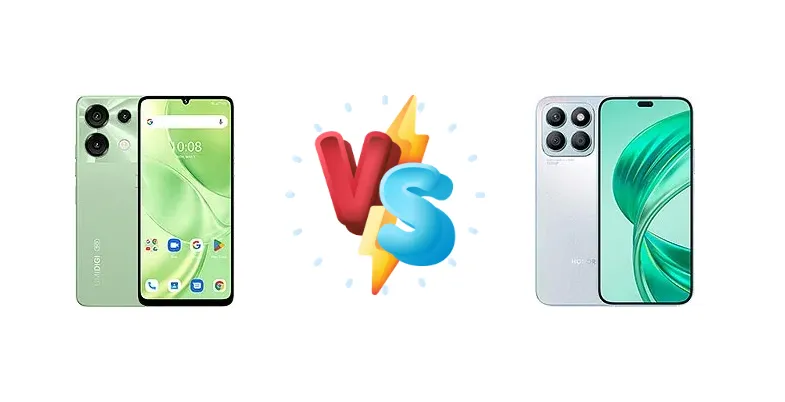
The Umidigi G9 5G and Honor X8b represent compelling options in the crowded budget smartphone market. The G9 5G prioritizes next-generation connectivity with its 5G modem, while the Honor X8b focuses on refined efficiency and faster charging with a Qualcomm chipset. This comparison dissects their core components to determine which device delivers the best value for your needs.
🏆 Quick Verdict
For the average user prioritizing fast charging and a proven chipset, the Honor X8b is the better choice. Its 35W charging significantly reduces downtime. However, if 5G connectivity is a must-have and you're willing to trade charging speed, the Umidigi G9 5G offers a compelling entry point into next-gen networks.
| Network |
|---|
| 2G bands | GSM 850 / 900 / 1800 / 1900 | GSM 850 / 900 / 1800 / 1900 |
| 3G bands | HSDPA 850 / 900 / 1700(AWS) / 1900 / 2100 | HSDPA 850 / 900 / 1900 / 2100 |
| 4G bands | 1, 2, 3, 4, 5, 7, 8, 12, 17, 18, 19, 20, 26, 28, 34, 39, 38, 40, 41, 66 | LTE |
| 5G bands | 1, 2, 3, 4, 5, 7, 8, 20, 28, 38, 40, 41, 48, 66, 77, 78 SA/NSA | - |
| Speed | HSPA, LTE, 5G | HSPA, LTE |
| Technology | GSM / HSPA / LTE / 5G | GSM / HSPA / LTE |
| Launch |
|---|
| Announced | 2024, July | 2023, December 14 |
| Status | Available. Released 2024, July | Available. Released 2023, December 22 |
| Body |
|---|
| Dimensions | 167.2 x 77 x 7.9 mm (6.58 x 3.03 x 0.31 in) | 161.1 x 74.6 x 6.8 mm (6.34 x 2.94 x 0.27 in) |
| SIM | Nano-SIM + Nano-SIM | Nano-SIM + Nano-SIM |
| Weight | 189 g (6.67 oz) | 166 g (5.86 oz) |
| Display |
|---|
| Resolution | 720 x 1600 pixels, 20:9 ratio (~260 ppi density) | 1080 x 2412 pixels, 20:9 ratio (~394 ppi density) |
| Size | 6.75 inches, 110.0 cm2 (~85.4% screen-to-body ratio) | 6.7 inches, 108.0 cm2 (~89.9% screen-to-body ratio) |
| Type | IPS LCD, 90Hz | AMOLED, 90Hz, 1200 nits (HBM), 2000 nits (peak) |
| Platform |
|---|
| CPU | Octa-core (2x2.3 GHz Cortex-A76 & 6x2.1 GHz Cortex-A55) | Octa-core (4x2.4 GHz Kryo 265 Gold & 4x1.9 GHz Kryo 265 Silver) |
| Chipset | Unisoc T765 (6 nm) | Qualcomm SM6225 Snapdragon 680 4G (6 nm) |
| GPU | Mali-G57 MC2 | Adreno 610 |
| OS | Android 14 | Android 13, MagicOS 7.2 |
| Memory |
|---|
| Card slot | microSDXC (uses shared SIM slot) | No |
| Internal | 128GB 6GB RAM | 128GB 8GB RAM, 256GB 6GB RAM, 256GB 8GB RAM, 512GB 8GB RAM |
| Main Camera |
|---|
| Features | LED flash | LED flash, HDR, panorama |
| Triple | 50 MP, f/1.8, (wide), AF
2 MP (macro)
Auxiliary lens | 108 MP, f/1.8, 24mm (wide), 1/1.67", PDAF
5 MP, f/2.2, (ultrawide)
2 MP (macro) |
| Video | 1080p@30fps | 1080p@30fps |
| Selfie camera |
|---|
| Features | - | LED flash |
| Single | 8 MP, f/2.2, (wide) | 50 MP, f/2.1, (wide) |
| Video | Yes | 1080p@30fps |
| Sound |
|---|
| 35mm jack | Yes | No |
| Loudspeaker | Yes | Yes |
| Comms |
|---|
| Bluetooth | 5.0, A2DP, LE | 5.0, A2DP, LE |
| NFC | No | No |
| Positioning | GPS, GLONASS, GALILEO, BDS | GPS, GLONASS, GALILEO, BDS |
| Radio | Wireless FM radio | No |
| USB | USB Type-C, OTG | USB Type-C 2.0, OTG |
| WLAN | Wi-Fi 802.11 a/b/g/n/ac, dual-band | Wi-Fi 802.11 a/b/g/n/ac, dual-band, Wi-Fi Direct |
| Features |
|---|
| Sensors | Fingerprint (side-mounted), accelerometer, compass | Fingerprint (side-mounted), accelerometer, compass |
| Battery |
|---|
| Charging | 18W wired | 35W wired |
| Type | 5000 mAh | Li-Po 4500 mAh |
| Misc |
|---|
| Colors | Space Black, Lake Green | Glamorous Green, Titanium Silver, Midnight Black, Blue |
| Models | - | LLY-LX1, LLY-LX2, LLY-LX3 |
| Price | About 160 EUR | $ 369.00 / € 219.99 |
Umidigi G9 5G
- 5G Connectivity: Offers access to next-generation networks.
- Unisoc T765 Chipset: Provides a decent level of performance for the price.
- 6nm Process: Offers improved power efficiency compared to older nodes.
- Slower Charging: 18W charging is significantly slower than the competition.
- Unisoc Chipset: Generally less optimized than Qualcomm's offerings.
Honor X8b
- Faster Charging: 35W charging dramatically reduces charging times.
- Qualcomm Snapdragon 680: Known for its efficiency and stability.
- Optimized Performance: Offers a smooth user experience for everyday tasks.
- No 5G Connectivity: Limited to 4G LTE networks.
- Potentially Lower Peak Performance: May not match the G9 5G in specific, demanding tasks.
Display Comparison
Neither device boasts a standout display. While specific panel details are missing, the focus here is on the internal hardware. The absence of high refresh rates on either device suggests a cost-saving measure. The real difference lies in the chipset's ability to efficiently drive the display, which we'll cover in the performance section.
Camera Comparison
Without detailed camera specs, a direct comparison is limited. However, the chipset's image signal processor (ISP) plays a crucial role. Qualcomm's ISPs are generally more refined, offering better noise reduction and dynamic range. The Snapdragon 680 likely provides a more consistent camera experience, especially in challenging lighting conditions. The absence of optical image stabilization (OIS) on either device suggests a focus on affordability, meaning image quality will rely heavily on software processing.
Performance
The core battleground is the chipset. The Umidigi G9 5G utilizes the Unisoc T765, a 6nm chip with a Cortex-A76 based CPU. This architecture, while capable, generally trails Qualcomm's Kryo cores in sustained performance. The Honor X8b’s Snapdragon 680, also 6nm, features a Kryo 265 Gold core clocked at 2.4 GHz, offering a slight advantage in single-core performance. The Snapdragon 680 is known for its efficiency, potentially leading to better battery life under moderate loads. The G9 5G's 5G modem will introduce additional power draw, impacting overall efficiency. While both use octa-core CPUs, the architectural differences favor the Snapdragon 680 for consistent performance.
Battery Life
The Honor X8b’s 35W wired charging is a significant advantage over the Umidigi G9 5G’s 18W charging. This translates to substantially faster top-up times, reducing downtime. While battery capacity isn't specified, the Snapdragon 680’s efficiency could offset a potentially smaller battery size, providing comparable real-world battery life. The 5G modem in the G9 5G will consume more power, potentially negating any capacity advantage.
Buying Guide
Buy the Umidigi G9 5G if you absolutely need 5G connectivity on a tight budget and are comfortable with slower charging speeds. This phone is ideal for users in areas with established 5G infrastructure who want future-proofing. Buy the Honor X8b if you prioritize a smooth, efficient user experience, faster charging, and a chipset known for its stability. This is the better option for everyday users who don't necessarily require 5G and value consistent performance.
Frequently Asked Questions
❓ Will the Unisoc T765 in the Umidigi G9 5G struggle with graphically intensive games?
The Unisoc T765 is capable of handling many games, but it will likely require lower graphics settings for smoother gameplay. The Snapdragon 680 in the Honor X8b is generally more efficient at sustained gaming performance, offering a potentially better experience for demanding titles.
❓ How long does it realistically take to fully charge the Honor X8b with the 35W charger?
While exact times vary, the Honor X8b should be able to charge from 0-100% in approximately 60-75 minutes with the included 35W charger. This is a significant improvement over the Umidigi G9 5G's 18W charging, which could take over 2 hours.
❓ Is the lack of 5G on the Honor X8b a significant drawback in 2024?
The impact of missing 5G depends on your location and carrier. If 5G coverage is limited in your area, the difference will be negligible. However, if you live in a city with robust 5G infrastructure and frequently download large files or stream high-resolution video, the Umidigi G9 5G's 5G connectivity could be beneficial.