
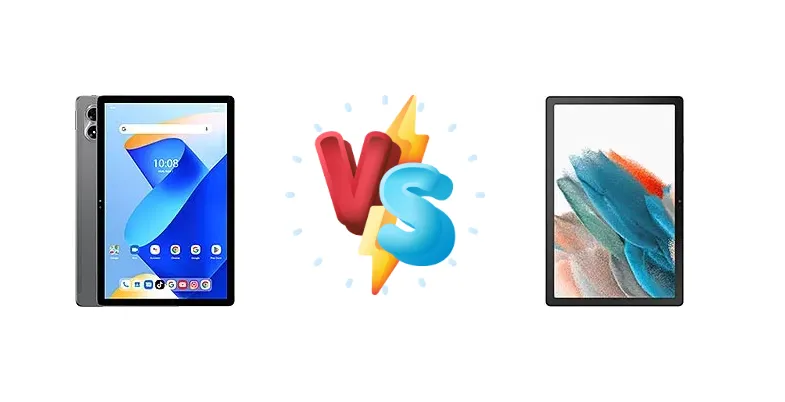
Umidigi G7 Tab Pro vs Samsung Galaxy Tab A8: A Detailed Performance and Value Comparison
| Phones Images | |||||
|---|---|---|---|---|---|
|
🏆 Quick Verdict
For the average user prioritizing performance and efficiency, the Umidigi G7 Tab Pro is the better choice. Its Mediatek Helio G99 chipset, built on a 6nm process, offers a noticeable advantage over the Samsung Galaxy Tab A8’s 12nm Unisoc Tiger T618, translating to smoother multitasking and potentially better gaming performance.
| PHONES | ||
|---|---|---|
| Phone Names | Umidigi G7 Tab Pro | Samsung Galaxy Tab A8 10.5 (2021) |
| Network | ||
|---|---|---|
| 2G bands | GSM 850 / 900 / 1800 / 1900 | GSM 850 / 900 / 1800 / 1900 |
| 3G bands | HSDPA 850 / 900 / 1700(AWS) / 1900 / 2100 | HSDPA 850 / 900 / 1700(AWS) / 1900 / 2100 |
| 4G bands | 1, 2, 3, 4, 5, 7, 8, 17, 18, 19, 20, 26, 28, 38, 40, 41, 66 | 1, 2, 3, 4, 5, 7, 8, 12, 17, 20, 28, 38, 40, 41, 66 |
| Speed | HSPA, LTE | HSPA, LTE - cellular model only |
| Technology | GSM / HSPA / LTE | GSM / HSPA / LTE |
| Launch | ||
|---|---|---|
| Announced | 2024, September | 2021, December 15 |
| Status | Available. Released 2024, September | Available. Released 2022, January 17 |
| Body | ||
|---|---|---|
| Build | Glass front, aluminum back, aluminum frame | - |
| Dimensions | 256.6 x 168.1 x 7.5 mm (10.10 x 6.62 x 0.30 in) | 246.8 x 161.9 x 6.9 mm (9.72 x 6.37 x 0.27 in) |
| SIM | Nano-SIM + Nano-SIM | Nano-SIM (cellular model only) |
| Weight | 513 g (1.13 lb) | 508 g (1.12 lb) |
| Display | ||
|---|---|---|
| Resolution | 1200 x 1920 pixels, 16:10 ratio (~206 ppi density) | 1200 x 1920 pixels, 16:10 ratio (~216 ppi density) |
| Size | 11.0 inches, 350.9 cm2 (~81.3% screen-to-body ratio) | 10.5 inches, 319.7 cm2 (~80.0% screen-to-body ratio) |
| Type | IPS LCD | TFT LCD |
| Platform | ||
|---|---|---|
| CPU | Octa-core (2x2.2 GHz Cortex-A76 & 6x2.0 GHz Cortex-A55) | Octa-core (2x2.0 GHz Cortex-A75 & 6x2.0 GHz Cortex-A55) |
| Chipset | Mediatek Helio G99 (6 nm) | Unisoc Tiger T618 (12 nm) |
| GPU | Mali-G57 MC2 | Mali G52 MP2 |
| OS | Android 13 | Android 11, upgradable to Android 14, One UI 6 |
| Memory | ||
|---|---|---|
| Card slot | microSDXC (uses shared SIM slot) | microSDXC (dedicated slot) |
| Internal | 256GB 8GB RAM | 32GB 2GB RAM, 32GB 3GB RAM, 64GB 2GB RAM, 64GB 3GB RAM, 64GB 4GB RAM, 128GB 3GB RAM, 128GB 4GB RAM |
| Main Camera | ||
|---|---|---|
| Features | LED flash | - |
| Single | 13 MP, (wide) | 8 MP, AF |
| Video | 1080p@30fps | 1080p@30fps |
| Selfie camera | ||
|---|---|---|
| Single | 8 MP, (wide) | 5 MP |
| Video | 720p@30fps | 1080p@30fps |
| Sound | ||
|---|---|---|
| 3.5mm jack | - | Yes |
| 35mm jack | Yes | Yes |
| Loudspeaker | Yes, with stereo speakers (4 speakers) | Yes, with stereo speakers (4 speakers) |
| Comms | ||
|---|---|---|
| Bluetooth | 5.2, A2DP, LE | 5.0, A2DP, LE |
| NFC | No | No |
| Positioning | GPS, GALILEO, GLONASS, BDS | GPS, GLONASS, BDS, GALILEO, QZSS - cellular model only |
| Radio | FM radio | No |
| USB | USB Type-C 2.0, OTG | USB Type-C 2.0 |
| WLAN | Wi-Fi 802.11 a/b/g/n/ac, dual-band | Wi-Fi 802.11 a/b/g/n/ac, dual-band, Wi-Fi Direct |
| Features | ||
|---|---|---|
| Sensors | Accelerometer, proximity (accessories only), compass | Accelerometer, gyro, proximity, compass |
| Battery | ||
|---|---|---|
| Charging | 18W wired | 15W wired |
| Type | 8000 mAh | Li-Po 7040 mAh |
| Misc | ||
|---|---|---|
| Colors | Space Grey | Gray, Silver, Pink Gold |
| Models | - | SM-X200, SM-X205 |
| Price | - | About 230 EUR |
| SAR EU | - | 0.92 W/kg (body) |
Umidigi G7 Tab Pro
- More powerful and efficient Mediatek Helio G99 chipset
- Faster 18W charging
- Potentially more modern design
- Less established brand reputation
- Camera specifications unknown
Samsung Galaxy Tab A8 10.5 (2021)
- Well-known Samsung brand
- Potentially wider accessory availability
- Established software support
- Less powerful Unisoc Tiger T618 chipset
- Slower 15W charging
- Less efficient 12nm process
Display Comparison
Neither device's display specifications are provided, so a direct comparison is limited. However, given the Tab A8's positioning, it likely utilizes an IPS LCD panel. The G7 Tab Pro, being a newer device, *may* incorporate a more advanced panel technology, but this is speculative. Bezels are a key consideration; typically, Umidigi aims for a modern aesthetic, potentially offering slimmer bezels than the Tab A8. Color accuracy will likely be standard for this price segment, with Samsung potentially having a slight edge in calibration.
Camera Comparison
Camera details are absent for both devices. Given the market segment, we can expect basic camera setups focused on video calls and casual snapshots. It's highly probable that both tablets feature a primary rear camera and a front-facing camera. Image processing will likely be simpler on the Umidigi, while Samsung may offer slightly more refined software algorithms. Without specific sensor information, a meaningful comparison is impossible.
Performance
The core difference lies in the chipsets. The Umidigi G7 Tab Pro’s Mediatek Helio G99 (6nm) boasts a more modern architecture than the Samsung Galaxy Tab A8’s Unisoc Tiger T618 (12nm). The G99’s Cortex-A76 cores, clocked at 2.2 GHz, are more powerful than the Tab A8’s Cortex-A75 cores at 2.0 GHz. The 6nm fabrication process of the G99 is significantly more efficient, leading to lower heat generation and potentially sustained performance. While both are octa-core CPUs with a similar Cortex-A55 cluster, the G99’s superior architecture and process node give it a clear advantage in CPU-intensive tasks and gaming.
Battery Life
The Umidigi G7 Tab Pro supports 18W wired charging, while the Samsung Galaxy Tab A8 is limited to 15W. While battery capacity isn't specified, the G99’s 6nm efficiency should translate to longer battery life on the Umidigi, even with a similar capacity battery. The faster charging on the G7 Tab Pro also means less time tethered to a wall outlet. The difference in charging speed, while not dramatic, adds to the G7 Tab Pro’s overall convenience.
Buying Guide
Buy the Umidigi G7 Tab Pro if you need a tablet capable of handling demanding applications and multitasking without significant slowdowns, and if you value a more modern, efficient processor. Buy the Samsung Galaxy Tab A8 10.5 (2021) if you prioritize brand recognition, a potentially wider ecosystem of accessories, and are primarily focused on basic tasks like media consumption and light web browsing.